X
myLot
kataztrophy
•
@kataztrophy
(1836)
• United States
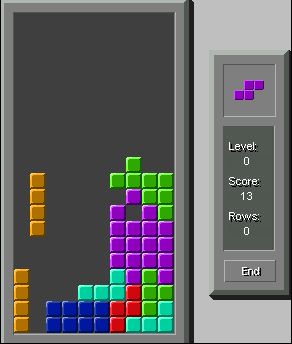
Tetris - Tetris is a very popular computer puzzle game. It was originally designed and programmed by Alexey Pazhitnov (last name transliterated Pajitnov by The Tetris Company ) in 1985, while he was working for the Dorodnicyn Computing Centre of the Russian Academy of Sciences in Moscow, during the days of the Soviet Union. Pajitnov has cited pentominoes as a source of inspiration for the game. Its name is derived from the Greek numerical prefix 'tetra-' meaning four, as all of the blocks are made up of four segments. The game (or one of its many variants) is available for nearly every video game console and computer operating system, as well as on devices such as graphing calculators, mobile phones, and PDAs. Tetris has even appeared as part of an art exhibition on the side of Brown University's 14-story Sciences Library. The game first gained mainstream exposure and popularity beginning in 1989 when Nintendo released Tetris on its Game Boy system. Tetris consistently appears on lists of the greatest video games of all time. A random sequence of tetrominoes (sometimes called 'tetrads' in older versions) - shapes composed of four square blocks each - fall down the playing field. The object of the game is to manipulate these tetrominoes with the aim of creating a horizontal line of blocks without gaps. When such a line is created, it disappears, and the blocks above (if any) fall. As the game progresses, the tetrominoes fall faster, and the game ends when the player 'tops out', that is, when the stack of tetrominoes reaches the top of the playing field and no new tetrominoes are able to enter. (The exact definition of a top-out varies from version to version.) The seven one-sided tetrominoes in Tetris are referred to as I, J, L, O, S, T, and Z. All are capable of single and double clears. I, J, and L are able to clear triples. Only the I tetromino has the capacity to clear four lines simultaneously, and this clear is referred to as a 'tetris.' (This may vary depending on the rotation and compensation rules of each specific Tetris implementation. For instance, in the Tetris Worlds type rules (see below) used in many recent implementations, certain rare situations allow T, S and Z to 'snap' into tight spots, clearing triples.)