X
myLot
stvasile
•
@stvasile
(7306)
• Romania
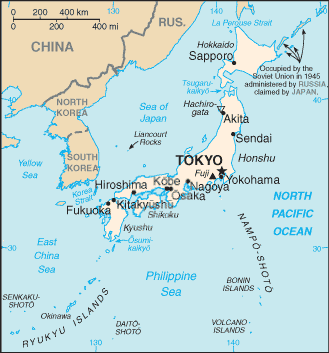
Japan - Background: Definition Field Listing In 1603, a Tokugawa shogunate (military dictatorship) ushered in a long period of isolation from foreign influence in order to secure its power. For 250 years this policy enabled Japan to enjoy stability and a flowering of its indigenous culture. Following the Treaty of Kanagawa with the US in 1854, Japan opened its ports and began to intensively modernize and industrialize. During the late 19th and early 20th centuries, Japan became a regional power that was able to defeat the forces of both China and Russia. It occupied Korea, Formosa (Taiwan), and southern Sakhalin Island. In 1931-32 Japan occupied Manchuria, and in 1937 it launched a full-scale invasion of China. Japan attacked US forces in 1941 - triggering America's entry into World War II - and soon occupied much of East and Southeast Asia. After its defeat in World War II, Japan recovered to become an economic power and a staunch ally of the US. While the emperor retains his throne as a symbol of national unity, actual power rests in networks of powerful politicians, bureaucrats, and business executives. The economy experienced a major slowdown starting in the 1990s following three decades of unprecedented growth, but Japan still remains a major economic power, both in Asia and globally. Geography Japan Top of Page Location: Definition Field Listing Eastern Asia, island chain between the North Pacific Ocean and the Sea of Japan, east of the Korean Peninsula Geographic coordinates: Definition Field Listing 36 00 N, 138 00 E Map references: Definition Field Listing Asia Area: Definition Field Listing Rank Order total: 377,835 sq km land: 374,744 sq km water: 3,091 sq km note: includes Bonin Islands (Ogasawara-gunto), Daito-shoto, Minami-jima, Okino-tori-shima, Ryukyu Islands (Nansei-shoto), and Volcano Islands (Kazan-retto) Area - comparative: Definition Field Listing slightly smaller than California Land boundaries: Definition Field Listing 0 km Coastline: Definition Field Listing 29,751 km Maritime claims: Definition Field Listing territorial sea: 12 nm; between 3 nm and 12 nm in the international straits - La Perouse or Soya, Tsugaru, Osumi, and Eastern and Western Channels of the Korea or Tsushima Strait contiguous zone: 24 nm exclusive economic zone: 200 nm Climate: Definition Field Listing varies from tropical in south to cool temperate in north Terrain: Definition Field Listing mostly rugged and mountainous Elevation extremes: Definition Field Listing lowest point: Hachiro-gata -4 m highest point: Mount Fuji 3,776 m Natural resources: Definition Field Listing negligible mineral resources, fish Land use: Definition Field Listing arable land: 11.64% permanent crops: 0.9% other: 87.46% (2005) Irrigated land: Definition Field Listing 25,920 sq km (2003) Natural hazards: Definition Field Listing many dormant and some active volcanoes; about 1,500 seismic occurrences (mostly tremors) every year; tsunamis; typhoons Environment - current issues: Definition Field Listing air pollution from power plant emissions results in acid rain; acidification of lakes and reservoirs degrading water quality and threatening aquatic life; Japan is one of the largest consumers of fish and tropical timber, contributing to the depletion of these resources in Asia and elsewhere Environment - international agreements: Definition Field Listing party to: Antarctic-Environmental Protocol, Antarctic-Marine Living Resources, Antarctic Seals, Antarctic Treaty, Biodiversity, Climate Change, Climate Change-Kyoto Protocol, Desertification, Endangered Species, Environmental Modification, Hazardous Wastes, Law of the Sea, Marine Dumping, Ozone Layer Protection, Ship Pollution, Tropical Timber 83, Tropical Timber 94, Wetlands, Whaling Geography - note: Definition Field Listing strategic location in northeast Asia