X
myLot
milindp
•
@milindp
(123)
• India
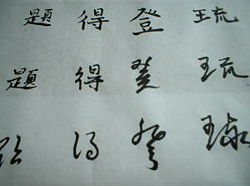
chinese language - Chinese characters evolved over time from earliest forms of hieroglyphs. The idea that all Chinese characters are either pictographs or ideographs is an erroneous one: most characters contain phonetic parts, and are composites of phonetic components and semantic Radicals. Only the simplest characters, such as ren ? (human), ri ? (sun), shan ? (mountain), shui ? (water), may be wholly pictorial in origin. In 100 CE, the famed scholar Xu Shèn in the Hàn Dynasty classified characters into 6 categories, namely pictographs, simple ideographs, compound ideographs, phonetic loans, phonetic compounds and derivative characters. Of these, only 4% as pictographs, and 80-90% as phonetic complexes consisting of a semantic element that indicates meaning, and a phonetic element that arguably once indicated the pronunciation. There are about 214 radicals recognized in the Kangxi Dictionary, which indicate what the character is about semantically.