X
myLot
Marius
•
@dan2003
(147)
• Romania
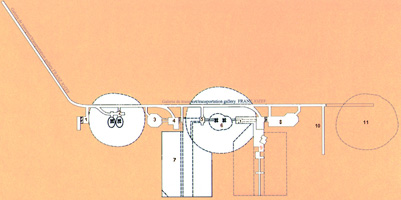
The Plan - The building of a new transportation gallery (Franz Jozef gallery) was decided in 1853, in order to facilitate the salt transportation to the surface. This gallery is 916.65m lenght. At the same time, the Terezia well was modernized by adding two side rooms to it: Ghizela and Rudolf, the latest running the extraction of the salt. Throughout that time, prisoners were never used as workers (lat.-incisoresm salium). Tha salt was brought to the surface by other workers (lat.-famuli). They used a vertical mechanical transporter. The mines were lighted by candles and tallow rush lights. Explosives were never used for exploitation nor mechanical equipment for cutting tha salt. Turda Salt Mine ceased its activity in 1932. During the World War II the mine was used as an anti-aircraft shelter. The microclimate is characterized by yearly variations of the temperature between 11-12 C, an average humidity of 80% the air pressure is between 747-752 mm Hg and the air's moving speed between 0.02-0.7 m/sec. All these factors, the lack of pathogen bacterium and a moderate ionization of the air have their contribution to the wellknown benefic effect over the breathing apparatus. The mine entered the touristic circuit in 1992. 1. The extraction well room - Iosif Mine - Contemporary Art Museum 2. Dress circle - Iosif Mine 3. The octogonal room 4. The extraction well room - Rudolf Mine 5. The appeal room - The Altar - The Rich men's Stair 6. Dress circle - Terezia Mine 7. Mina Rudolf 8. Stationary room - Ghizela Mine 9. Digger's room - Ghizela Mine 10. Slopped way out to the Salt Valley 11. Anton Mine