

What Do You Think About Scrambled Pedestrian Intersections?

By Muelitz
@Muelitz (1592)
Canada

August 31, 2008 6:19am CST
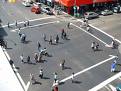
In the city they have implemented a Pedestrian Scrambled Intersection where in at a give point pedestrians can cross the intersection in any direction. I don't think this is a good idea because it will keep motorists longer to wait for the go signal when both directions are stopped. Please see the uploaded figure and the excerpt below from roadrules.ca website and let me know what you think?
 Cedric HughesPedestrian “scrambled” intersections are intersections controlled by traffic signals that provide a crossing phase for pedestrians only, permitting simultaneous crossing in all directions of the intersection including on the diagonals. In other words, when the pedestrian phase is activated, all vehicular traffic in both directions is stopped, and when the vehicular phases are activated, all pedestrian crossing is stopped. Some municipalities have delineated scrambled intersections using decorative asphalt surfacing systems in patterns that mark the lateral and the diagonal pathways, i.e., a large “X” inside a square box.
In theory, this type of intersection design has two advantages. First, it is safer for pedestrians because it eliminates conflicts between pedestrians and turning vehicles. Second, it improves traffic flow efficiency. Diagonal crossing reduces two directional pedestrian travel time through the intersection. The flow of turning vehicles is more efficient because it is uninterrupted by pedestrian traffic.
But there is some inherent inefficiency. Conventional signalized intersections maximize the flow capacity of the intersection and the phases are shorter. Scrambled intersections not only require a separate pedestrian phase, but also a longer one to accommodate crossing the longer diagonal path.
Cedric HughesPedestrian “scrambled” intersections are intersections controlled by traffic signals that provide a crossing phase for pedestrians only, permitting simultaneous crossing in all directions of the intersection including on the diagonals. In other words, when the pedestrian phase is activated, all vehicular traffic in both directions is stopped, and when the vehicular phases are activated, all pedestrian crossing is stopped. Some municipalities have delineated scrambled intersections using decorative asphalt surfacing systems in patterns that mark the lateral and the diagonal pathways, i.e., a large “X” inside a square box.
In theory, this type of intersection design has two advantages. First, it is safer for pedestrians because it eliminates conflicts between pedestrians and turning vehicles. Second, it improves traffic flow efficiency. Diagonal crossing reduces two directional pedestrian travel time through the intersection. The flow of turning vehicles is more efficient because it is uninterrupted by pedestrian traffic.
But there is some inherent inefficiency. Conventional signalized intersections maximize the flow capacity of the intersection and the phases are shorter. Scrambled intersections not only require a separate pedestrian phase, but also a longer one to accommodate crossing the longer diagonal path.
because it will keep motorists longer to wait for the go signal when both directions are stopped. Please see the uploaded figure and the excerpt below from roadrules.ca website and let me know what you think?Cedric HughesPedestrian “scrambled” intersections are intersections controlled by traffic signals that provide a crossing phase for pedestrians only, permitting simultaneous crossing in all directions of the intersection including on the diagonals. In other words, when the pedestrian phase is activated, all vehicular traffic in both directions is stopped, and when the vehicular phases are activated, all pedestrian crossing is stopped. Some municipalities have delineated scrambled intersections using decorative asphalt surfacing systems in patterns that mark the lateral and the diagonal pathways, i.e., a large “X” inside a square box.
In theory, this type of intersection design has two advantages. First, it is safer for pedestrians because it eliminates conflicts between pedestrians and turning vehicles. Second, it improves traffic flow efficiency. Diagonal crossing reduces two directional pedestrian travel time through the intersection. The flow of turning vehicles is more efficient because it is uninterrupted by pedestrian traffic.
But there is some inherent inefficiency. Conventional signalized intersections maximize the flow capacity of the intersection and the phases are shorter. Scrambled intersections not only require a separate pedestrian phase, but also a longer one to accommodate crossing the longer diagonal path.No responses
