

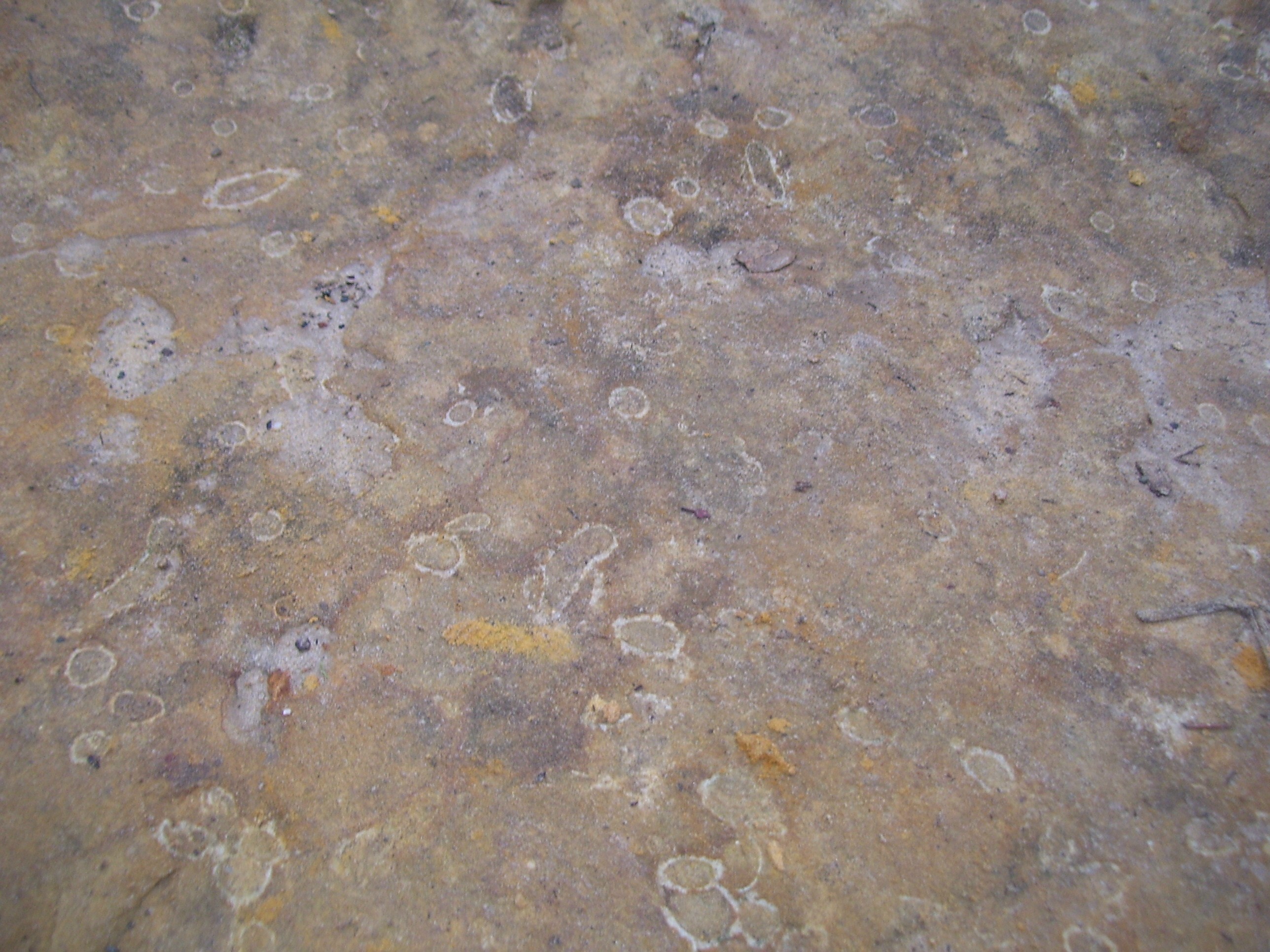
Are these crop circles from small UFOs?

By The Horse
@TheHorse (238277)
Walnut Creek, California

January 15, 2016 12:52pm CST
OK, they're not crop circles, because they're on rocks. This past Tuesday, one of my kid clients (he likes science) and I went hiking at Black Diamond Mines (Northern California). The rocks there are mostly sandstone, which is quite soft. You can throw a baseball sized sandstone rock against a larger rock and it will explode into pieces.
On a boulder we hiked over, we spied these mysterious circles (you have to click on the picture to really see them). If the boulder were a kid's back, I'd say he has ringworm, which is a fungus. Is this some kind of fungus? Or some other kind of growth? Or just erosion? Any thoughts from other hikers out there? Or perhaps from a closet botanist?
11 people like this
10 responses

@owlwings (43897)
• Cambridge, England
15 Jan 16
They look to me like patches where lichen used to be. Lichen is a symbiosis between an algae and a fungus. The fungus anchors the combination to the rock and also creates acids which dissolve the rock, making the nutrients available to the algae; the algae use photosynthesis to produce food which feeds both the algae and the fungus.
8 people like this

@vandana7 (102698)
• India
18 May 16
Exactly. But my thinking is...if it is chemical reaction like limestone reacting to acid formation during the rains...then you get more spherical stuff like a bubble, which on drying would leave that kinda of spherical border. But in case of lichen the spherical shape is accidental..if it is there. Moreover, the central part is not like protected by the bubble kind...so more white or gray area would be visible. So me thinks there was some chemical reaction there, more like some acid in rains.
1 person likes this

@celticeagle (189819)
• Boise, Idaho
16 Jan 16
@Owlwings hypothesis sounds like a good one.
4 people like this

@celticeagle (189819)
• Boise, Idaho
16 Jan 16
@TheHorse ...I've seen it a lot around here.
2 people like this
@TheHorse (238277)
• Walnut Creek, California
16 Jan 16
@celticeagle I think deer and other animals like to eat lichen, so it makes sense.
2 people like this

@pgiblett (6524)
• Canada
15 Jan 16
I have seen these kinds of markings and have thought them to be from erosion, but I am not sure. You can also see similar markings on granite, which is of course much harder (but there I think it is part of the extrusion process that creates the rocks).
2 people like this
@TheHorse (238277)
• Walnut Creek, California
16 Jan 16
@pgiblett From my childhood rock collecting days, I remember sedimentary, metamorphic, and igneous. I assume the soft sandstone is sedimentary, as it's easy to see that it's layered. Igneous is volcanic, so obsidian would be the classic example. I'll have to check to see if granite is considered igneous or metamorphic, since I assume it's subject to pressure as it's formed. Thanks for getting my brain going this morning.
3 people like this

@Drosophila (16568)
• Ireland
16 Jan 16
How big are these? Is there water near by?
3 people like this

@JamesHxstatic (29410)
• Eugene, Oregon
16 Jan 16
I would guess that the circles are some form of mineral embedded in sandstone, but it is a wild guess.
2 people like this
@TheHorse (238277)
• Walnut Creek, California
16 Jan 16
@JamesHxstatic One of the things I enjoy abut this site is learning new stuff. Your comment led me to wonder exactly what the acid does to the rock. More questions means more learning...
4 people like this
@JamesHxstatic (29410)
• Eugene, Oregon
16 Jan 16
@TheHorse Yes, after my comment, I read that and it makes sense.
3 people like this


