

And What Was Old Shall Be New Again

By DW Davis
@DWDavis (25797)
United States

February 12, 2016 5:50am CST
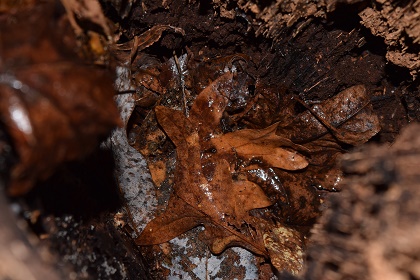
A few weeks ago while outside with the dogs and experimenting with my camera I decided to revisit an tree stump I have photographed in the past as an example of the work of decomposers recycling the stump. On this day, with the capabilities of my new camera, I was able to capture the scene deep inside the stump. You can see the accumulation of leaves at the bottom of the hollow. If you look closely, you can see a leaf that appears frost rimed beneath the more recent leaf. That "frost" is actually a sign that decomposition is at work turning that leaf into humus.
Not as visible in this photograph are the wafer like partitions along the sides of the hollow left behind after the softer parts of the trees interior had been consumed, leaving behind only the stiff, fibrous cellulose. Being a cold rainy day, after a short spell of freezing weather, none of the larger decomposers such as beetles were in evidence.
Next spring I will check in on this stump again to see how much farther the work of its decomposition and recycling has progressed. It won't be long before the humus in the hollow will be close enough to the surface for sunlight to reach it and, just maybe, a new tree may start to grow in the heart of the old.
{Previously posted on Persona Paper. Since removed from that site.}
8 people like this
8 responses

@DWDavis (25797)
• United States
12 Feb 16
Our magnolia tree did that several years ago. The original tree was snapped off about six inches off the ground in a story. It was a big, beautiful tree. The next spring new trunks sprouted from the stump and now we have a lovely triple trunk magnolia in that spot.
2 people like this

@ScribbledAdNauseum (104615)
• United States
12 Feb 16
Nature at it's best. Now if only humanity would make a concerted effort to truly replace our oxygen sources (ahem trees).
1 person likes this
@DWDavis (25797)
• United States
12 Feb 16
Forestry companies do replace a lot of trees, but with the wrong kind of trees. They cut old growth hardwoods and replace them with fast growing coniferous trees. The coniferous trees retain more heat because of their darker needles and exacerbate warming. My real concern is ocean algae. That is where most of our oxygen comes from.
1 person likes this
@ScribbledAdNauseum (104615)
• United States
12 Feb 16
@DWDavis Ocean Algae? I've never heard of it being where most of our Oxygen comes from. How?
1 person likes this
@DWDavis (25797)
• United States
12 Feb 16
@ScribbledAdNauseum Photosynthesis in marine plants such as plankton and algae account for approximately 70% of the oxygen produced on Earth. Rainforests account for another 28%. All the rest of the plants on Earth only produce about 2% of our atmospheric oxygen.


@jillybean1222 (6406)
•
12 Feb 16
I really like that photograph. such an interesting perspective.
1 person likes this

@JamesHxstatic (29410)
• Eugene, Oregon
13 Feb 16
That will be interesting to keep track of.
1 person likes this

@JohnRoberts (109841)
• Los Angeles, California
12 Feb 16
That is a really unique perspective. You could have a contest trying to guess what that is. You can do a series of photos over time depicting its decomposition and revitalization. I don't recall this one from PP.
1 person likes this
@DWDavis (25797)
• United States
12 Feb 16
I must have posted there during a lull. It's already gotten more comments here than it did views there. I am hoping to get several more shots over the course of spring and summer to show how it changes and, hopefully, what does begin to grow.
1 person likes this

@Marilynda1225 (91013)
• United States
12 Feb 16
Normally I would bypass an old stump but this caught my attention. Amazing how nature works