

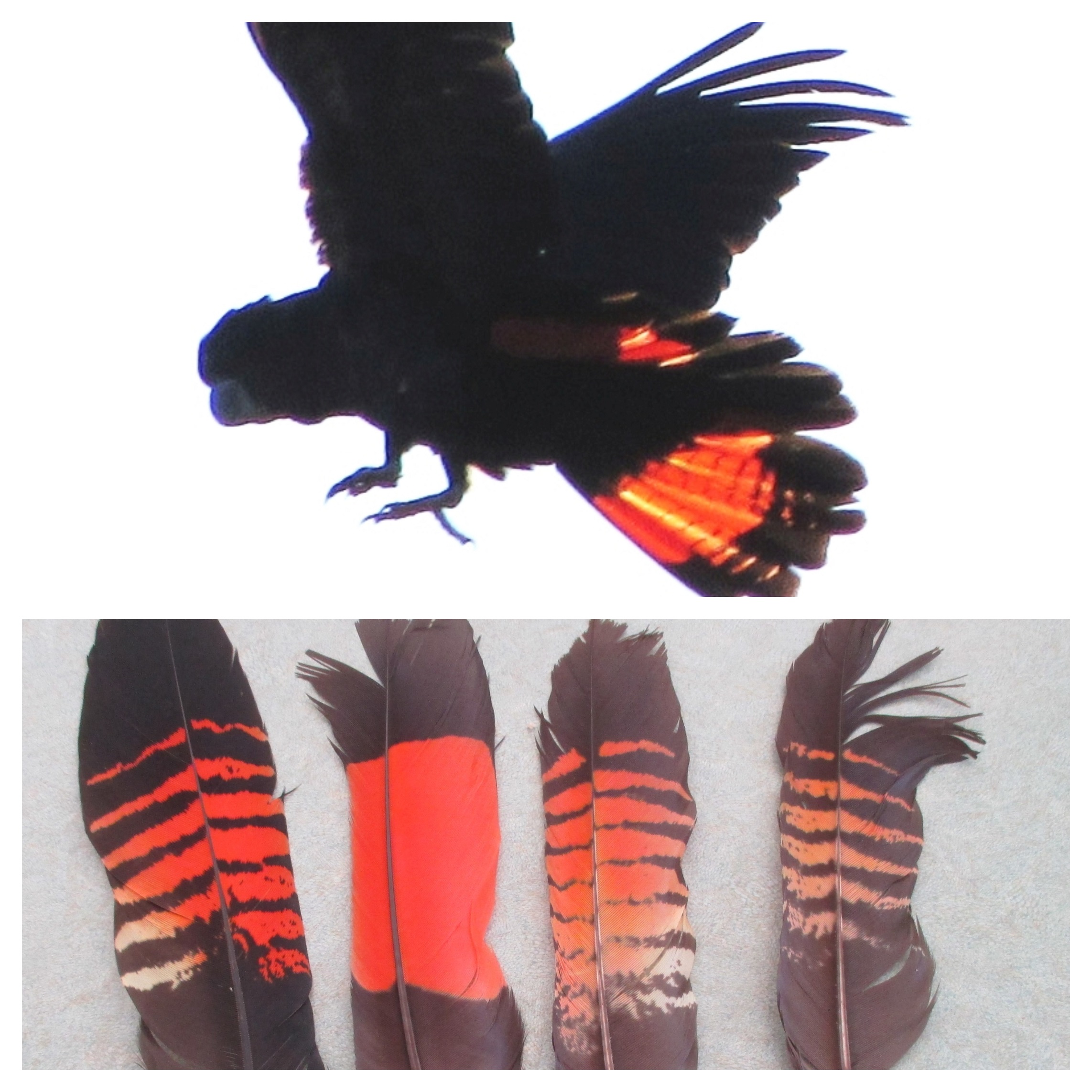
Feathers from the forest red-tail black cockatoo

By Judy Evans
@JudyEv (381837)
Rockingham, Australia

January 13, 2019 9:58pm CST
While out and about on our 18 acres in south-west Western Australia, I occasionally come across pretty feathers. These four were picked up at various times and are from the forest red-tail black cockatoo (Calyptorhynchus banksii). There are also white- and yellow-tailed black cockatoos lthough the latter isn’t seen in WA.
The forest red-tail is endangered but we see them quite often. When they come in to land, they spread their tail and it looks like stop-lights. They are noisy birds with strong, hooked beaks. They feed on the kernels inside gumnuts from the eucalyptus trees.
I don’t know which feather comes from which part of the bird but they’re all pretty.
14 people like this
15 responses

@moffittjc (128831)
• Gainesville, Florida
14 Jan 19
Isn't it amazing how nature has developed so many amazing colors on animals over time? That is a beautiful bird. Is it endangered because people hunt it for its feathers? Or is it from loss of habitat?
2 people like this

@moffittjc (128831)
• Gainesville, Florida
15 Jan 19
@JudyEv Isn't Australia by far still a relatively undeveloped country in terms of habitat? I'm surprised that on a continent such as yours with such a low population of humans that a species would be facing habitat loss.
We have an issue with that here in Florida. We have a sub-species of cougar called the Florida Panther that is indigenous to our state. However, less than 50 still remain in the wild due to habitat loss. Florida has recently surpassed 20 million people in population, making it the 3rd most populated state in the US. Being that the state is a peninsula, there isn't much land left that hasn't been touched by man. Thankfully, we have a very robust land conservation plan that is trying to preserve as much natural habitat as possible, but I think it may be too late to save the panther.
1 person likes this
@JudyEv (381837)
• Rockingham, Australia
14 Jan 19
It's from loss of habitat. I don't think the aborigines have ever been into a lot of decoration with feathers. And have you seen the incredible patterns/colours on spiders and tiny things? It's a shame we rarely get to see the beauty there unless someone with a macro lens chooses to share a photo.
1 person likes this
@JudyEv (381837)
• Rockingham, Australia
15 Jan 19
@moffittjc That is sad about the panther. Although we may seem relatively undeveloped almost all the arable land has been cleared which at the time meant getting rid of virtually all the timber. Good nesting trees are now few and far between.
1 person likes this

@andriaperry (118793)
• Anniston, Alabama
14 Jan 19
These birds sounds beautiful.
1 person likes this

@JudyEv (381837)
• Rockingham, Australia
14 Jan 19
They are aren't they? I must keep collecting them and see how many I end up with.
@wolfgirl569 (135601)
• Marion, Ohio
14 Jan 19
@JudyEv I have a friend that would love those for her crafting. They would look real good on the indian items she makes.
1 person likes this
@JudyEv (381837)
• Rockingham, Australia
15 Jan 19
@wolfgirl569 Our aborigines never seemed to get into collecting and wearing feathers. That's not quite true. I think the witch-doctors might have but it wasn't a general thing.


@snowy22315 (208793)
• United States
14 Jan 19
Those are some interesting bird feathers. Around here we have the red winged blackbird. The colors are really almost the same.
1 person likes this
@JudyEv (381837)
• Rockingham, Australia
15 Jan 19
These only have the red in the tail. I checked out the blackbird. He is very handsome.


@JudyEv (381837)
• Rockingham, Australia
14 Jan 19
To put on my sore thumb? I tried to take a photo of it but it doesn't look very impressive at all. I might have to whack it again. 


@JudyEv (381837)
• Rockingham, Australia
23 Jan 19
They're gorgeous aren't they? Maybe one day I'll have enough for a head-dress. 

@JohnRoberts (109841)
• Los Angeles, California
14 Jan 19
You can decorate hats with the feathers.
1 person likes this

@JudyEv (381837)
• Rockingham, Australia
15 Jan 19
You mostly only notice the red in the tail as they come in to land.