

BED BUGS

By MySpot
@MySpot (2600)
United States

November 30, 2006 4:35pm CST
BED BUGS
Most householders of this generation have never seen a bed bug. Until recently, they also were a rarity among pest control professionals. Bed bug infestations were common in the United States before World War II. But with improvements in hygiene, and especially the widespread use of DDT during the 1940s and '50s, the bugs all but vanished. The pests remained prevalent, though, in other regions of the world including Asia, Africa, Central/South America and Europe. In recent years, bed bugs have also made a comeback in the U.S. They are increasingly being encountered in homes, apartments, hotels, motels, dormitories, shelters and modes of transport. International travel and immigration have undoubtedly contributed to the resurgence of bed bugs in this country. Changes in modern pest control practice - and less effective bed bug pesticides - are other factors suspected for the recurrence.
Description and Habits
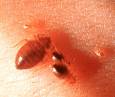
Adult bed bug feeding on a human. (M. Potter, Univ. of Kentucky) Bed bugs are small, brownish, flattened insects that feed solely on the blood of animals. The common bed bug, Cimex lectularius, is the species most adapted to living with humans. It has done so since ancient times.
Bed bugs are mentioned, for example, in medieval European texts and in classical Greek writings back to the time of Aristotle. Other bed bug species prefer to feed on wild hosts, especially bats and birds.
Adult bed bugs are about 1/4 inch long and reddish brown, with oval, flattened bodies. They are sometimes mistaken for ticks or cockroaches. The immatures (nymphs) resemble the adults, but are smaller and somewhat lighter in color. Bed bugs do not fly, but can move quickly over floors, walls, ceilings and other surfaces. Female bed bugs lay their eggs in secluded areas, depositing up to five a day and 500 during a lifetime. The eggs are tiny, whitish, and hard to see without magnification (individual eggs are about the size of a dust spec). When first laid, the eggs are sticky, causing them to adhere to substrates. Newly hatched nymphs are no bigger than a pinhead. As they grow, they molt (shed their skin) five times before reaching maturity. A blood meal is needed between each successive molt. Under favorable conditions (70 - 90° F), the bugs can complete development in as little as a month, producing three or more generations per year. Cool temperatures or limited access to a blood meal extends the development time. Bed bugs are very resilient. Nymphs can survive months without feeding and the adults for more than a year. Infestations therefore are unlikely to diminish by leaving premises unoccupied. Although C. lectularius prefers feeding on humans, it will also bite other warm-blooded animals, including pets.
Bed bugs are active mainly at night. During the daytime, they prefer to hide close to where people sleep. Their flattened bodies enable them to fit into tiny crevices - especially those associated with mattresses, box springs, bed frames, and headboards. Bed bugs do not have nests like ants or bees, but do tend to congregate in habitual hiding places.
Dark spots of bed bug excrement on a mattress. (M. Potter, Univ. of Kentucky) Characteristically these areas are marked by dark spotting and staining, which is the dried excrement of the bugs. Also present will be eggs and eggshells, molted skins of maturing nymphs, and the bugs themselves.
Another likely sign of bed bugs is rusty or reddish spots of blood on bed sheets, mattresses, or walls. Heavy infestations may have a musty or "buggy" smell, but the odor is seldom apparent and should not be relied upon for detection.
Bed bugs prefer to hide close to where they feed. However if necessary, they will crawl several feet to obtain a blood meal. Initial infestations tend to be around beds, but the bugs eventually may become scattered throughout a room, occupying any crevice or protected location. They also can spread to adjacent rooms or apartments.
Bites and Concerns
Bed bugs usually bite people at night while they are sleeping. They feed by piercing the skin with an elongated beak through which they withdraw blood. Engorgement takes about three to 10 minutes, yet the person seldom knows they are being bitten. Symptoms thereafter vary with the individual. Many people develop an itchy red welt or localized swelling, which sometimes appears a day or so after the bite. Others have little or no reaction. Unlike fleabites, which occur mainly around the ankles, bed bugs feed on any bare skin exposed while sleeping (face, neck, shoulders, arms, hands, etc.). The welts and itching are often attributed to other causes such as mosquitoes. For these reasons, infestations may go a long time unnoticed, and can become quite large before being detected. The possibility of bed bugs increases if the affected individual has been traveling, or had acquired used beds or furnishings before symptoms started to appear. Bed bugs also are suspect if you wake up with itchy bites you did not have when you went to sleep. Conversely, it is important to recognize that not all bites or bite-like reactions are due to bed bugs. Confirmation requires finding and identifying the bugs themselves, which often requires the help of a professional. (Other possible sources of irritation are discussed in University of Kentucky entomology fact sheet ENT-58: Invisible Itches: Insect and Non-Insect Causes).
A common concern with bed bugs is whether they transmit diseases. Although bed bugs can harbor pathogens in their bodies, transmission to humans is highly unlikely. For this reason, they are not considered a serious disease threat. Their medical significance is mainly limited to the itching and inflammation from their bites. Antihistamines and corticosteroids may be prescribed to reduce allergic reactions, and antiseptic or antibiotic ointments to prevent infection. Infestations also may cause anxiety, embarrassment, and loss of sleep.
How Infestations Originate
It often seems that bed bugs arise from nowhere. The bugs are efficient hitchhikers and are usually transported in on luggage, clothing, beds, furniture, etc. Outbreaks can often be traced to travel, especially in countries or cities where bed bugs are common. This is a particular problem for hotels, motels, and apartments, where turnover of occupants is constant. Bed bugs are small, cryptic and agile, escaping detection after crawling into suitcases, boxes, and belongings. The eggs are almost impossible to see when laid on most surfaces. Use of secondhand beds, couches, and furniture is another way that the bugs are transported into previously non-infested dwellings.
Bed bugs infesting a couch. (M. Potter, Univ. of Kentucky) Once bed bugs are introduced, they often spread room to room throughout a building. Unlike cockroaches that feed on filth, the level of cleanliness has little to do with most bed bug infestations.
Pristine homes, hotels, and apartments have plenty of hiding places and an abundance of warm-blooded hosts. Thus, they are almost as vulnerable to infestation as are places of squalor.
When bed bug-like insects are found, it's important to consider whether bats, swallows, chimney swifts, pigeons, or other wild hosts are involved. Although similar in appearance, bed bug species that normally feed on bats and birds can be differentiated from those that prefer humans. Entomologists and knowledgeable pest control firms can make this determination.
Controlling Infestations
Bed bugs are challenging pests to control. They hide in many tiny places, so inspections and treatments must be very thorough. In most cases, it will be prudent to enlist the services of a professional pest control firm. Experienced companies know where to look for bed bugs, and have an assortment of management tools at their disposal. Owners and occupants will need to assist the professional in important ways. Affording access for inspection and treatment is essential, and excess clutter should be removed. In some cases, infested mattresses and box springs will need to be discarded. Since bed bugs can disperse throughout a building, it also may be necessary to inspect adjoining rooms and apartments.
Where They Hide
Bed bugs often congregate along seams of mattresses and box springs. Blackish spots are excrement. (M. Potter, Univ. of Kentucky) Bed bugs can live in almost any crevice or protected location. The most common place to find them is the bed. Bed bugs often hide within seams, tufts, and crevices of the mattress, box spring, bed frame and headboard.
A thorough inspection requires dismantling the bed and standing the components on edge so that upper and lower surfaces can be examined. Things to look for are the bugs themselves, and the light-brown, molted skins of the nymphs. Dark spots of dried bed bug excrement are often present along mattress seams or wherever the bugs have resided. Box springs afford many places for bed bugs to hide, especially underneath where the fabric is stapled to the wooden frame. Oftentimes the underlying dust cover must be removed to gain access for inspection and possible treatment. Successful treatment of mattresses and box springs is difficult, however, and infested components may need to be discarded. Cracks and crevices of bed frames should be examined, especially if the frame is wood. (Bed bugs have an affinity for wood and fabric more so than metal or plastic). Headboards secured to walls should also be removed and inspected. In hotels and motels, the area behind the headboard is often the first place that the bugs become established. Bed bugs also hide among items stored under beds.
Many areas besides beds, however, can harbor bed bugs.
Bed bugs hidden beside a recessed screw under a nightstand. (M. Potter, Univ. of Kentucky) Upholstered chairs and sofas should be checked carefully, including seams, tufts, skirts, and crevices. Sof
2 responses

@ossie16d (11821)
• Australia
12 Dec 06
This is very interesting, and also a bit scary, MySpot although I was aware that they can be found anywhere, not just in beds of course. For some years now here in Australia there have been periodic articles about bed bugs and what they can do, how to get rid of them etc. I am getting the itches just from reading and responding to this discussion actually.