

designed


By shilpa28k
@shilpa28k (1737)
India

1 response

@swarn47 (1706)
• India
18 Dec 06
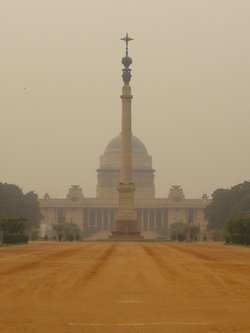
The Palace of Rashtrapati Bhavan is the official residence of the President of India, located in New Delhi, Delhi. Until 1950 it was known as "Viceroy's House" and served as the residence of the Governor-General of India.
Design
During the Delhi Durbar year of 1911 it was decided that the capital of India would be shifted from Calcutta to Delhi. This was announced on December 12 by King George V. As the plan for New Delhi took shape, the Governor-General's residence was given an enormous scale and prominent position. The British architect Edwin Landseer Lutyens, a key member of the city-planning process, was also given the prime architectural opportunity of designing the building.
The original plans of the viceroy’s house called for something which would be a mixture between western and eastern styles. There were some who wanted the palace to be a classical designed one, in the tradition of the Greeks. This would clearly show western power in India. Others desired a palace which would be modelled on Indian architecture, and designed by Indians. It was also suggested for various degrees of mixing the two styles. The Viceroy declared that the palace was to be classical, but with an Indian motif.
This was close to what the design eventually developed into. While Lutyens wanted an almost totally classical building, it was probably due to pressure from others that forced him to include Indian elements in the design. It is thought that Lutyens believed he came to India to bring Western culture to it, rather than to conform to Indian designs. The palace developed very similarly to the original sketches which Lutyens sent Baker from Simla on June 14, 1912.
Lutyens' design is grandly classical overall, with colors and details inspired by Indian architecture. Lutyens was especially proud to hear that the palace would not be called "Government House" (as most British colonial governors' residences were and are) but instead "Viceroy's House." Apart from Edwin Lutyens, the Chief architect and Chief Engineer Hugh Keeling there were many Indian contractors who were involved in the construction of this building. While a Muslim contractor Haroun-al-Rashid did most of the work of the main building the forecourt was built by Sujan Singh and his son Sobha Singh. Surprisingly the names of these Indians did not find a place in the official biography of Lutyens.
Lutyens and Baker who had been assigned to work on the Viceroy’s House and the Secretariats, began on friendly terms, although they later quarrelled. Baker had been assigned to work on the two secretariat buildings which were in front of Viceroy’s House. Early on in the design process, Viceroy’s House was decided to be moved from the original position on the top of Raisina Hill. The original plan was to have Viceroy’s House on the top of the hill, with the secretariats lower down. It was decided to move it back 400 yards, and put both buildings on top of the plateau. While Lutyens wanted the Viceroy’s house to go higher up, he was forced to move it back from the intended position due to a dispute with Baker. Following the completion of the palace, Lutyens fought with Baker, because the view of the front of the palace was obscured by the high angle of the road.
Source: http://www.answers.com/rashtrapati+bhavan?initiator=IE7:SearchBox
To know more about Rashtrapati bhavan U can visit the source page.
