

cfc

By smartnrich
@smartnrich (1067)
Malaysia

3 responses

@smbilalshah (1316)
• Pakistan
7 Feb 07
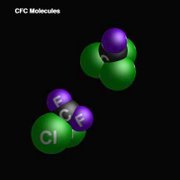
do you mean chlorofluorocarbons?
well these are compounds highly disasterous for the ozone layer, instead modern appliances and aerosols use HCFCs or some other ozone friendlty gases.
The haloalkanes (also known as halogenoalkanes) are a group of chemical compounds, consisting of alkanes, such as methane or ethane, with one or more halogens linked, such as chlorine or fluorine, making them a type of organic halide. They are known under many chemical and commercial names. As fire extinguishants, propellants and solvents they have or had wide use. Some haloalkanes (those containing chlorine or bromine) have negative effects on the environment such as ozone depletion. The most widely known family within this group are the chlorofluorocarbons (CFCs).
A haloalkane, also known as alkyl halogenide, halogenalkane or halogenoalkane, and alkyl halide is a chemical compound derived from an alkane by substituting one or more hydrogen atoms with halogen atoms. Substitution with fluorine, chlorine, bromine and iodine results in fluoroalkanes, chloroalkanes, bromoalkanes and iodoalkanes, respectively. Mixed compounds are also possible, the best-known examples being the chlorofluorocarbons (CFCs) which are mainly responsible for ozone depletion. Haloalkanes are used in semiconductor device fabrication, as refrigerants, foam blowing agents, solvents, aerosol spray propellants, fire extinguishing agents, and chemical reagents.
Freon is a trade name for a group of chlorofluorocarbons used primarily as a refrigerant. The word Freon is a registered trademark belonging to DuPont.
There are 3 types of haloalkane. In primary haloalkanes (1o), the carbon which carries the halogen atom is only attached to one other alkyl group. However CH3Br is also a primary haloalkane, even though there is no alkyl group. In secondary haloalkanes (2o) the carbon that carries the halogen atom is attached to 2 alkyl groups. In a tertiary haloalkanes (3o) the carbon that carries the halogen atom is attached to 3 alkyl groups.
Chlorofluorocarbons (CFC) are haloalkanes with both chlorine and fluorine. They were formerly used widely in industry, for example as refrigerants, propellants, and cleaning solvents. Their use has been generally prohibited by the Montreal Protocol, because of effects on the ozone layer (see ozone depletion). They also contribute to global warming. They have a global warming potential (GWP), in terms of carbon dioxide equivalence (over a time period of one hundred years) between 6000 and 9800 per kg.[citation needed]Hydrochlorofluorocarbons (HCFCs) are of a class of haloalkanes where not all hydrogen has been replaced by chlorine or fluorine. They are used primarily as chlorofluorocarbon (CFC) substitutes, as the ozone depleting effects are only about 10% of the CFCs. When the chlorine is reduced to zero, these compounds are known as hydrofluorocarbons (HFCs), with an even lower global warming potential, and no known effects at all on the ozone layer (only fluorine compounds containing chlorine and bromine are thought to harm the ozone layer-- fluorine itself is not ozone-toxic)
Polymer haloalkanes
Chlorinated or fluorinated alkenes can be used for polymerization, resulting in polymer haloalkanes with notable chemical resistance properties. Important examples include polychloroethene (polyvinyl chloride, PVC), and polytetrafluoroethene (PTFE, Teflon), but many more halogenated polymers exist.
During World War II, various early chloroalkanes were in standard use in military aircraft by some combatants, but these early halons suffered from excessive toxicity. Nevertheless, after the war they slowly became more common in civil aviation as well.
In the 1960s, fluoroalkanes and bromofluoroalkanes became available and were quickly recognized as being among the most effective fire-fighting materials discovered. Much early research with Halon 1301 was conducted under the auspices of the US Armed Forces, while Halon 1211 was, initially, mainly developed in the UK. By the late 1960s they were standard in many applications where water and dry-powder extinguishers posed a threat of damage to the protected property, including computer rooms, telecommunications switches, laboratories, museums and art collections. Beginning with warships, in the 1970s, bromofluoroalkanes also progressively came to be associated with rapid knockdown of severe fires in confined spaces with minimal risk to personnel.
Work on alternatives for chlorofluorocarbons in refrigerants began in the late 1970s after the first warnings of damage to stratospheric ozone were published in the journal Nature in 1974 by Molina and Rowland (who shared the 1995 Nobel Prize for Chemistry for their work). Adding hydrogen and thus creating hydrochlorofluorocarbons (HCFC), chemists made the compounds less stable in the lower atmosphere, enabling them to break down before reaching the ozone layer. Later alternatives dispense with the chlorine, creating hydrofluorocarbons (HFC) with even shorter lifetimes in the lower atmosphere.
By the early 1980s, bromofluoroalkanes were in common use on aircraft, ships and large vehicles as well as in computer facilities and galleries. However, concern was beginning to be felt about the impact of chloroalkanes and bromoalkanes on the ozone layer. The Vienna Convention on Ozone Layer Protection did not cover bromofluoroalkanes as it was thought, at the time, that emergency discharge of extinguishing systems was too small in volume to produce a significant impact, and too important to human safety for restriction.
However, by the time of the Montreal Protocol it was realised that deliberate and accidental discharges during system tests and maintenance accounted for substantially larger volumes than emergency discharges, and consequently halons were brought into the treaty, albeit with many exceptions.
@smartnrich (1067)
• Malaysia
8 Feb 07
Thank you so much for your detail usefull explanation my friend. have a great day.Are you a scientist?
@smartnrich (1067)
• Malaysia
24 Feb 07
Because you're still in your field, you can explain detail about this topic.Thanks, and have a great day.

@emquinsat (1058)
• Philippines
7 Feb 07
CFC as in cloro-flouro carbon? It's a compuond produced from spray cans, styro foam and even our fridge. It actaully breaks up our ozone layer thus thinning it. In return, more sun (heat) comes into the surface of the earth making us prone to skin cancers. That's all I know about it from my science class from way way way before. Hope this helps.
@smartnrich (1067)
• Malaysia
7 Feb 07
Thank you for your response and I agree with you, my friend. Have agreat day.

