

HOw to avoid of thinning our Ozone layer

By smartnrich
@smartnrich (1067)
Malaysia

1 response

@smbilalshah (1316)
• Pakistan
7 Feb 07
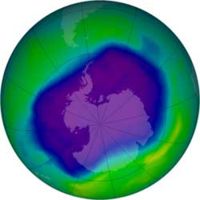
this process is called ozone depletion and an over view of the factors oinvolved in it and the ways to stop it will be given ahead,The term ozone depletion is used to describe two distinct but related observations: a slow, steady decline of about 3 percent per decade in the total amount of ozone in Earth's stratosphere during the past twenty years; and a much larger, but seasonal, decrease in stratospheric ozone over Earth's polar regions during the same period. The latter phenomenon is commonly referred to as the ozone hole.
The detailed mechanism by which the polar ozone holes form is different from that for the mid-latitude thinning, but the most important process in both trends is believed to be catalytic destruction of ozone by atomic chlorine and bromine. The main source of these halogen atoms in the stratosphere is photodissociation of chlorofluorocarbon (CFC) compounds, commonly called freons, and of bromofluorocarbon compounds known as halons. These compounds are transported into the stratosphere after being emitted at the surface. Both ozone depletion mechanisms strengthened as emissions of CFCs and halons increased.
CFCs, halons and other contributory substances are commonly referred to as ozone-depleting substances (ODS). Since the ozone layer prevents most harmful UVB wavelengths (270–315 nm) of ultraviolet light (UV light) from passing through the Earth's atmosphere, observed and projected decreases in ozone have generated worldwide concern leading to adoption of the Montreal Protocol banning the production of CFCs and halons as well as related ozone depleting chemicals such as carbon tetrachloride and trichloroethane (also known as methyl chloroform). It is suspected that a variety of biological consequences such as increases in skin cancer, damage to plants, and reduction of plankton populations in the ocean's photic zone may result from the increased UV exposure due to ozone depletion.
Three forms (or allotropes) of oxygen are involved in the ozone-oxygen cycle: Oxygen atoms (O or atomic oxygen), oxygen gas (O2 or diatomic oxygen), and ozone gas (O3 or triatomic oxygen). Ozone is formed in the stratosphere when oxygen molecules photodissociate after absorbing an ultraviolet photon whose wavelength is shorter than 240 nm. This produces two oxygen atoms. The atomic oxygen then combines with O2 to create O3. Ozone molecules absorb UV light between 310 and 200 nm, following which ozone splits into a molecule of O2 and an oxygen atom. The oxygen atom then joins up with an oxygen molecule to regenerate ozone. This is a continuing process which terminates when an oxygen atom "recombines" with an ozone molecule to make 2 O2 molecules. The overall amount of ozone in the stratosphere is determined by a balance between photochemical production and recombination.
Ozone can be destroyed by a number of free radical catalysts, the most important of which are the hydroxyl radical (OH·), the nitric oxide radical (NO·) and atomic chlorine (Cl·) and bromine (Br·). All of these have both natural and anthropogenic (manmade) sources; at the present time, most of the OH· and NO· in the stratosphere is of natural origin, but human activity has dramatically increased the chlorine and bromine. These elements are found in certain stable organic compounds, especially chlorofluorocarbons (CFCs), which may find their way to the stratosphere without being destroyed in the troposphere due to low reactivity. Once in the stratosphere, the Cl and Br atoms are liberated from the parent compounds by the action of ultraviolet light, and can destroy ozone molecules through a variety of catalytic cycles. In the simplest example of such a cycle, a chlorine atom reacts with an ozone molecule, taking an oxygen atom with it (forming ClO) and leaving a normal oxygen molecule. A free oxygen atom then takes away the oxygen from the ClO, and the final result is an oxygen molecule and a chlorine atom, which then reinitiates the cycle. The chemical shorthand for these reactions are:Cl + O3 ? ClO + O2
ClO + O ? Cl + O2
In sum O3 + O ? O2 + O2
The overall effect is to increase the rate of recombination, leading to an overall decrease in the amount of ozone. For this particular mechanism to operate there must be a source of O atoms, which is primarily the photodissociation of O3; thus this mechanism is only important in the upper stratosphere where such atoms are abundant. More complicated mechanisms have been discovered that lead to ozone destruction in the lower stratosphere as well.
A single chlorine atom would keep on destroying ozone for up to two years (the time scale for transport back down to the troposphere) were it not for reactions that remove them from this cycle by forming reservoir species such as hydrogen chloride (HCl) and chlorine nitrate (ClONO2). On a per atom basis, bromine is even more efficient than chlorine at destroying ozone, but there is much less bromine in the atmosphere at present. As a result, both chlorine and bromine contribute significantly to the overall ozone depletion. Laboratory studies have shown that fluorine and iodine atoms participate in analogous catalytic cycles. However, in the Earth's stratosphere, fluorine atoms react rapidly with water and methane to form strongly-bound HF, while organic molecules which contain iodine react so rapidly in the lower atmosphere that they do not reach the stratosphere in significant quantities.
] Observations
The most pronounced decrease in ozone has been in the lower stratosphere. However, the ozone hole is most usually measured not in terms of ozone concentrations at these levels (which are typically of a few parts per million) but by reduction in the total column ozone, above a point on the Earth's surface, which is normally expressed in Dobson units, abbreviated as "DU". Marked decreases in column ozone in the Antarctic spring and early summer compared to the early 1970s and before have been observed using instruments such as the Total Ozone Mapping Spectrometer.
Lowest value of ozone measured by TOMS each year in the ozone holeReductions of up to 70% in the ozone column observed in the austral (southern hemispheric) spring over Antarctica and first reported in 1985 (Farman et al 1985) are continuing[2]. Through the 1990's, total column ozone in September and October have continued to be 40–50% lower than pre-ozone-hole values. In the Arctic the amount lost is more variable year-to-year than in the Antarctic. The greatest declines, up to 30%, are in the winter and spring, when the stratosphere is colder.
Reactions that take place on polar stratospheric clouds (PSCs) play an important role in enhancing ozone depletion[3]. PSCs form more readily in the extreme cold of Antarctic stratosphere. This is why ozone holes first formed, and are deeper, over Antarctica. Early models failed to take PSCs into account and predicted a gradual global depletion, which is why the sudden Antarctic ozone hole was such a surprise to many scientists.
In middle latitudes it is preferable to speak of ozone depletion rather than holes. Declines are about 3% below pre-1980 values for 35–60°N and about 6% for 35–60°S. In the tropics, there are no significant trends.
Ozone depletion also explains much of the observed reduction in stratospheric and upper tropospheric temperatures The source of the warmth of the stratosphere is the absorption of UV radiation by ozone, hence reduced ozone leads to cooling. Some stratospheric cooling is also predicted from increases in greenhouse gases such as CO2; however the ozone-induced cooling appears to be dominant.
Predictions of ozone levels remain difficult. The World Meteorological Organization Global Ozone Research and Monitoring Project - Report No. 44 comes out strongly in favor for the Montreal Protocol, but notes that a UNEP 1994 Assessment overestimated ozone loss for the 1994–1997 period.
Chemicals in the atmosphere
CFCs in the atmosphere
Chlorofluorocarbons (CFCs) were invented by Thomas Midgeley in the 1920's. They were used in air conditioning/cooling units, as aerosol spray propellants prior to the 1980s, and in the cleaning processes of delicate electronic equipment . They also occur as by-products of some chemical processes. No significant natural sources have ever been identified for these compounds — their presence in the atmosphere is due almost entirely to human manufacture. As mentioned in the ozone cycle overview above, when such ozone-depleting chemicals reach the stratosphere, they are dissociated by ultraviolet light to release chlorine atoms. The chlorine atoms act as a catalyst, and each can break down tens of thousands of ozone molecules before being removed from the stratosphere. Given the longevity of CFC molecules, recovery times are measured in decades. It is calculated that a CFC molecule takes an average of 15 years to go from the ground level up to the upper atmosphere, and it can stay there for about a century, destroying up to one hundred thousand ozone molecules during that time.
Verification of observations
Scientists have been increasingly able to attribute the observed ozone depletion to the increase of anthropogenic halogen compounds from CFCs by the use of complex chemistry transport models and their validation against observational data (e.g. SLIMCAT, CLaMS). These models work by combining satellite measurements of chemical concentrations and meteorological fields with chemical reaction rate constants obtained in lab experiments. They are able to identify not only the key chemical reactions but also the transport processes which bring CFC photolysis products into contact with ozone.
The ozone hole and its causes
Image of the largest Antarctic ozone hole ever recorded in September 2006.The Antarctic ozone hole is an area of the Antarctic stratosphere in which the recent ozone levels have dropped to as low as 33% of their pre-1975 values. The ozone hole occurs during the Antarctic spr
@smartnrich (1067)
• Malaysia
8 Feb 07
Great my friend. Thank you so much for you idea and explanation.
