

Kolkata

By debjit
@debjit (339)
India

October 21, 2006 1:44pm CST
Kolkata (help·info) (IPA: ['kolkat?a] Bengali: ??????) (formerly Calcutta (help·info)) is the capital of the Indian state of West Bengal. It is located in eastern India on the east bank of the River Hooghly. The city has a population of almost 5 million, with an extended metropolitan population of over 14 million, making it the third-largest urban agglomeration and the fourth-largest city in India.
The city served as the capital in India during the British Raj until 1911. Once the centre of modern education, science, culture and politics in India, Kolkata witnessed economic stagnation in the years following India's independence in 1947. Since 2000 however, an economic rejuvenation has arrested the morbid decline, leading to a spurt in the city's growth. Like other large cities, Kolkata continues to struggle with urbanisation problems like poverty, pollution and traffic congestion. A vibrant city with a distinct socio-political culture, Kolkata is noted for its revolutionary history, ranging from the Indian struggle for independence to the leftist and trade union movements.
Referred to as the "Cultural Capital of India", "The City of Processions", and the "City of Joy", Kolkata has been home to luminaries such as Rabindranath Tagore, Ronald Ross, Subhas Chandra Bose, Mother Teresa, Satyajit Ray, Satyendranath Bose, Swami Vivekananda and many others.
[edit] Name
The names Kolkata and Calcutta were probably based on Kalikata, the name of one of the three villages (Kalikata, Sutanuti, Gobindapur) in the area before the arrival of the British.[1] "Kalikata", in turn, is an anglicised version of Kalikshetra ("Land of the goddess Kali"). However, other theories exist regarding the origin of the name. The original settlement of the city was claimed to be located beside a khal, meaning a canal in Bengali. Khal might have given rise to the name. Again, the place was known for the manufacture of shell-lime and the name could have been derived from lime (kali) and burnt shell (kata). Alternatively, the name may have been derived from the Bengali term kilkila ("flat area").[2] The government of West Bengal changed the official name of the city from Calcutta to Kolkata; the new name was legalised in 2001. A number of other Indian cities have enacted similar name changes.
[edit] History
Main article: History of Kolkata
The Government House in colonial Kolkata — when it was known as the "City of Palaces".The discovery of the nearby Chandraketugarh,[3] an archaeological site, provides evidence that the area has been inhabited for over two millennia.[4] The city's documented history, however, begins with the arrival of the British East India Company in 1690, when the Company was consolidating its trade business in Bengal. Job Charnock, an administrator with the Company who eventually settled in Sutanuti after invading through Hijli Kingdom, is traditionally credited with founding the city.
In 1699,the British completed the construction of old Fort William, which was used to station its troops and as a regional base. Kolkata (then Calcutta) was declared a Presidency City, and later became the headquarters of the Bengal Presidency. Faced with frequent skirmishes with French forces, in 1756 the British began to upgrade their fortifications. When protests against the militarisation by the Nawab of Bengal Siraj-Ud-Daulah went unheeded, he attacked and captured Fort William leading to the infamous Black Hole incident. A force of Company sepoys and British troops led by Robert Clive recaptured the city the following year. Clive himself described it as one of the most wicked places in the Universe.[5]
Kolkata was named the capital of British India in 1772. A contemporary description refers to the splendid sloth and languid debauchery of European society, when great men rode about in State coaches, with a dozen servants running before and behind them to bawl out their titles.[5] It was during this period that the marshes surrounding the city were drained and the government area was laid out along the banks of the Hooghly River. Richard Wellesley, the Governor General between 1797-1805, was largely responsible for the growth of the city and its public architecture which led to the description of Kolkata as 'the City of Palaces'. Miss Emily Eden (the sister of the Governor General, who gave her name to Eden Gardens), in 1836 wrote of Calcutta: "Depend upon it, Calcutta is the finest place in the world. I know there are towns with far larger and grander buildings; but then they are not half so clean, and new, and beautiful, as this bride-like city. I have been standing on the roof of the house the last half-hour for air, and, as it was midnight, had an opportunity of seeing all the gay company - returning from an entertainment at the government-house; and I assure you I never witnessed any thing that could compare with the splendour exhibited." [6]
Kolkata port in 1945. It was an important military port during WW2.By the early 19th century, Kolkata was split into two distinct areas — one British, one Indian, known as 'Black Town'. Even at the time, the poverty of the 'Black Town' shanties was considered shocking. The city underwent rapid industrial growth from the 1850s, especially in the textile and jute sectors; this caused a massive investment in infrastructure projects like rail roads and telegraph by British government. The coalescence of British and Indian culture resulted in the emergence of a new class of urbane Indians — Asia's first middle class — whose members were often professionals, read newspapers, were Anglophiles, and usually belonged to upper-caste Hindu communities.[7] Throughout the nineteenth century, a socio-cultural reform, often referred to as the Bengal Renaissance resulted in the general uplifting of the people. In 1883, Surendranath Banerjea organised a national conference — the first of its kind in nineteenth century India. Gradually Kolkata became a centre of the Indian independence movement, especially revolutionary organisations. The 1905 Partition of Bengal on communal grounds resulted in widespread public agitation and the boycott of British goods (swadeshi movement). These activities, along with the administratively disadvantageous location of Kolkata in the eastern fringes of India, prompted the British to move the capital to New Delhi in 1911. The city's port was bombed twice by the Japanese during World War II.[8] As food stocks were being diverted to feed Allied troops, millions starved to death during the Bengal famine of 1943.[9] In 1946, demands for the creation of a Muslim state led to large-scale communal violence resulting in the deaths of over 2,000 people.[10] The partition of India also created intense violence and a shift in demographics - large numbers of Muslims left for East Pakistan, while hundreds of thousands of Hindus fled into the city.[11]
Over the 1960s and 1970s, severe power shortages, strikes and a violent Marxist-Maoist movement — the Naxalites — damaged much of the city's infrastructure, leading to an economic stagnation. In 1971, war between India and Pakistan led to the mass influx of thousands of refugees into Kolkata resulting in a massive strain on its infrastructure.[12] In the mid-1980s, Mumbai overtook Kolkata as India's most populous city. Kolkata has been a strong base of Indian communism as West Bengal has been ruled by the CPI(M) dominated Left Front for three decades now — the world's longest-running democratically-elected Communist government.[13][14] The city's economic recovery gathered momentum after economic reforms in India introduced by the central government in the mid-1990s. Since 2000, Information Technology (IT) services revitalized the city’s stagnant economy. The city has also experienced a growth in the manufacturing sector. Following similar moves elsewhere in the country, the state government changed the city’s official name from Calcutta to Kolkata in 2001; this act was seen largely as a political ploy.[15]
[edit] Geography
Main article: Geography of Kolkata
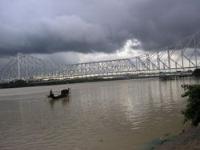
Monsoon clouds over the Howrah Bridge
A radar image of Kolkata showing different urban land use patterns. North is to the upper left. Central Kolkata is the light blue and orange area on the right of the river in the center of the image.Kolkata is located in eastern India at 22°33'N 88°20'E in the Ganges Delta at an elevation ranging between 1.5 to 9 metres.[16] It is spread linearly along the banks of the River Hooghly in a north-south direction. Much of the city was originally a vast wetland, reclaimed over the decades to accommodate the city's burgeoning population. The Sundarbans National Park separates the city from the Bay of Bengal, which is located about 154 km to the south.
Like the most of the Indo-Gangetic plains, the predominant soil type is alluvial. Quaternary sediments consisting of clay, silt, various grades of sand and gravel underlie the city. These sediments are sandwiched between two clay beds, the lower one at depths between 250 and 650 m and the upper one ranging between 10 and 40 m in thickness.[17] According to the Bureau of Indian Standards, the town falls under seismic zone-III, in a scale of I to V (in order of increasing proneness to earthquakes)[18] while the wind and cyclone zoning is "very high damage risk", according to UNDP report.[18]
[edit] Climate
Kolkata has a tropical climate. The annual mean temperature is 26.8 °C (80 °F); monthly mean temperatures range from 19 °C to 30 °C (67 °F to 86 °F). Summers are hot and humid and maximum temperatures often exceed 40 °C (104 °F) during May and June. Winter tends to last for only about two and a half months, with seasonal lows dipping to the 12 °C – 14 °C between December and January. The highest recorded temperature is 43 °C (111 °F) and the lowest is 5 °C (41 °F).[19] Often during early summer, dusty squalls followed by spells of thunderstorm and heavy rains la
2 responses

@sann007m2 (717)
• India
3 Nov 06
Errekk...!! It takes more time to display in my desktop....My friend ..I m miss my kolkata for 1 n half years

@y2ksuprio (853)
• India
21 Oct 06
I live in kokata ,it is my birth place.I live in behala sarsuna at banarje para.I love my city very much.Kolkata is also known as city of joy.
