

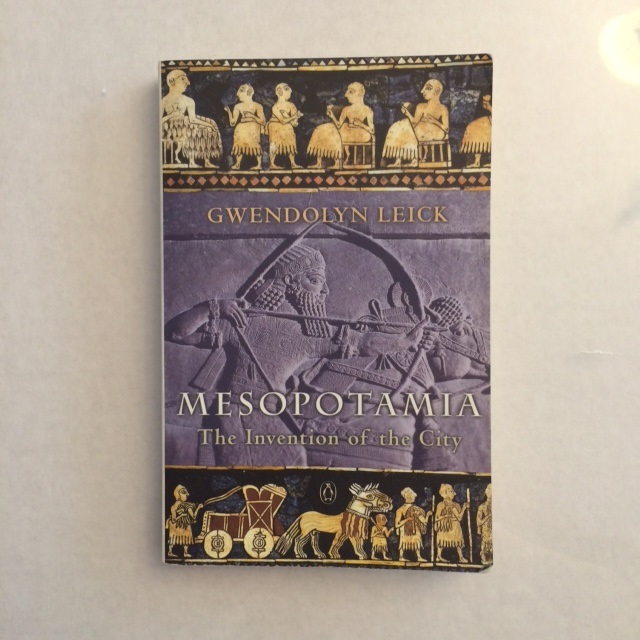
Book Review: "Mesopotamia: The Invention of the City" by Gwendolyn Leick

By Siduri
@msiduri (5687)
United States

July 31, 2016 8:59am CST
Anthropologist and Assyriologist Gwendolyn Leick depicts the history of Mesopotamia via the history of ten of Mesopotamian cities: Eridu, Uruk, Shuruppak, Akkad, Ur, Nippur, Sippar, Ashur, Nineveh, and Babylon. She dedicates a chapter to each city and arranges those chapters in roughly chronologically order. The time examined begins with earliest stages of the city Eridu in the fifth millennium BCE to the demise of Babylonian culture in the closing centuries of the last centuries BCE. The author surveys each city with respect to the excavation of the site (with one exception), its history, and its place in Mesopotamian literature among other things.
Lieck demonstrates a continuity of some cultural elements across millennia despite changes in ethnicity and language. The cities lay forgotten for centuries, but the culture that arose in them still influences both the Middle East and Western culture.
The author begins with what she calls the Mesopotamian Eden, Eridu (present day Abu Shahrein in Iraq). It was built with access to the marshland, to fresh water and to western deserts allowing its inhabitants to exploit the three different ecosystems. In her preference, the author says the invention of the city may well be the most enduring legacy of Mesopotamia.
Because it was believed to be the site of creation, Eridu was viewed as holy throughout its history though it had little political power and was economically dependent on the neighboring city of Ur. Like most Mesopotamian cities, it underwent periodic declines—even to the point apparent abandonment—and revitalizations. Evidence exists of occupation during the Chalcolithic period (approx. 6000 BCE), then on and off up until the first millennium BCE when its last revitalization took place under Nebuchadrezzar II of Babylon (605-562 BCE) before its final decline. The pattern, if not necessarily the longevity, is typical of many Mesopotamian cities.
One city detailed, Akkad, has never been found, yet no one doubts its existence. Lieck must rely on literary evidence and references to it in other cities’ monuments to form a portrait. One of the great early literary works, “The Curse of Agade,” describes the city in its heyday as cosmopolitan city, wealthy on the tribute of others, full of foreigners, until the god Enlil withdrew his favor. No particular reason is given for his action.
The development and evolution of the complex system of cuneiform writing, which served more than one language, is covered, as well as religion, the ideas of kingship and empire are all covered in the different chapters.
Different literary forms are also discussed, such as a lamentation for the destruction of a city, a literary form familiar to readers of the Bible:
On the banks of the Tigris and Euphrates “bad weeds” grow,
That no one sets out for the road, that no one seeks out the highway,
That the city and its surroundings be razed to ruins,
(…)
That the hoe not attack the fertile fields, that the seed not be planted in the ground,
That the sound of one tending the oxen not resound in the plain,
(…)
That the sound of churning not resound in the cattle pen.
(“Lamentation Over the Destruction of Ur” quoted on p. 137)
Lieck is writing in the time of Saddam Hussein’s reign in Iraq, not foreseeing the many cataclysmic events that have taken place since then.
The prose is utilitarian and can be dry at times tends. Ideas and point are repeated in different sections, as the author apparently intended the book for reference rather than for cover-to-cover reading. There is a map covering the area roughly from Anatolia (modern Turkey) to the edge of the Persian Gulf, a concise chronology of time periods from the Middle Paleolithic (c. 78,000–28,000 BCE) to 1979, but most of the time covered takes place since the Chalcolithic (c. c.6000–3000 BCE). There is also a glossary which I didn’t find all overly helpful. Fourteen pages of black-and-whites plates of different artifacts have been inserted into the middle of the book.
Lieck may have oversold her case slightly that the invention of the city is the greatest legacy of Mesopotamia as opposed to writing and religion. Like the wheel, the city is useful enough to have been to have been invented independently several times. Nevertheless, the book full of interesting information and some lively stories such as “The Poor Man of Nippur,” a violent little tale of vengeance wrought by a little guy against a rich man who ignored his needs. The book is a reminder, also, of achievements of the ancient world.
According to the London Art History Society, Lieck is Senior Lecturer at Chelsea College of Art and Design in the U. K. Her publications include Who's Who in the Ancient Near East and Sex and Eroticism in Mesopotamian Literature. She was general editor of The Babylonian World.
_____
Book: Mesopotamia: The Invention of the City
Author: Gwendolyn Leick (b. 1951)
Published: 2001
384 pages
_____
*An older version of this review appeared on another site. It has been updated and expanded for its inclusion on myLot*
5 people like this
4 responses

@ElicBxn (64177)
• United States
7 Aug 16
Very interesting. I agree, the city certainly wasn't the sole invention of Mesopotamia, China certainly developed it independently. And I agree, that the religion and writing were probably more important, although those were also developed independently. Mesopotamia certainly didn't influence the civilizations in the New World...
I do think that the Jewish texts that came to form the Bible certainly have a lot of influence from the Minnesotans as well as the Egyptians.
1 person likes this

@msiduri (5687)
• United States
7 Aug 16
@ElicBxn The story of the flood comes in several different forms. Ziusudra (sp.?) is the Sumerian form. There, the gods just got t'd off because people were making too much noise, ruining the neighborhood, doncha know. One of the gods liked Ziusudra and pulled him aside, told him to build a boat. Remarkably, the bit about sending a dove out while the flood waters are receding remains the same.
1 person likes this
@msiduri (5687)
• United States
7 Aug 16
Her argument was not so much for the city itself but the particular type of city. That it lasted for millennia, through different cultures testifies to its durability and adaptability, but I think writing (even though cuneiform has gone out of style) and religion (even though we don' t worship the Mesopotamian gods) are a greater influence. I think what probably is a greater influence on the modern city is the Roman outline. Just my thought.
Thanks for your note.
1 person likes this


@JohnRoberts (109841)
• Los Angeles, California
31 Jul 16
Because describing the book as more of a research volume, it can also be labeled a scholarly tome.
1 person likes this

@teamfreak16 (43717)
• Denver, Colorado
31 Jul 16
Would be interesting. I'd at least try to read it.
1 person likes this