

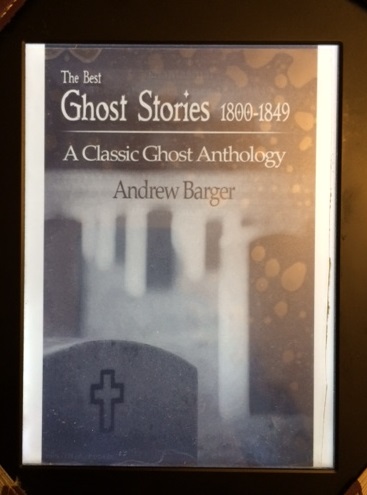
Book Review: "The Best Ghost Stories 1800-1849: A Classic Ghost Anthology" ed. Andrew Barger

By Siduri
@msiduri (5687)
United States

September 18, 2016 7:33am CST
This is a collection of nine ghost stories, some of which are familiar—classic, even—and some of which are obscure. Authors include Edgar Allan Poe, Washington Irving, F. Sheridan Le Fanu and Walter Scott among other such as the prolific anonymous.
Editor Andrew Barger opens the volume with an essay titled “All Ghosts are Gray” in which he posits that ghosts/spirits of the departed as understood in this period are indeed lifeless; they often bring about the destruction of the humans they contact with. They are objects of revulsion and horror, if sometimes pity. They impart no words of wisdom. They seldom talk. (One story violates this rule in an amusing way). Barger also prefaces each story with a few comments.
The stories are all good choices, both as examples of early nineteenth century American and European ghost stories and as good reading. The twenty-first century reader cannot expect them to be twenty-first stories. They may take a little longer to get to the point. They may dwell on description.
The nine tales are:
• “The Adventure of the German Student” by Washington Irving
Originally published 1824
A lonely German student from a good family finishing his studies in Paris during the “tempestuous times” of the French Revolution meets a lovely young lady on the Place de Greve, a square place where they’ve been guillotining people.
• “The Old Maid in the Winding Sheet” (AKA “The White Old Maid”) by Nathaniel Hawthorne
Originally Published 1835
As only a true gothic ghost story can, this opens with a corpse laid out for burial. Editor Barger claims this story began the tradition of ghosts wearing a sheets.
• “A Night in a Haunted House” by Anonymous (according to Editor Barger. Others credit an Irish clergyman named Henry Ferris)
Originally published 1848
At first, this appears to be an all-too-familiar set-up: two young men joke over dinner about wanting to spend the night in a haunted house. An older clergyman warns them against this in the gravest of tones and takes forever telling his story. This is a long tale, but the payoff is worth it.
• “The Story of the Spectral Ship” by Wilhem Hauff
Originally published 1826
This is a version of “The Flying Dutchman” legend set among Muslims, but not written by a Muslim. It’s a lot of fun, but gory and…weird.
• “The Tapestried Chamber” (AKA “The Lady in the Sacque”) by Sir Walter Scott
Originally published 1828
A traditional ghost story. A veteran of the American War (or, perhaps more familiarly to Americans, The Revolutionary War) visiting an old schoolmate cuts his visit short and won’t explain. While Scott talks and talks and talks, this is a scary story. It also shows the variation of language over time and geography.
• “The Legend of Sleepy Hollow” by Washington Irving
Originally published 1820
This story had been told and retold so many times, it’s nice to read the original again. The only action is at the very end, but the descriptions and setups are amusing.
• “The Mask of the Red Death” by Edgar Allan Poe
Originally published 1842
Prince Prospero knows how to live. He and his people retire to his country estate while the red death rages in the city. Yeah, if only it were so easy. Classic story.
• “A Chapter in the History of a Tyrone Family” by Joseph Sheridan Le Fanu
Originally published 1839
This is told in first person from the point of view of Fanny, a young woman who marries a man named Lord Glenfallen. Hmm…. Not a good omen. Editor Barger is quick to point out—both before and after the story—the many similarities between this story and Jane Eyre.
• “The Deaf and Dumb Girl” by Anonymous
Originally published 1839
Editor Barger says this is the first time this story has been republished. It is a good story. The bad guy gets his comeuppance in spades. I think one of the reasons it was neglected is it deals with suicide, viewed as a mortal sin back in the day. What might be even more off-putting (besides the term “deaf and dumb”) is the view that a disability is an indication of something cursed, something to be shunned or avoided.
This is a great collection of ghost stories. It includes humor, gothic stories, a bit of gore and craziness. The introductions/author biographies are short and informative. Barger also includes an extensive list of stories he considered for the book and an only slightly less extensive mentions of other collections the reader might be interested in buying.
The text is plagued with occasional typos. Most of them are no more than annoying word substitutions on the order of “on” for “in.” The most egregious happens in a passage discussing how one woman met her end and became a ghost:
“She left town, and shut herself up in her house at Wester Hilton, where, some say, she died of a broken heart, others, of the influenza, and others, again, maintain that she banged herself in her garters.”
All that aside, The Best Ghost Stories 1800-1849: A Classic Ghost Anthology is a fun book. “A Night in a Haunted House” is worth the price of admission by itself. This anthology is available as an e-book and a paperback.
_____
Book: The Best Ghost Stories 1800-1849: A Classic Ghost Anthology
Editor: Andrew Barger
Published: 2011
Pages: 218
*An earlier version of this review was posted on another site. It has been expanded for its inclusion in myLot*
Image is my own.
7 people like this
5 responses


@egdcltd (12059)
•
18 Sep 16
Not exactly on-topic, but you've reminded me I've got a collection of Poe stories. I've been reading old horror/ghost stories for research, and I'd forgotten about those. I don't think I've ever read them; I've only really come across Poe in the Roger Corman films usually starring Vincent Price.
1 person likes this


@JohnRoberts (109841)
• Los Angeles, California
26 Sep 16
You are right. This sounds like a solid collection from legendary writers.
1 person likes this

