

Book Review: "The Vanishing Hitchhiker" by Jan Harold Brunvand
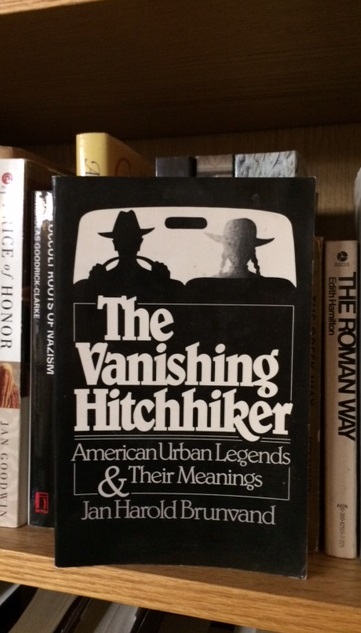

By Siduri
@msiduri (5687)
United States

October 2, 2016 8:44am CST
The vanishing hitchhiker of the title refers to a ghost story that has been around at least since the 19th century but I heard as a kid as a “true story” that happened to “a friend of Bob’s from college.”
The friend of Bob’s from college was driving home with a friend after a party. They noticed a girl walking along the road by herself and offered her a ride home as the night was getting chilly. After some initial reluctance, she agreed and got into the back seat. She told them her name was Lavender. Bob’s friend gave her his overcoat to keep her warm. She asked to be let out by a cemetery, telling them she lived toward the back of it. After the guys let her out, Bob’s friend realized she’d taken his overcoat. They decided to come the next day and see if could find out where she lived—a girl with an odd name like that couldn’t be too hard to find—and get the coat back.
The next day, they drove into the cemetery. Toward the back of it, they found Bob’s friend’s overcoat, neatly folded on top of grave in front of a tombstone engraved “Lavender.”
This book opens by discussing what urban legends are and what the folklorist’s role is in collecting them. The scholar does not try to debunk them per se, but the stories cannot be true in the sense that they all happened to so many people’s cousins, friends, ex-roommates, etc. in so many different locations. He also says that tracking down the origin of these stories has generally fruitless.
One exception to that is another story I initially heard as true, that is, that there are alligators living in the New York City sewer system. As the story goes, people coming back from trips to Florida (a popular vacation spot for people in the Northeast) would bring back baby alligators, but realize they didn’t stay babies. What better way to get rid of them then to flush them down the toilet? Turns out, there’s more to this than meets the eye.
Regarding another story: some years ago, a friend and I were discussing urban legends. I mentioned that the Mexican story of La Llorona, The Weeping Woman, bears some resemblance to a ghost story told about a family in upstate New York where I grew up. According to that story, the son of a wealthy family drowned in a river in the mid-19th century. The ghost of his father is said to haunt the road near the river looking for his son and menace nearby children.
My friend paused for a moment then said, “I know that story. It started in my hometown.” She knew the family of the woman who had, according to the story, drowned her children and herself. The people in the town were at one point so afraid of the ghost they begged the priest to bless the river. My friend even saw something herself once, looking down from a footbridge over the river. The priest blessed the river, even though he insisted the ghost couldn’t hurt anyone. If anything, it was just a restless spirit.
This is how urban legends work, how (at least in the pre-internet days) they were kept alive by people who knew them to be true because they happened to a friend of a friend and are filled with enough detail to give them weight to make them believable.
Author Jan Harold Brunvand divides his exploration of urban myths by topic: Classic Automobile Legends; “The Hook” and Other Teenage horrors; Dreadful Contaminations; Purloined Corpses and the Fear of the Dead; Dalliance, Nudity and Nightmares; Business Rip-offs: and Two Favorite Media Legends. He further raises the question of why we like to tell each other these stories beyond the obvious reason that they’re good stories. The bad guy is always discomfited. Philanderers are embarrassed. Some offer ways to get back at what appear to be greedy businesses. Many involve ghosts. Some are warnings about the use of new technology such as the legends about the woman who put her poodle in the microwave to dry it off. This was current while microwave ovens were still fairly new items in homes.
This is an enjoyable read, full of good stories, but Brunvand’s aim is a more than just to catalogue a bunch of good yarns. He’s successful in educating and entertaining the reader as well. This is a good read for anyone who likes a good story and would like to think a bit about them.
Brunvand (b. 1933) is currently professor emeritus of English at the University of Utah, where he taught from the mid-60s until his retirement in 1996. He’s had more than 100 articles and books—both popular and academic—published and helped popularize the idea of urban legends, those “true” stories that happen to a friend of a friend.
_____
Title: The Vanishing Hitchhiker: American Urban Legends & Their Meanings
Author: Jan Harold Brunvand (b. 1933)
Published: 1981
Pages: 208
*An earlier version of this review appeared at another site. It has been updated and expanded for its inclusion on myLot.*
Image is my own, of my copy of the book,
1 person likes this
3 responses

@JohnRoberts (109841)
• Los Angeles, California
2 Oct 16
I guess Lavender proves even ghosts feel chilly.
2 people like this


@akalinus (44366)
• United States
3 Oct 16
Look what I found. I kept thinking of Lavender and looked her up. Her name was Lily and lavender was her favorite color. I found a link with another version of the story.

There are many types of ghost stories: ghosts that haunt houses, ghosts that haunt battlefields or mansions, ghosts that move stuff around (poltergeists), and more. But the single most common type of ghost story, found all around the world, is that of the
1 person likes this
@akalinus (44366)
• United States
2 Oct 16
The vanishing hitchhiker is another variation of the woman in white legend. Someone picks up a woman wearing a white dress. She sits in the back seat and the driver glances in the mirror to check on her. Suddenly, she is gone just before they reach her destination.
I like your story more because the coat on the grave is physical evidence that she was there. I never knew anyone would name their kid Lavender.
1 person likes this
@akalinus (44366)
• United States
2 Oct 16
@msiduri I did not know about the dreaming sailors. I lived in the southwest as a kid and I heard woman in white stories then. We could see the Kneeling Nun, a rock formation. There were a lot of different stories about her. Then, there was the Llorna about a woman who drowned her two kids in the Rio Grande and spent eternity looking for them.
1 person likes this
@msiduri (5687)
• United States
2 Oct 16
Oh, my gosh, when I first heard this story, many years ago, it scared the bejesus out of me!
I associate the woman in white more with a warning almost a banshee sort of thing. There are stories of sailors dreaming of women in white before disaster at sea, for example.
1 person likes this
