

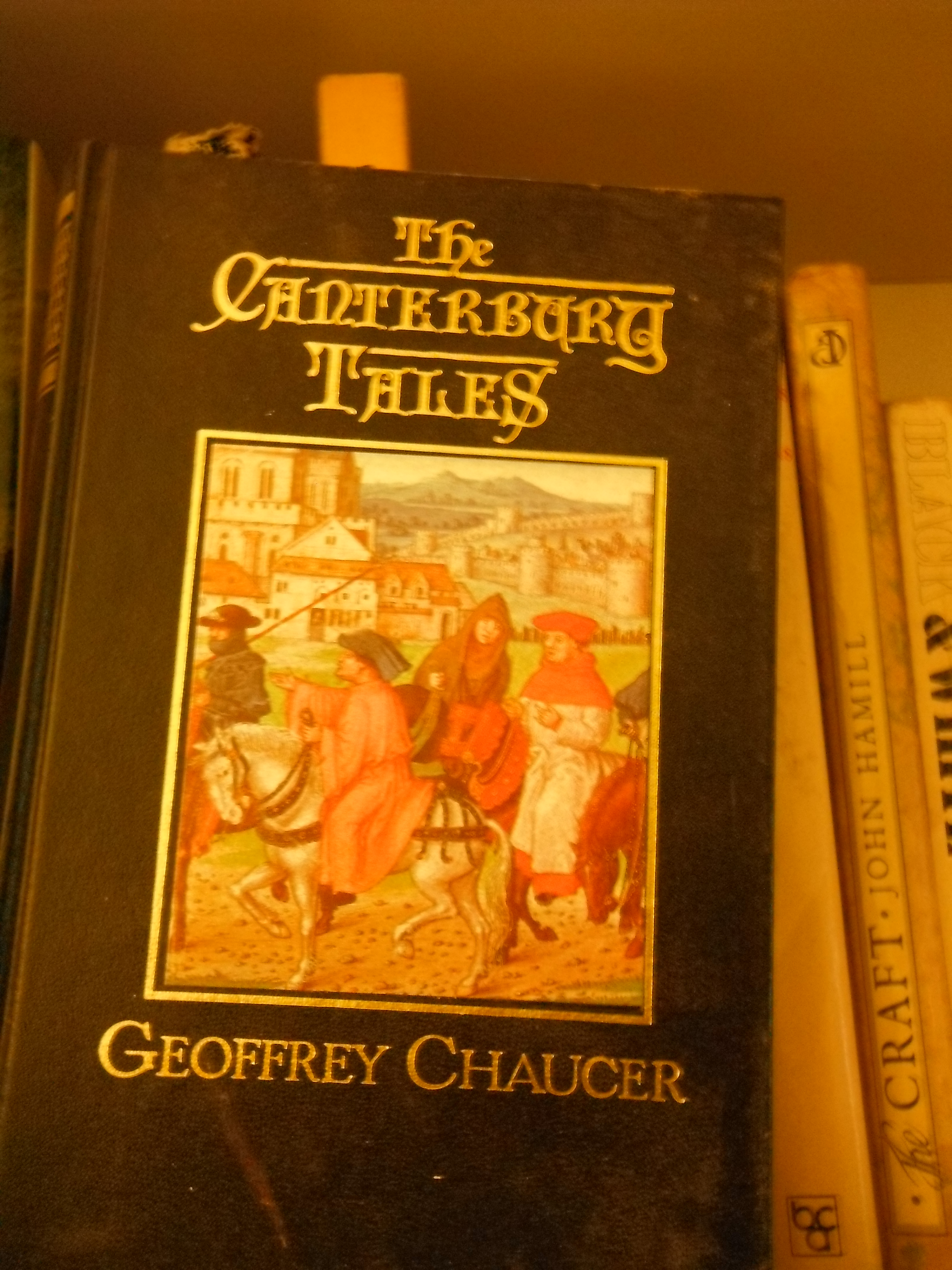
Book Review Chaucer The Canterbury Tales The Man Of Laws Tale

@arthurchappell (44941)
Preston, England

January 14, 2018 2:46pm CST
The story-telling contest is now in its stride, but the pilgrims are progressing slowly on their journey to Canterbury. Their host encourages them to move more quickly and reminds the Man Of law that the next story is his to tell. He offers one of the darkest and saddest stories in the collection.
It is the story of an Islamic Syrian Sultan, who wishes to marry the Roman, Catholic Lady Constance. He is so taken with the lady that he is willing to convert to her faith.
As the wedding date looms, Constance sails from Rome, but in Syria, the Sultan’s evil mother has become extremely hostile to the inter-faith marriage. She plots and schemes the downfall of her son and his bride to be, which would have led to Syria itself becoming a Catholic country. She pretends to convert to Catholicism, and when Constance arrives, the Sultana throws a pre-wedding banquet for the couple, but at the height of the feast, she has her son and all of his supporters murdered at the table.
Constance watches in horror, and then she is cast into the hull of a rudderless ship, and set adrift on the open sea, with plenty of food, but no possible way of steering the vessel, which could sink at any time.
After five years of this living Hell, Constance is shipwrecked when her ship is grounded off the coast of Northumberland, and rescued by a local Constable, who takes the shocked, half deranged lady in, and finds that she largely suffers from amnesia.
Constance seems to find some happiness among the pagan Northumbrians for a time but her happiness is soon shattered when Satan convinces a knight to murder the Constable’s wife, and frame Constance for the foul deed.
Constance is tried before the King, who suspects the Knight is not telling the truth. He makes the Knight swear an oath on the Bible, and the Knight tries this only to be immediately struck dead by the hand of God for his evil ways. Constance is now seen to be innocent, and the King himself falls in love with Constance and soon marries her.
They have a son, but once again, it is the machinations of an evil mother that leads to fresh tragedy. The King’s Mother is jealous of Constance and when her son, Maurice is born, while the King is away dealing with a Scottish crisis, the King’s Mother sends him false letters claiming that Maurice is an evil demon, terrorizing the castle.
The King sends word back that Constance is not to be harmed and neither is her son, until he gets home to look into the matter, but his Mother intercepts his letters and forges his name on orders to have Constance and child cast back into the sea in the boat she had so mysteriously arrived on board. This is done, and Constance and child spend several more years drifting at sea. They narrowly escape attack by sailors intent on rape, but it looks as if God himself intervenes to have the man washed overboard to drown.
The King launches a search party, and fate intervenes in other ways too. Constance’s father has learned belatedly of the machinations in Syria that led to his daughter’s fate, and he has been to war against Syria, killing the Sultana and her evil minions. He is on the return voyage when he finds the ship bearing his daughter, and he rescues her, though she cannot remember enough of her fate to allow him to recognise her. It is when her English husband visits Rome to arrange trading agreements that the various parties learn who one another are, and finally the characters find happiness, though Constance only has one year left to live.
It is a potent story of a woman who never gives up or loses dignity or faith no matter how cruel fate is to her, and finds a brief burst of happiness in the end, but it is the relentless horror around her that sticks in the reader’s mind.
Arthur Chappell
4 people like this
3 responses

@bagarad (14283)
• Paso Robles, California
15 Jan 18
I don't think that tale was in my textbook, which only published some of the more popular tales the editors liked best. This one could be rewritten as a novel for today, if someone hasn't already written it. Thanks for sharing this sad story. I like it the way you told it. I didn't enjoy plowing through the Middle English as much.
1 person likes this
@arthurchappell (44941)
• Preston, England
15 Jan 18
@bagarad you can get modern English translations
1 person likes this
@bagarad (14283)
• Paso Robles, California
16 Jan 18
@arthurchappell I know, but I'm not very motivated. I think my professors ruined it for me.
1 person likes this
@arthurchappell (44941)
• Preston, England
16 Jan 18
@bagarad often the way in education establishments sadly
1 person likes this


@Poppylicious (11134)
• United Kingdom
15 Jan 18
Beautifully tragic. It would make both a good novel and a fascinating film. It could even be set in contemporary times.
1 person likes this
@arthurchappell (44941)
• Preston, England
15 Jan 18
@Poppylicious it would work very well for modern audiences I expect
1 person likes this

