

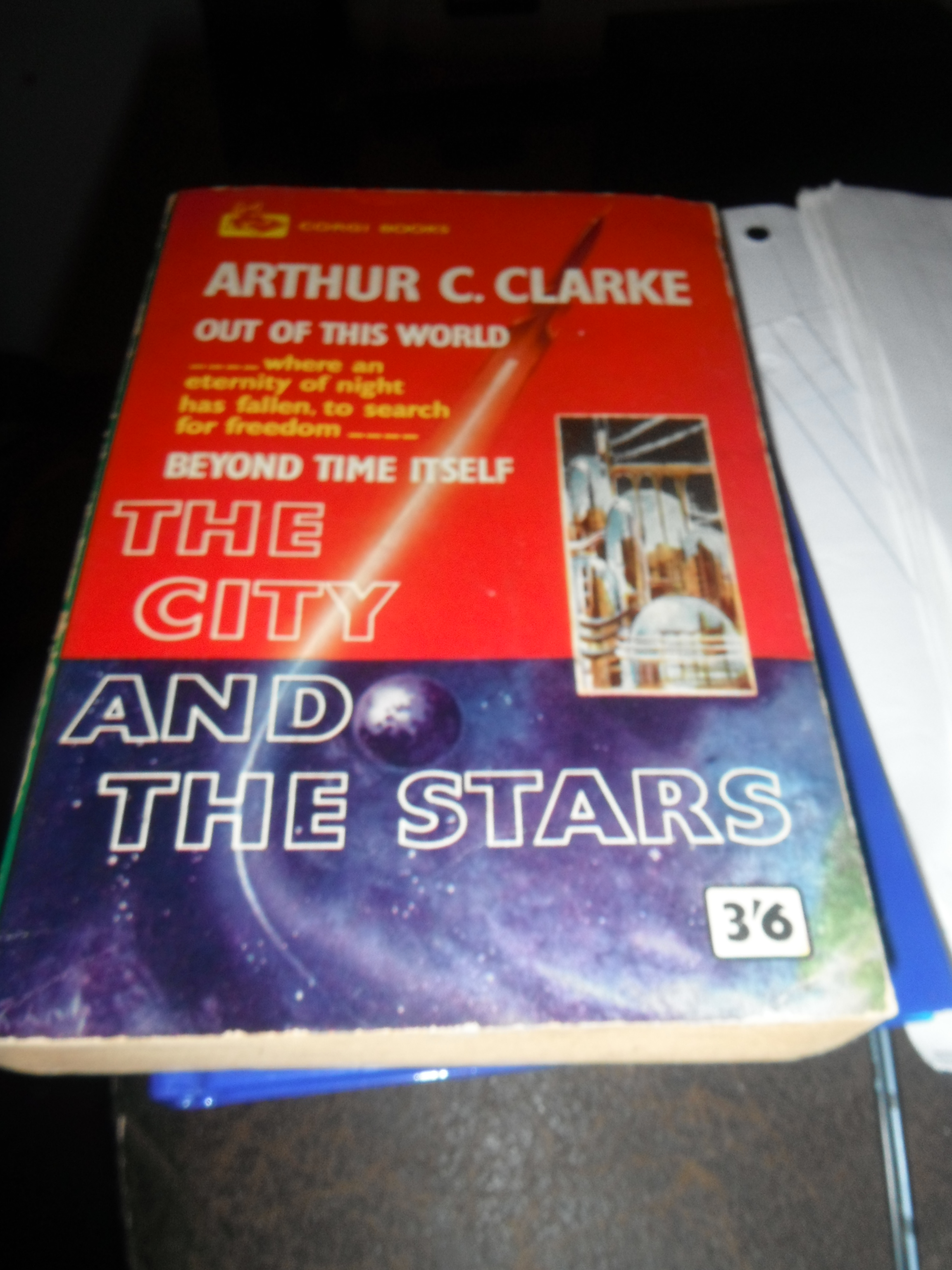
Science Fiction Novel Review Arthur C Clarke The City And The Stars

@arthurchappell (44941)
Preston, England

March 23, 2018 5:46am CST
1956 – Corgi Books - Spoiler alerts
I love most Arthur C Clarke books and stories that I have read, but this one is very disappointing, possibly among the worst books I have ever read.
It is actually a rewrite of an earlier book, Clarke’s first published novel, Against The Fall Of Night, from 1948. I haven’t read that version, but many fans are divided as to which version of the tale is best.
The story is set a billion years in the future, with Clarke trying to do an Olaf Stapledon style look at the far flung future. While Stapledon showed people have evolved into vastly different beings, Clarke depicts a stifled and held-back civilization.
The people of the Earth based city of Diaspar have become immortal. Bodies still wear out but memories and intelligence are kept in computer memory bank in the city which generates new bodies for its citizens to inhabit and most people are reborn hundreds of times over.
Then one day Alvin is created by the central computer, a man with no previous lives, and therefore in effect the first man born for a billion years, even if his body is synthetic.
No one has left Diaspar. Human conquest of space was banned after an apparent war with some unspecified alien invader decimated most of Earth, leaving Diaspar the only city surviving, or so it is taught.
Alvin is insatiably curious to see the world beyond Diaspar, and with help from a political maverick called The Jester, he escapes and discovers another city, Lys.
The people of Lys are less dependent on computers, highly telepathic, mortal, and born from conventional procreation. They are friendly, but in fear of Diaspar. They have met others who have escaped from there but erased their memories of Lys and sent them home. They plan to do the same to Alvin, but he is saved when he finds an alien robot and uses it to escape back to Diaspar to reveal the truth about the other civilization exiting, forcing the two cultures to meet and integrate peacefully.
Meanwhile, Alvin, along with his robot and Hilvar, hi best friend from Lys use the robot’s spaceship to inspect the galaxy. After finding lots of dead or once used but abandoned Worlds, they meet an alien entity, the child-like but hyper-intelligent Vanemonde, and learn the truth about themselves.
There was never an alien invader. Earth scientists had created a upper-intelligent God-like entity, but it had gone insane, becoming known as The Mad Mind. The beings of the galaxy had trapped the entity away in a dark sun, a sort of Black Hole dimension, though one day it will be destined to escape and potentially destroy the universe. Vanamonde was a second, more successfully created God-being who will hopefully grow quickly enough to fight the Mad-Mind when he time comes. Meanwhile, Alvin is content to stay earthbound and help recover and cultivate the largely desert environment beyond the two surviving cities.
A sweep of grand ideas, but little characterization. Alvin meets people who exist only long enough to give him clues to take on to the next part of his quest. The Jester is written out early on. Alvin’s lover, a girl separated from him when he finds the exit to Diaspar, is not mentioned again when he returns from Lys or when he comes home from space. In the end he wants to be a farmer but makes no effort to find or remember his former girlfriend.
Clarke is trying to be mystical, and yet we see little of the Mad-Mind, a techno-Cthulhu entity, and Vanamonde is treated as a benevolent pet and weapon rather than as a being with any free will.
Clarke left the novel open for a sequel which he never wrote, though Gregory Bensford did write a sequel called Beyond The Fall Of Night in 1990.
Arthur Chappell
5 people like this
7 responses

@arthurchappell (44941)
• Preston, England
23 Mar 18
@aureliah yes, most of his books are great
1 person likes this

@arthurchappell (44941)
• Preston, England
23 Mar 18
@Courage7 yes, there are truths we may not discover about of leaders for generations to come
1 person likes this


@silvermist (19701)
• India
23 Mar 18
Though I have read many stories and books by Arthur C Clarke,I have not read this one.I do not think I will read it.
1 person likes this

@JohnRoberts (109841)
• Los Angeles, California
23 Mar 18
I never liked Arthur C. Clarke anyway.
1 person likes this
@arthurchappell (44941)
• Preston, England
23 Mar 18
@JohnRoberts some of his books are great, especially Childhood's End
1 person likes this

@thislittlepennyearns (68246)
• Defuniak Springs, Florida
23 Mar 18
Sounds like I wont be reading this one, but I do love the cover.
1 person likes this

