

5th Century Grave Reveals Child Buried with a Stone in It's Mouth

By Gary Sibio
@garysibi (702)
Chicago, Illinois

October 14, 2018 3:40am CST
A grave dating back to the 5th century AD contained the remains of a 10 year old child who had died of malaria. The child was buried with a stone in its mouth.
Archaeologists speculate that this was done to prevent the child from returning from the dead and spreading the disease.
More info and photos at
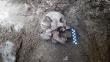
The remains of a 10-year-old biting on a stone have been unearthed by archaeologists in a 5th Century Italian cemetery, evidence suggesting a “vampire burial” to prevent the child’s return from the dead.
4 people like this
5 responses


@topffer (42155)
• France
14 Oct 18
There is nothing similar known for early Christianity, and I do not know any text from the Antiquity speaking of this. Briefly said, it can be interpreted like you want, maybe this kid had just a big mouth .
I had to deal in the past with a structure looking like a burial with a massive metallic deposit, the only problem is that there was not a piece of human bone among the burnt bones found. Despite of this detail some colleagues told that it could not be anything else than a tomb, I had just not seen the urn... I ended by writing an article in collaboration with an anthropologist and a college professor showing that many structures with large deposits had been considered like "tombs" without having given any human bone...
Some archeologists tend to do hazardous interpretations that cannot be supported by any text or other discoveries. Difficult to tell it on an US site, but American archeologists are very good at that.
.
I had to deal in the past with a structure looking like a burial with a massive metallic deposit, the only problem is that there was not a piece of human bone among the burnt bones found. Despite of this detail some colleagues told that it could not be anything else than a tomb, I had just not seen the urn... I ended by writing an article in collaboration with an anthropologist and a college professor showing that many structures with large deposits had been considered like "tombs" without having given any human bone...
Some archeologists tend to do hazardous interpretations that cannot be supported by any text or other discoveries. Difficult to tell it on an US site, but American archeologists are very good at that.
.
I had to deal in the past with a structure looking like a burial with a massive metallic deposit, the only problem is that there was not a piece of human bone among the burnt bones found. Despite of this detail some colleagues told that it could not be anything else than a tomb, I had just not seen the urn... I ended by writing an article in collaboration with an anthropologist and a college professor showing that many structures with large deposits had been considered like "tombs" without having given any human bone...
Some archeologists tend to do hazardous interpretations that cannot be supported by any text or other discoveries. Difficult to tell it on an US site, but American archeologists are very good at that.2 people like this
@topffer (42155)
• France
14 Oct 18
@pgntwo All we can tell about this one is that the E-W orientation, with the head at the East, permits to believe that he was a Christian, and Christians are not usually buried with a stone in their mouth. I have seen skeletons that had been buried chained, tied, the head looking to the ground, not counting those who woke up too late in their coffin and did not managed to escape. I would have noted the presence of this stone without calling the media because it is impossible to give a serious interpretation of it...
2 people like this