

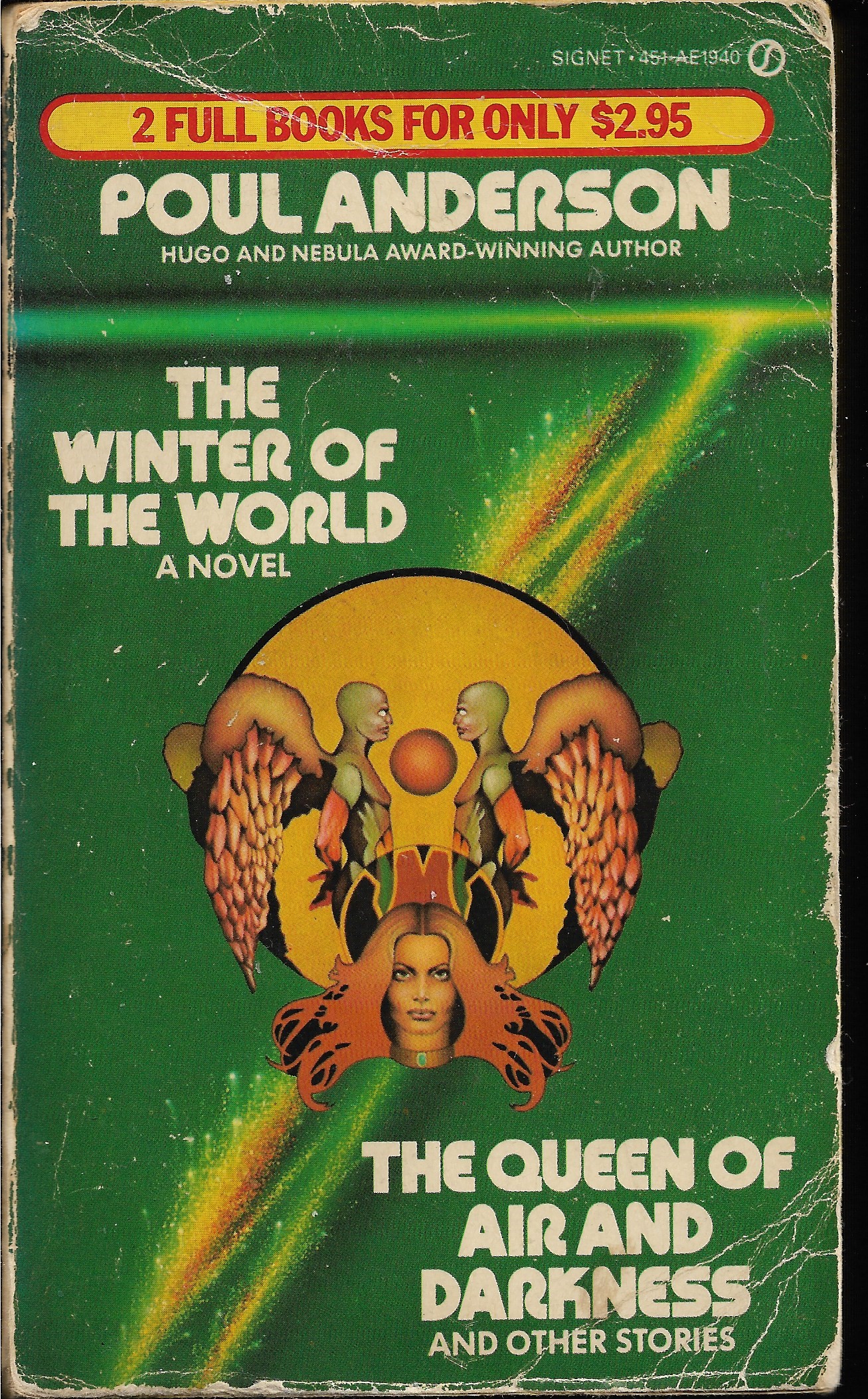
Science Fiction Book Review – The Winter of the World by Poul Anderson

@VictorFrankenstein (319)
United Kingdom

September 24, 2021 3:27pm CST
Poul Anderson was a world-famous science fiction writer, who won multiple Hugo and Nebula awards, and yet I don't think I've got round to reading any of his work until recently. This book came my way as part of a job lot on eBay though, so I read it and I'm really impressed by his writing ability. I'll be keeping an eye out for more of his work in the future.
“The Winter of the World” is essentially a political/espionage thriller set around ten thousand years in the future, during the next ice age. Our civilisation's gone, with most of our cities either crushed by glaciers or destroyed in a final war for dwindling resources.
In the intervening millennia, multiple civilisations have risen and fallen. At the time this story is set, civilisation is back on the rise, complete with international trade, diplomacy and imperialism. The people of this new era know that there was a previous civilisation before the Ice, but after ten thousand years they don't know much about us – mostly just legends.
The action in this story is set in North America, now known as Andalin (as you'd expect, all the place names have changed over time). The northern part of the continent is completely covered in ice, and the southern part is mostly dominated by the Rahidian Empire, which has recently conquered the ancient city state of Arvenneth – a city so old that it's said to pre-date the Ice. The Rahidians' next planned step is to invade the country north of Arvinneth, partly because of it has the potential to provide a lot of rich farmland, and partly because the biggest source of metal for the whole of Andalin is far north, right at the edge of the glaciers. This territory is occupied by the semi-nomadic Rogaviki, who are regarded as barbarians by the Rahidians, due to their nomadic lifestyle and complete lack of any kind of political organisation. As it turns out, the Rogaviki are highly civilised in their own peculiar way, being a fully-functioning anarchic society. Apart from living off the meat and hides of the animal herds they follow round their territory, they also salvage metal from the derelict skyscrapers of the long-abandoned pre-Ice city of Roong. They then trade this metal in exchange for manufactured goods from the countries south of them. As previously noted, this is the main source of metal for the whole continent, and therefore an objective for the Rahidians.
Watching developments with some concern is the government of Kilimaraich in eastern Australia, the most powerful country in a loose association of Pacific nations collectively know as the Seafolk. Until it was invaded by the Rahidians, Arvenneth was Kilimaraich's main supplier of sulphur, which they use in the manufacture of gunpowder. That supply is likely to be shut off in the future, as the Rahidians tend to horde such resources for the use of their own military. So the Seafolk have an interest in stopping or even reversing the Rahidian Empire's expansion, but don't want to risk a direct military confrontation. So we have the makings of a Cold War-style plot.
The story focuses on three main characters:
Sidir is the military governor of Arvanneth. An able military field commander, he's less happy trying to deal with the day to day complexities of running an occupation government, and can't wait to be out on campaign again. He's a bit of a loser, frankly, having dedicated his life to working his way up the political ladder and advancing his family within the Rahidian aristocracy without stopping to think if that's the best way to spend his life. He ditched his first wife, who he loved, in favour of a political marriage, and every move since has apparently been to advance his position within the hierarchy. He's got a fancy title, power, a nice headquarters and all the material comforts, but he daydreams about enjoying the simple pleasures of a common soldier. His only real outlets seem to be sex and combat. He believes that conquering the Rogaviki territory will enhance his political career further, but there's no doubt that he also prefers the problems of running an army at war to running a government.
Jossarek is a secret agent from Kilimaraich, sent on an open-ended mission to establish contact with the Rogaviki and see if anything can be done to head off the impending invasion. Jossarek is a former convict, merchant seaman and itinerant labourer, handy with his fists, with a good general education and an enquiring mind. His homeland seems to be on a similar social and political level to today's western democracies, with a strong sense of respect for human rights. Jossarek has a pretty liberal outlook on life and doesn't pre-judge different cultures. He's baffled by Rogaviki society, and frustrated at their lack of organisation in the face of the threat from the Rahidians, but he respects them and does his best to understand and help them.
The third major character is Donya, a Rogaviki woman who is put in touch with Jossarek by the head of a criminal organisation in Arvanneth. Donya, like her people, is an enigma. As previously mentioned, the Rogaviki have no political organisation whatsoever – no government or military. They have non-binding traditions, and that's all. Donya is not in any conventional sense a leader, but she is prominent within her “kith” (something like a clan but with no laird). She's just someone who's opinion is respected among her people. Donya has several husbands, which is a common family structure among the Rogaviki, and marriages are also open, so all partners are free to pair up with others when they feel like it. This book was written in 1976, so no-one seems to be concerned about STDs. Donya herself has affairs with both Sidir and Jossarek at different points in the story. She's an intelligent, courageous woman, but neither Sidir or Jossarek are ever really able to understand what's going on in her mind. Both men fall in love with her, in different ways – Sidir can't accept that Donya thinks differently to him, and Jossarek struggles to understand her.
The plot of the book focuses on the military campaign against the Rogaviki, and how Jossarek and Donya struggle to defeat the Rahidians. But there's also an underlying mystery which emerges as the real main theme of the book, the mystery of Donya and her people. They're not like outsiders, either physically or mentally. Not only do they not have any government, they have no concept of why anyone would want to either give or obey orders – especially as their society runs pretty well on a voluntary basis. They live well off the land, but their population doesn't increase – they keep their numbers well within the limits of what they can support on hunter-gatherer lifestyle. They enjoy a high degree of sexual freedom, but unwanted pregnancies are rare. Rogaviki women can control their fertility through willpower most of the time. The occasional unwanted pregnancy that does still occur is dealt with through infanticide (so not a perfect society). Men from other countries are often instantly attracted to Rogaviki women, and repeated encounters can result in said men becoming romantically obsessed with them. But if a Rogaviki woman has a baby with a man from another country, that child will be infertile. Rogaviki have never launched a war of aggression against anyone, and crime is rare among their own society – but if their territory is invaded, they'll fight like fanatics, even to the extent of committing what we would consider war crimes. Just the thought of their land being invaded and the animals they live off being wantonly destroyed is enough to send them into a berserker rage. But they don't bear any grudges once an enemy has retreated. Like I said, the Rogaviki are different, and this is a source of bafflement to both Sidir and Jossarek.
The level of world-building in this novel is impressive. Poul Anderson clearly put a lot of thought into the environment and what a future society might look like. The Rahidian army mostly depends on cavalry, pike men and archers, with only a small number of rifles and cannon, resulting in an old-fashioned style of linear warfare. There's no mention of powered land vehicles, or any kind of aircraft. But this setup is not as primitive as it looks at first glance. The Rahidians have telegraphs, which are mostly reserved for military use, and the Seafolk have recently re-invented the radio. The Seafolk operate great ocean-going sailing ships, which have steam-powered engines for auxiliary use, and the Rahidians operate steam-powered riverboats. There's no sign of railways or motorised traffic. Astronomy and evolutionary theory are also known about. Coal is available but doesn't seem to be used in industrial quantities, solar power is used to heat water, telescopes exist, books are printed etc. All of this points to a world that's fairly advanced in terms of scientific knowledge, but lacks the resources to make full use of it. It doesn't take much thought to see why – most of the mineral resources that are easy to get at have been mined out by our civilisation, leaving not much left over for the next lot. Hence an abandoned city becomes a major economic resource because of the metal that can be salvaged from the old buildings. So a limited supply of metal means that firearms are a rarity even in the army, telegraph facilities are limited, and there certainly wouldn't be enough steel to lay down extensive railway lines, even if that idea occurred to anyone. A lot is suggested about the history of this future world without resorting to blatant info-dumping, instead we just get hints here and there.
Summing up, I found this to be a very enjoyable novel, that can be read as a spy thriller, with lots of captures, escapes and intrigues, and as a thought experiment, if you like to think of how the world might develop in the future, especially if catastrophic climate change trashes our current civilisation. This won't be the last Poul Anderson story I read.
3 people like this
1 response

@RebeccasFarm (91297)
• United States
24 Sep 21
Sounds fascinating..did I spell that right?
Heh, I always forget but I checked and yeah.
You wrote an excellent book report here.
It sounds a marvelous read!
A great wonder of a writing.
Wish I had the concentration to read like I used to.
I like the sound of this and the Seafolk!!
1 person likes this
@VictorFrankenstein (319)
• United Kingdom
24 Sep 21
Thanks for the kind words, Ocean.
1 person likes this
@RebeccasFarm (91297)
• United States
25 Sep 21
@VictorFrankenstein Welcome and thanks for composing something of substance here..it is refreshing you know.
