

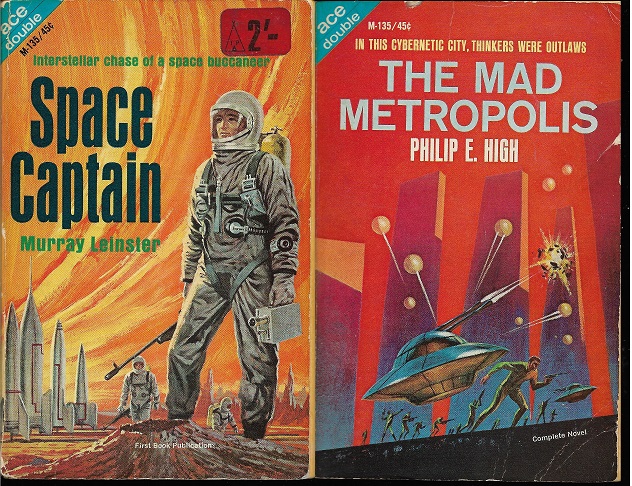
Science Fiction Book Review: Ace Double: Space Captain by Murray Leinster and The Mad Metropolis by Philip E High

@VictorFrankenstein (311)
United Kingdom

January 1, 2022 11:02am CST
Long-time science fiction fans might be familiar with “Ace Doubles”. This was a line of paperbacks published by Ace Books over a period of about twenty years between the early fifties and the early seventies. These were pairs of books bound together in what's known as tete-beche format – tete-beche being French for “head to tail”. In other words, the two books were printed upside-down in relation to each to each other, with two front covers. So instead of one standard-sized novel, you got two shorter novels bound together – or sometimes one novel and one short-story anthology, or maybe even two anthologies bound together.
There were Ace Double westerns and detective stories, and also some Ace Doubles in other genres, but the best remembered line is their science fiction series. These were so popular that Ace Books published a science fiction Double every month – so over twenty years, that's quite a lot of books. Some of the authors were unknown, some already popular, and some writers who later became famous got their start writing for Ace. As you'd expect, the writing quality can vary quite a bit. Sometimes it benefits, because the short length of the books prevents the authors from waffling, and forces them to get to the point faster. But some authors also complained that their stories had been butchered to fit. It's very much pot luck, but for me that's part of the fun of reading these books.
Taking advantage of being home most of the time during last year's lockdowns, I bought a few dozen of these books in job lots via eBay. It'll take me years to work through all of them, and I plan on posting reviews as I finish each one. So this is my first, reviewing, Ace Double M-135, published in 1966, which consists of two novels – Space Captain by Murray Leinster and The Mad Metropolis by Philip E High.
Space Captain
Murray Leinster was a science fiction writer of some repute, back in the day. His first SF story was published in 1919, although it's probably fair to say he reached his peak in the 30s and 40s. Some of his work from that period is still anthologised to this day. Written in the mid-60s, this isn't his best work. But it's still readable.
The story is set centuries in the future, when humanity has spread out into the galaxy and colonised many planetary systems. The various colonies trade with each other via interstellar freighters equipped with a faster than light “overdrive”. When in overdrive, spacecraft are unable to communicate with their home bases, and can be away from port for weeks at a time. This creates a situation similar to the old days of sailing ships, with starship captains having a high degree of autonomy. It also creates an environment where space pirates can operate. For reasons which I didn't find the author made clear enough, if two spacecraft in overdrive come close to another, this causes the drive on one of the ships to blow out, and it then takes hours to repair. This allows pirates to ambush spacecraft in overdrive, cripple them and then use artillery to shoot them full of holes prior to looting them. The pirate problem has become so serious that interstellar trade has almost ground to a halt among the worlds of the Pleiad star cluster.
The hero, loosely speaking, is Captain Trent. Trent is the latest in a long line of ship's captains going back all the way to the 18th Century. Trent is offered command of the ageing and almost obsolete interstellar freighter Yarrow. The owners want Trent to take the Yarrow on a trading run through the Pleiads and are so keen to get the ship off the ground before harbour fees and insurance premiums pile up that they offer Captain Trent an extremely generous compensation package, including salvage rights, carte blanch to recruit his own crew, select his own cargo, pick his own route and make whatever deals he sees fit. They also have an engineer in their employ who has invented a gadget that can supposedly disable pirates ships' overdrives while leaving the Yarrrow's own overdrive operational. So they assure Trent that the ship will as a result be perfectly safe while plying its trade in this pirate-infested region. And there's good money to be made in a situation where no-one else is trading. In reality, the owners would be just as happy to collect on the insurance if this old ship gets intercepted.
Captain Trent is happy to accept the offer, despite some scepticism about this new anti-pirate gadget (which is referred to as “the gadget” throughout). With a bit of a buccaneering attitude himself, he seems quite happy to risk life and limb for the chance of a healthy profit. So Trent takes the Yarrow into the Pleiads with a crew of hard-faced roughnecks, and at his first port of call he negotiates a deal to purchase some weapons. He then goes off on the same flight path as another freighter which had departed the day before, apparently fully expecting trouble. Sure enough, he finds the other freighter crippled and under fire from a pirate ship. Initially Trent tries to use the new anti-pirate gadget, but not surprisingly it fails under combat conditions. He still manages to take the pirate by surprise with aggressive and old-fashioned tactics, and the damaged pirate ship retreats. He then takes on board the crew and passengers of the damaged freighter, which includes Marian, the empty-headed daughter or an influential politician. Well, you know what usually happens in adventure fiction when a hero rescues a damsel in distress. The trouble is, Marian's only notable character trait is stupidity. Anyway, having picked up the survivors from the other ship, Trent fixes it so that he can go back and salvage that ship later on, which he does after dropping off the survivors at the next planet he comes to. During the salvage operation on the other ship, Trent and his crew also manage to capture the crew of the pirate ship when it returns looking for booty. Taking both the salvaged freighter and the pirates back to port, he arranges to collect salvage on the former and turns the latter over to the authorities for trial and execution. There's a refreshingly cynical undertone to this story, in that Trent is very clearly motivated primarily by the profit motive - although he doesn't mind killing and capturing pirates, it's really just a side benefit to his main business of making as much money out of this trip as he can.
It's at this point that events start to spin out of control. As word spreads that Trent has managed to defeat a pirate ship, some people get the idea that the pirate threat is now neutralised, and merchant ships start to fly again. Even worse, the aforementioned empty-headed damsel Marian gets the same idea and takes a ship back to her home world – a ship that never arrives. It now emerges that other pirates are now hijacking spaceships and taking hostages, threatening to kill them unless their friends are released. So now, feeling an unwanted obligation, Trent sets out to find the pirate base and eliminate them.
At 112 pages, this short novel moves along quite swiftly and never gets boring, but frankly it's not Murray Leinster's best work. We get little insight into the characters and their motivations, and most of them are defined by a single character trait. This is getting towards the end of Leinster's writing career and his best work was behind him. Having said that, even on a bad day Murray Leinster was a competent writer. It's not the most engaging story I've ever read, but it never gets boring either.
Now to see what the story on the flip side is like...
The Mad Metropolis
One of the things I find appealing about Ace Doubles is that there's a bit of a “pot luck” element to them. Out of the two novels you get, you can't be sure which one you're going to enjoy the most until you read them. I already had some familiarity with Murray Leinster, so I expected “Space Captain” to be the best of the two. I was wrong. It turns out that “The Mad Metropolis” is the superior of the two stories, at least in my opinion. I hadn't read anything else by Philip E High, but I understand that he was a British author who actually had quite a long writing career.
The setting is Earth, about 400 years from now. Specifically, most of the action takes place in London, now re-named Free City Two. Most of the world's population now lives in huge, highly-automated mega-cities. Automation has rendered unskilled working class types (known as “Proles”) surplus to requirements, at least from an economic point of view. Most economic activity is now carried out by huge corporations (“Combines”), and the Combines receive government subsidies to employ the Proles in order to soak up unemployment and prevent unrest. The Proles live and work in giant, self-contained blocks owned by the Combines, in a sort of revived feudal system. The blocks contain living quarters, workplaces and leisure facilities, and Proles commonly spend their entire lives in the blocks, never stepping outside. This is made bearable by the invention and widespread use of a device called the “hypnad”, which can create mental illusions so convincing that you think you're at the beach when you're in a windowless room, that you're eating tasty food when you're just eating basic rations, or that your spouse is gorgeous when they're actually hideous. The use of the hypnad is so universal that hardly anyone can tell the difference between reality and fantasy anymore, and hardly anyone cares. This leads to increased inefficiencies in the social and economic systems, and also to an increase in the rate of mental illness, creating a situation where it's not safe to be out on the streets at night because they're crawling with violent lunatics. It's a world of high technology but limited opportunities.
The hero is Cook, a Prole of supposedly low intelligence, but who likes reading poetry and creative hobbies. Relaxing in a bar after work, he's surprised by some hired thugs and thrown out into the street at night, with no way to get back inside. It's implied, but never totally confirmed, that he was thrown out because his unconventional pastimes made his bosses uncomfortable. Whatever the case, he faces almost certain death at the hands of one of the “crazies” until he's rescued by the Nonpol – an organisation which poses as a legitimate private security agency but is actually a violent paramilitary organisation with ambitions to take over the government. They also like money, so Cook is able to bribe them into keeping him in “protective custody” until it's safe to go out in the morning.
This leaves Cook with the problem of what to do next. The Combine have already replaced him with another Prole worker, so he can't go back to the block he's always lived in. No other Combine is likely to give him a job, so he's left homeless and with limited funds. He manages to find some cheap accommodation for a couple of days, and in desperation he contacts an “Oracle” for advice. The Oracles are a loose association of extremely high IQ geniuses who hire themselves out as advisors when people have seemingly unsolvable problems. The Oracles quickly deduce that Cook isn't a normal Prole. Although he apparently has a low IQ, he actually has a much higher IQ potential – on a similar level to the Oracles themselves. Someone installed some psychological blocks in his mind when he was young to prevent him reaching his full potential. So the Oracles take Cook in and get to work removing his blocks and training him to use his mind's potential.
While all this is going on, Mayor Tearling, the well-meaning but authoritarian head of Free City Two, has been at the centre of a conspiracy of fellow politicians who realise that the world's problems have become insoluble by any group of humans. Fearing a total collapse of civilisation, they've spent years secretly building a network of supercomputers to take the running of the world out of their hands. This computer network, collectively known as “the Brain” is designed to run all the automated systems as efficiently as possible, with no mistakes or corruption, and with an inbuilt bias towards benevolence. They're within a few weeks of activating the Brain at the start of the story, and they're hoping that the Brain will be able to stabilise the situation and save civilisation.
It's extremely difficult to keep a conspiracy on that scale a complete secret, and both Nonpol and the Oracles have gathered intelligence that something's about to happen, although they don't know the exact nature of the conspiracy – they suspect it's going to be something more in the nature of a military takeover. So in the weeks leading up to the plan's activation, both these groups evacuate most of their personnel to hidden bases in the wilderness. The fascist-style Nonpol have been stockpiling huge quantities of weapons and other military assets over the years, in preparation for their own coup. The more intellectual Oracles have no such hardware, but they train Cook to be a very effective special forces-type fighter in case violence is needed.
Tearling and his fellow conspirators activate the Brain, but find that they immediately lose control of the situation. The Brain is so sophisticated that it's developed emotions, most importantly an unconditional love of all humans. Now calling itself Mother, it takes complete control, gently restraining the general population from any activities that involve even the mildest risk – and also psychologically re-programming people who resist, as well as the “crazies”. So the cities become safer and better run, but people have even less autonomy than they had before, and “Mother” now has an increasing army of reprogrammed supporters on her side.
Naturally, there's resistance. Three organised factions fight back against Mother. The Nonpol use their military capabilities to start launching raids against the cities, and later an invasion of Free City One, which Mother has to defend against. This exposes a flaw in Mother's thinking processes – she's programmed with an inbuilt desire to protect all humans, but in order to defend herself and the cities against the Nonpol's incursions, she has to use violence. This sets up a contradiction which makes Mother more and more paranoid and irrational over time. There's also an urban resistance movement organised by crime syndicates who resent the loss of their power. Their acts of sabotage and direct attacks add to Mother's problems. The third faction fighting back is the Oracles – their way is to set up a series of problems for Mother which will increase its confusion and hopefully lead to it having a nervous breakdown. To assist in this, the Oracles employ Cook, with his newly-learned military skills, as a one-man commando force, carrying out acts of sabotage.
Cook is perfectly willing to do his part in the struggle at first, but as his campaign of sabotage progresses he realises that there's a danger of killing or injuring innocent civilians. And if the Oracles succeed in their plan of giving Mother a nervous breakdown, the whole social and economic system could collapse, potentially killing millions. So he decides he has to find another solution.
I won't spoil it for the reader by revealing the solution to the problem, but it does flow logically from the nature of the situation. All in all, I found this story entertaining, with several well-developed characters dealing with a seemingly impossible situation in their own ways. I'll certainly watch out for more stories by Philip E High.
2 people like this
1 response

@ElicBxn (64169)
• United States
5 Jan 22
I have read quite a few Ace Doubles back in my misspent youth. Reading them wasn't one of those things I misspent my time on however.
I have not read these two stories, but I agree, it really was the luck of the draw with those stories. I read some that were great, some I considered a waste of time and some were short term amusement.
Do I really remember any now that I'm in my late 60s? No. But I consider the time I read them better than the time I wasted on most television back then.
1 person likes this
