

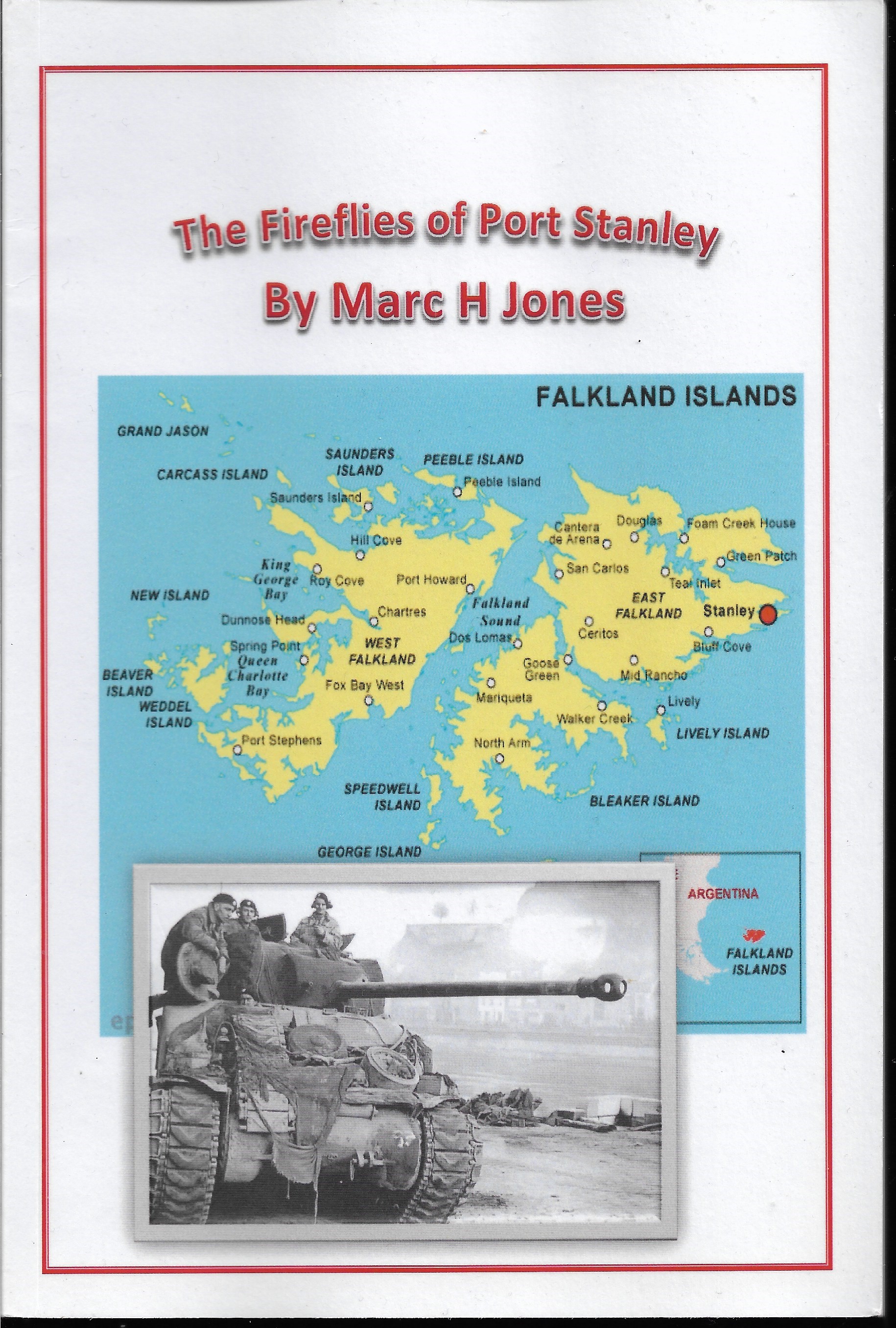
Book Review: The Fireflies of Port Stanley by Marc H Jones

@VictorFrankenstein (319)
United Kingdom

February 17, 2022 12:11pm CST
One of my interests is the Falklands War, which happened when I was a teenager back in 1982. I've read a few non-fiction books about it, by people who were there, but this is the first alternate history book that I've seen about it – or even heard of. So when I saw it advertised on Amazon, I bought it and I've just read it.
I don't think the Falklands War is very well known outside Britain, Argentina and the Falklands, so I'll give a quick potted history before moving on to the actual review:
The Falkland Islands is an archipelago in the South Atlantic, about 300 miles east of South America. It was a British colony at the time of the war (it's now a British Overseas Territory), and had a small population of about 1,800 people, around half of whom lived in the islands' capital, Stanley (often referred to as Port Stanley). This population had lived there since the early 19th Century, and there hadn't been any major problems with the neighbours until 1946, when the government of Argentina started claiming (falsely) that the Falklands actually belonged to them. The Falklands being one of the last British colonies, the UK Foreign Office was actually quite keen to hand over the islands to Argentina, and negotiations to do this went on for years. The obstacle was the population of the islands themselves, who resolutely wanted to stay British – especially given Argentina's tendency towards fascist governments.
The crisis came in 1982. By that time, Argentina was ruled by a fascist military junta, but it was in deep trouble with its own population, due to mismanagement of the economy, corruption, and their habit of kidnapping, torturing and murdering dissidents. The junta decided to distract the attention of the population with a quick war. They must have been delusional, because they convinced themselves that if they invaded with overwhelming force, the British wouldn't fight back. At the time, the Falklands was extremely under-defended, with a small garrison of Royal Marines hardly bigger than platoon-sized, and an under-equipped local militia called the Falkland Islands Defence Force (FIDF). On the morning of the invasion, on 2 April 1982, the defenders consisted of just over 60 Royal Marines, a few sailors, about 25 FIDF members and a couple of extra local volunteers who were ex-Marines. Their weapons were mostly L1A1 semi-automatic rifles, a few Sterling sub-machine guns, a few General Purpose Machine Guns, a small number of barely-effective anti-tank rockets, one broken mortar and no anti-aircraft weapons. The spearhead of the Argentine invasion force consisted of around 700 troops, equipped with helicopters, armoured personnel carriers, mortars and ship-based artillery. So a pretty one-sided fight. The Governor of the islands, Rex Hunt, had received notification from London the day before that an invasion force was on its way – but the Falklands is 8,000 miles away from the UK, so no chance of rapid reinforcement, so they had to fight with just what they had.. Despite the imbalance of forces, the Royal Marines put up a heroic defence, mounting a fighting retreat through the streets of Stanley, and defending Government House for three hours, before being ordered to lay down arms by the Governor, who was trying to avoid loss of life among the Falklanders. The Marines managed to inflict casualties among the invasion force, and somehow avoided sustaining any themselves. It's a battle that's not as well-known as it should be. The Argies seem to have thought that would be the end of it, but of course the British retaliated, assembling a large naval task force to liberate the Falklands. Incidentally, the Argies had repatriated both Rex Hunt and the Royal Marine garrison, and most of the Marines joined the task force and took part in the liberation. But it wasn't an easy process – the Falklanders had to endure ten weeks of occupation, and the campaign to set them free wasn't easy – almost a thousand people were killed in the war.
The reason I've gone into so much detail about what really happened, before moving on to my review about this story of what might have happened is so that the reader can appreciate the repercussions of the very small change that the author makes at the start of the book. The thing about alternate history is that small changes can sometimes have big results.
The story begins in 1955, when a civil servant who's working late on a Friday evening at the UK's Ministry of Defence has to decide what to do with three obsolete World War 2 Sherman Firefly tanks that have been found in a storage depot. He decides to have them scrapped, but throws them into the wrong pigeon hole while he's hurrying out of the office to have a drink. As a result, instead of going to the scrapyard, they're transferred to the Falklands. Several months later, the tanks arrive at Stanley via the regular supply ship, overseen by an Army sergeant who's orders are to hand them over to the commanding officer of the local defence force. So the major in charge of the FIDF is surprised to find himself taking delivery of three tanks (including the ammunition for their armament). He assumes there must be a good reason for it, and that the Governor and Marines must know about it (they don't), so he accepts delivery and the tanks spend the next thirty-seven years parked in the corner of a workshop and ignored, apart from regular servicing.
Having worked in several large organisations, including government organisations, I find the idea of a clerical error leading to three tanks being transferred halfway across the world utterly believable. What I don't find believable is that these Fireflies could have been unloaded from a ship and driven through the streets of Stanley to be stored away without anyone noticing. And you'd think the FIDF commander would have at least casually mentioned it to the Governor or his opposite number in the Marine garrison. But never mind, it's a great idea for a story.
So flash forward to 1 April 1982, and Major Mike Norman, head of the Royal Marine garrison, is driving around preparing his defences and wondering how many of his guys are going to get killed in the coming hours, when he's stopped by an FIDF member who wants to know where he wants the tanks putting. After overcoming his shock that they've actually got these three tanks, still in working order, that he never knew about, Norman realises that they've now got some serious firepower to defend themselves with. The Sherman Firefly was a British improvement on the standard American Sherman, being fitted with a 12 pounder gun that was capable of destroying the German tanks of the 40s. Well obsolete by 1982, of course, but the Argentines didn't have any heavy armour in the initial invasion – just some amphibious armoured personnel carriers (Amtracs) that were good against small arms fire but not against serious artillery.
The defenders are able to scratch together crews for the Fireflies, consisting of FIDF men, Royal Marines and one Canadian volunteer who'd been a tank man in the Korean War, and they're deployed to the most likely invasion routes. Bear in mind that the Argies have no idea that these tanks even exist, so the British are able to take them by surprise, not only destroying all the Amtracs while they're still trying to make it ashore, but sinking three ships that have come in close to the shore to disembark troops. Hundreds of Argies are killed or captured – a complete disaster for their task force.
This still leaves the Falklands in a precarious position though, since the Argentines still have air supremacy and the junta is so desperate for a victory that they start assembling a task force for a second invasion attempt. At the same time, the British government assembles a Royal Navy taskforce to reinforce the Falklands garrison – but they're weeks away from being able to do that. With good planning and a lot of luck, they might be able to fly some paratroopers in.
While this is going on, the diplomatic and political repercussions are slightly different from what happened in the real world. Argentina has become an international laughing stock for their failure to overcome less than 100 defenders, with Chile openly mocking them (and covertly helping the British) and no apparent support forthcoming from any of their South American neighbours or the Soviet Union. On the other hand, the Thatcher government in Britain is hardly any better off, with harsh criticism in Parliament for letting such a situation occur in the first place.
The story ends up coming down to a race between the Argies getting their second invasion force prepared and the British struggling to reinforce the Falklands.
This short novel is self-published, and it does show. It could have done with a bit of editing, as there are spelling mistakes, and also some historical errors, but not enough to spoil my enjoyment. The chapters are quite short, and the narrative is fast-moving. The focus is on the politicians, diplomats and military men involved (mostly real people), and I would have liked to see a bit more from the point of view of the civilian population in the Falklands. It could also have been a bit more balanced in the sense that everything goes right for the British and the Argentines seem to be plagued by a combination of bad luck and incompetence – although to be fair, the Argie military establishment also came across pretty badly in the real war, whereas the British forces worked wonders. All the same, the story could have done with the British suffering some kind of reverse – maybe the Argentines sneaking ashore some special forces to disable the Fireflies, or launching a bombing raid against Stanley, or something of that general nature.
All the same, I found this an enjoyable read, fast-moving and with some touches of humour. And it makes such a change from the usual alternate history scenarios that you see on the bookshelves, most of which seem to be based around World War 2 or the American Civil War. And it doesn't cost much on Amazon, so if you're into alternate history or interested in the Falklands War (or both), this book might be worth your time.
No responses