

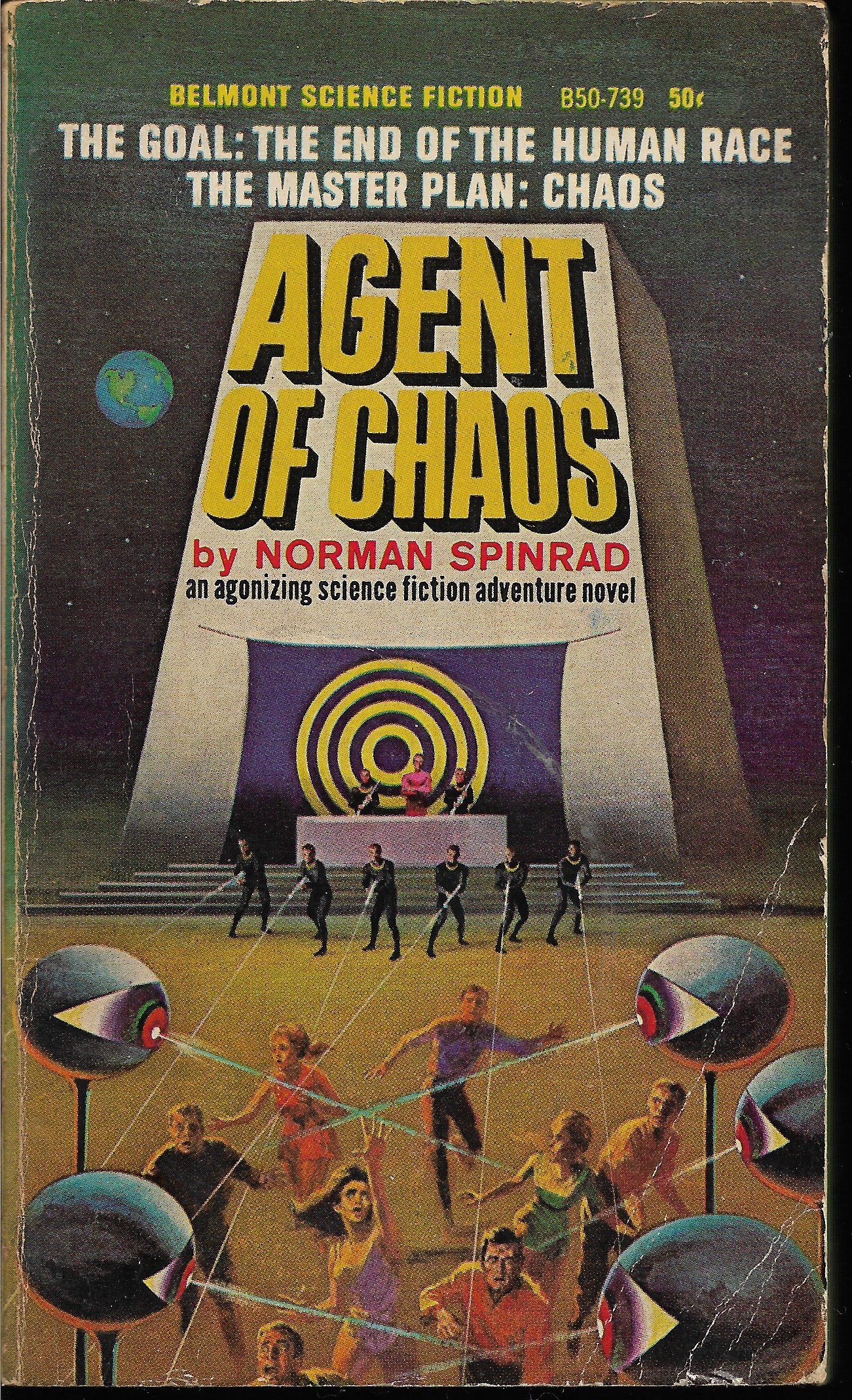
Book Review: Agent of Chaos by Norman Spinrad

@VictorFrankenstein (314)
United Kingdom

May 29, 2022 5:01pm CST
I sometimes buy job lots of books through online marketplaces like eBay and Ebid. It's a good way of getting vintage books - especially old science fiction books - without spending too much money. Some I keep to read, and others I sell on.
This particular book was part of a lot that I bought a couple of weeks ago. I wasn't originally going to read it right away, but the blurb on the back caught my eye and I just had to read it:
"The Scene: Dome One Mars
The terrible dictatorship ruling the planet was the Brotherhood of Assassins, and Boris Johnson, head of the Democratic League was plotting to overthrow the Hegemony and to restore democratic rule."
To any readers who don't happen to be British, the name Boris Johnson may not mean anything, but that happens to be the name of the current Prime Minister of the United Kingdom. So the idea of the hero of a novel having that name made me laugh. It's just a coincidence though, this book was written in 1967.
As is often the case with books of this vintage, the blurb isn't completely accurate - the Hegemony and the Brotherhood of Assassins are two different groups.
The story is set 300 years in the future. Humanity has spread out into space and colonised the Solar System, and all inhabited worlds are under the authority of a unified totalitarian government called the Hegemony. They have almost total control of the population, and only two groups oppose them.
The first group is Boris Johnson's Democratic League, which is relatively small - only a few thousand members out of the billions that the Hegemony rules over. The League has been in existence for about ten years, but struggles to even be noticed.
The other group is the shadowy Brotherhood of Assassins, which has been in existence for about as long as the Hegemony, but whose exact goals and overall strategy remain unknown. They follow the theories of an academic who believed that the natural tendency of any organised society is towards chaos, and that chaos is in fact a desirable state to be worked towards. As followers of this philosophy, the Brotherhood's actions are unpredictable and seemingly random.
At the start of the book, Boris Johnson is leading a large contingent of his comrades in the Democratic League in an attempt to assassinate Coordinator Vladimir Khustov, the head of the Council that runs the Hegemony. The attempt almost succeeds but is thwarted at the last moment by intervention by the Brotherhood of Assassins.
Regrouping, Johnson and his associates attempt two further assassination attempts against members of the Hegemonic Council. What he doesn't know is that his trusted deputy Arkady Duntov is actually an agent for the Brotherhood of Assassins. So he's being spied on and manipulated.
The Brotherhood, headed by the devious, fanatical Robert Ching, is attempting to maximise chaos by playing the League and the Hegemony against each other without letting either side win. The Brotherhood is a very cult-like group, with leaders who are totally dedicated to serving Chaos, and agents like Duntov blindly following their leaders. It acts very much like a religion. Apart from manipulating the politics of the Hegemony, the Brotherhood also has a secret project to develop a faster than light space drive to visit the nearby stars - and when their first interstellar probe returns proof of alien life, this confirms the Brotherhood's belief in a chaotic universe.
Things come to a head when the League attempts a mass assassination of the whole Hegemonic Council, which quickly turns into a fiasco, and the Brotherhood openly moves against both of the other factions.
There are no real heroes in this story. Boris Johnson is a bumbling incompetent who implements overly complex plans, overlooks basic security precautions and doesn't really know what he's fighting for. He's got a vague belief in democracy, but doesn't have a real plan for reforming the political system if his group ever succeeds in overthrowing the Hegemony. He's also willing to get innocent bystanders killed as a result of his activities. He's an instinctive rebel, but not a thinker.
Khustov is the sort of ruthless manipulator who would naturally rise to the top of a dictatorial political system, but he is in some ways an honest villain. He genuinely believes that the Hegemony is a good system, having abolished wars and improved the economic wellbeing of most of the population. He believes a dictatorship is necessary to maintain order, doesn't see the point in individual freedom, and genuinely struggles to understand why anyone would oppose the Hegemony.
Ching has the mentality of a religious fanatic, totally devoted to serving Chaos, but he's also very clever and has a good understanding of the thought processes of his enemies. He believes Chaos will serve the ultimate good of humanity, and always tries to choose a path to maximise chaos, whereas Johnson and Khustov are vying to impose their own versions of order.
There are some interesting ideas in this book, but it's no classic. Norman Spinrad went on to become a writer of some note, but this is an example of his very early work. It's fast moving, never gets boring, and it's worth a read if it comes your way, but it'll never appear on anyone's list of classics.
5 people like this
3 responses

@Deepizzaguy (122313)
• Lake Charles, Louisiana
29 May 22
Thank you for sharing the reviews of the book written by Norman Spinrad.
2 people like this

@snowy22315 (209168)
• United States
14 Jul 22
it sounds like an interesting read for sure.
1 person likes this

@jstory07 (148771)
• Roseburg, Oregon
30 May 22
That book sounds exciting to read. I am going to see if I can find that book in the library.
