

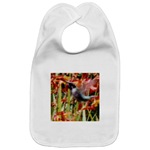
Hummingbird Baby Bib

By birthlady
@birthlady (5609)
United States

November 23, 2006 3:37pm CST
I love hummingbirds, I took this photo at a botanical garden in San Louis Obispo, CA. Baby bib for sale only at my online store, Art by Cathie
http://www.cafepress.com/artbycathie
Shop Now and Take Advantage of Holiday Sales!
Check out my store, then come back and tell me what you think!
Shop now for holidays!
Thank you,
Cathie the birthlady
2 responses

@k3tk3t (3128)
• Philippines
4 Dec 06
me too!! i like them
Here is a link:
http://en.wikipedia.org/wiki/Hummingbird
Hummingbird
From Wikipedia, the free encyclopedia
Hummingbirds are small birds in the family Trochilidae. They are known for their ability to hover in mid-air by rapidly flapping their wings, 15 to 80 times per second (depending on the species). Capable of sustained hovering, the hummingbird has the ability to fly deliberately backwards or vertically, and to maintain position while drinking from flower blossoms. They are named for the characteristic hum made by their wings.
Hummingbirds are attracted to many flowering plants—shrimp plants, Heliconia, bromeliads, verbenas, fuchsias, many penstemons—especially those with red flowers. They feed on the nectar of these plants and are important pollinators, especially of deep-throated flowers. Most species of hummingbird also take insects, especially when feeding young.
The Bee Hummingbird (Mellisuga helenae) is the smallest bird in the world, weighing 1.8 grams (0.06 ounces). A more typical hummingbird, such as the Rufous Hummingbird (Selasphorus rufus), weighs approximately 3 g (0.106 ounces) and has a length of 10-12 cm (3.5-4 inches). The largest hummingbird is the Giant Hummingbird (Patagona gigas), with some individuals weighing as much as 24 grams (0.85 ounces).
Most male hummingbirds take no part in nesting. Most species make a neatly woven cup in a tree branch. Two white eggs are laid, which despite being the smallest of all bird eggs, are in fact large relative to the hummingbird's adult size. Incubation is typically 14-19 days.
Metabolism
With the exception of insects, hummingbirds while in flight have the highest metabolism of all animals, a necessity in order to support the rapid beating of their wings. Their heartbeat can reach as high as 1260 beats per minute, a rate once measured in a Blue-throated hummingbird [1]. They also typically consume more than their own weight in food each day, and to do that they have to visit hundreds of flowers daily. At any given moment, they are only hours away from starving. However, they are capable of slowing down their metabolism at night, or any other time food is not readily available. They enter a hibernation-like state known as torpor. During torpor, the heartrate and rate of breathing are both slowed dramatically (the heartrate to roughly 50-180 beats per minute), reducing their need for food.
Studies of hummingbirds' metabolism are highly relevant to the question of whether a migrating Ruby-throated Hummingbird can cross 800 km (500 miles) of the Gulf of Mexico on a nonstop flight, as field observations suggest it does. This hummingbird, like other birds preparing to migrate, stores up fat to serve as fuel, thereby augmenting its weight by as much as 40 to 50 percent and hence increasing the bird's potential flying time. (Skutch, 1973)
[edit] Range
Hummingbird nest with two chicks in Santa Monica, CAHummingbirds are found only in the Americas, from southern Alaska and Canada to Tierra del Fuego, including the West Indies. The majority of species occur in tropical Central and South America, but several species also breed in temperate areas. Excluding vagrants, sometimes from Cuba or the Bahamas, only the migratory Ruby-throated Hummingbird breeds in eastern North America. The Black-chinned Hummingbird, its close relative and another migrant, is the most widespread and common species in the western United States and Canada.
Most hummingbirds of the U.S. and Canada and southern migrate to warmer climates in the northern winter, though some remain in the warmest coastal regions. Some southern South American forms also move to the tropics.
The Rufous Hummingbird shows an increasing trend to migrate east to winter in the eastern United States, rather than south to Central America, as a result of increasing survival prospects provided by artificial feeders in gardens. In the past, individuals that migrated east would usually die, but now many survive, and their changed migration direction is inherited by their offspring. Provided sufficient food and shelter is available, they are surprisingly hardy, able to tolerate temperatures down to at least -20°C (-4°F).
[edit] Systematics and evolution
A male Costa's Hummingbird, showing its plumage to good effectTraditionally, hummingbirds were placed in the order Apodiformes, which also contains the swifts. In the Sibley-Ahlquist taxonomy, hummingbirds are separated as a new order, Trochiliformes, but this is not well supported by additional evidence.
There are between 325 and 340 species of hummingbird, depending on taxonomic viewpoint, historically divided into two subfamilies, the hermits (subfamily Phaethornithinae, 34 species in six genera), and the typical hummingbirds (subfamily Trochilinae, all the others).
The modern diversity of hummingbirds is thought by evolutionary biologists to have evolved in South America, as the great majority of the species are found there. However, the ancestor of extant hummingbirds may have lived in parts of Europe to what is southern Russia today.
Genetic analysis has indicated that the hummingbird lineage diverged from their closest relatives some 35 million years ago, in the Late Eocene, but fossil evidence is limited. Fossil hummingbirds are known from the Pleistocene of Brazil and the Bahamas - neither of which has been scientifically described -, and there are fossils and subfossils of a few extant species known, but until recently, older fossils had not been securely identifiable as hummingbirds.
Then, in 2004, Dr. Gerald Mayr of the Senckenberg Museum in Frankfurt am Main identified two 30-million-year-old hummingbird fossils and published his results in Nature.[1] The fossils of this primitive hummingbird species, named Eurotrochilus inexpectatus ("unexpected European hummingbird"), had been sitting in a museum drawer in Stuttgart; they had been unearthed in a clay pit at Wiesloch-Frauenweiler, south of Heidelberg, Germany and because it was assumed that hummingbirds never occurred outside the Americas were never believed to be hummingbirds until Mayr took a closer look at them.
Fossils of birds not clearly assignable to either hummingbirds or a related, extinct family, the Jungornithidae, have been found at the Messel pit and in the Caucasus, dating from 40-35 mya, proving that the split between these two lineages indeed occurred at that date. The areas where these early fossils have been found had a climate quite similar to the northern Caribbean or southernmost China during that time. The biggest remaining mystery at the present time is what happened to hummingbirds in the roughly 25 million years between the primitive Eurotrochilus and the modern fossils. The astounding morphological adaptations, the decrease in size and the dispersal to the Americas and extinction in Eurasia all occurred during in this timespan. DNA-DNA hybridization results (Bleiweiss et al, 1994) suggest that the main radiation of South American hummingbirds at least partly took place in the Miocene, some 12-13 mya, durng the uplifting of the northern Andes.
1 person likes this