

space flight

By kaniam
@kaniam (582)
India

December 27, 2006 11:24am CST
Supernovae (the plural of supernova) are extremely important for understanding our Galaxy. They heat up the interstellar medium, distribute heavy elements throughout the Galaxy, and accelerate cosmic rays. But just what is a supernova? And is there more than one type?
Indeed, there seems to be two distinct types of supernovae -- those which occur for a single massive star and those which occur because of mass transfer onto a white dwarf in a binary system. As you will see, however, it is only what gets the process started toward the explosion which differs between the two types.
Supernovae from Single, Massive Stars
The Life Cycle of a Massive Star
Stars which are 8 times or more massive than our Sun end their lives in a most spectacular way; they go supernova. A supernova explosion will occur when there is no longer enough fuel for the fusion process in the core of the star to create an outward pressure which combats the inward gravitational pull of the star's great mass. First, the star will swell into a red supergiant...at least on the outside. On the inside, the core yields to gravity and begins shrinking. As it shrinks, it grows hotter and denser. A new series of nuclear reactions begin to occur....temporarily halting the collapse of the core... but alas, it is only temporary. When the core contains essentially just iron, it has nothing left to fuse (because of iron's nuclear structure, it does not permit its atoms to fuse into heavier elements). Fusion in the core ceases. In less than a second, the star begins the final phase of gravitational collapse. The core temperature rises to over 100 billion degrees as the iron atoms are crushed together. The repulsive force between the nuclei overcomes the force of gravity. So the core compresses, but then recoils. The energy of the recoil is transferred to the envelope of the star, which then expodes and produces a shock wave. As the shock encounters material in the star's outer layers, the material is heated, fusing to form new elements and radioactive isotopes. The shock then propels the matter out into space. The material that is exploded away from the star is now known as a supernova remnant.
Cygnus Loop in X-rays
Crab Nebula in X-rays
All that remains of the original star is a small, super-dense core composed almost entirely of neutrons -- a neutron star. Or, if the original star was very massive indeed (say 15 or more times the mass of our Sun), even the neutrons cannot survive the core collapse...and a black hole forms.
The hot material given off by the supernova, the radioactive isotopes, and the free electrons moving in the strong magnetic field of the neutron star... all of these things produce X-rays and gamma rays. These high energy photons are used by astrophysicists studying the phenomena of neutron stars and supernovae.
A White Dwarf Goes Thermonuclear
Another type of supernova involves the sudden explosion of a white dwarf star in a binary star system. A white dwarf is the endpoint for stars of up about 5 times that of the Sun. The remaining white dwarf has a mass less than 1.4 times the mass of the Sun, and is about the size of the Earth.
A white dwarf star in a binary star system will draw material off its companion star if they are close to each other. This is due to the strong gravitational pull of an object as dense as a white dwarf.
Should the in-falling matter from the companion star cause the white dwarf to approach a mass of 1.4 times that of the Sun (a mass called the Chandrasekhar limit after the scientist who discovered it), the pressure at the center will exceed the threshold for the carbon and oxygen nuclei to start to fuse uncontrollably. This results in a thermonuclear detonation of the entire star. Nothing is left behind, except whatever elements were left over from the white dwarf or forged in the supernova blast. Among the new elements is radioactive nickel, which liberates huge amounts of energy, including visible light. The evolution of these supernovae tend to all be similar.
Neutron Stars
Neutron stars are about 20 km in diameter and have the mass of about 1.4 times that of our Sun. This means that a neutron star is so dense that on Earth, one teaspoonful would weigh a billion tons! Because of its small size and high density, a neutron star possesses a surface gravitational field about 2 x 10¹¹ times that of Earth. Neutron stars can also have magnetic fields a million times stronger than the strongest magnetic fields produced on Earth.
Neutron stars are one of the possible ends for a star. They result from massive stars which have mass greater than 4 to 8 times that of our sun. After these stars have finished burning their nuclear fuel, they undergo a supernova explosion. This explosion blows off the outer layers of a star into a beautiful supernova remnant. The central region of the star collapses under gravity. It collapses so much that protons and electrons combine to form neutrons. Hence the name "neutron star".
Neutron stars may appear in supernova remnants, as isolated objects, or in binary systems. One neutron star is thought to have planets. When a neutron star is in a binary system, astronomers are able to measure its mass. From a number of such binaries seen with radio or X-ray telescopes, the neutron star mass has been found to be close to have masses of about 1.4 times the mass of the Sun. For binary systems containing an unknown object, this information helps distinguish whether the object is a neutron star or a black hole, since black holes are more massive than neutron stars.
What is a Pulsar and What Makes it Pulse?
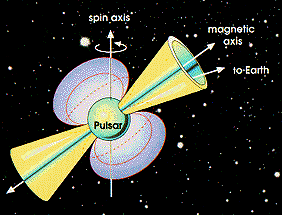
Simply put, pulsars are rotating neutron stars. And pulsars pulse because they rotate!
A diagram of a pulsar, showing its rotation axis
and its magnetic axis
Pulsars were first discovered in late 1967 by graduate student Jocelyn Bell Burnell as radio sources that blink on and off at a constant frequency. Now we observe the brightest ones at almost every wavelength of light. Pulsars are spinning neutron stars that have jets of particles moving almost at the speed of light streaming out above their magnetic poles. These jets produce very powerful beams of light. For a similar reason that "true north" and "magnetic north" are different on Earth, the magnetic and rotational axes of a pulsar are also misaligned. Therefore, the beams of light from the jets sweep around as the pulsar rotates, just as the spotlight in a lighthouse does. Like a ship in the ocean that sees only regular flashes of light, we see pulsars turn on and off as the beam sweeps over the Earth. Neutron stars for which we see such pulses are called "pulsars", or sometimes "spin-powered pulsars," indicating that the source of energy is the rotation of the neutron star.
X-ray Observations of Pulsars
Some pulsars also emit X-rays.
Below, we see the famous Crab Nebula, an undisputed example of a neutron star formed during a supernova explosion. The supernova itself was observed in 1054 A.D. These images are from the Einstein X-ray observatory. They show the diffuse emission of the Crab Nebula surrounding the bright pulsar in both the "on" and "off" states, i.e. when the magnetic pole is "in" and "out" of the line-of-sight from Earth.
Crab Pulsar "On" Crab Pulsar "Off"
A very different type of pulsar is seen by X-ray telescopes in some X-ray binaries. In this case, a neutron star and a normal star form the binary system. The strong gravitational force from the neutron star pulls material from the normal star. The material is funneled onto the neutron star at its magentic poles. In this process, called accretion, the material becomes so hot that it produces X-rays. The pulses of X-rays are seen when the hot spots on the spinning neutron star rotate through our line of sight from Earth. These pulsars are sometimes called "accetion-powered pulsars" to distinguish them from the spin-powered pulsars.
No responses
