

Hawking's Life history

@abhinavkumar1987 (177)
India

2 responses

@DarlingGirl (745)
• United States
13 Apr 08
Your best bet is at his official website, located at:
http://www.hawking.org.uk/info/mindex.html
I know there was a response above that details his life, but you should really take it from the horse's mouth, so to speak!

@smbilalshah (1316)
• Pakistan
8 Feb 07
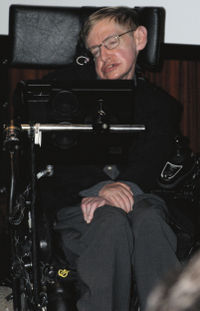
Stephen William Hawking, CH, CBE, FRS (born 8 January 1942) is an English theoretical physicist. Hawking is the Lucasian Professor of Mathematics at the University of Cambridge, and a Fellow of Gonville and Caius College, Cambridge. He is known for his contributions to the fields of cosmology and quantum gravity, especially in the context of black holes, and his popular works in which he discusses his own theories and cosmology in general. These include the runaway popular science bestseller A Brief History of Time, which stayed on the London Sunday Times bestseller list for a record-breaking 37 weeks.
His two most important scientific contributions up until now have been providing, with Roger Penrose, theorems regarding singularities in the framework of general relativity, and the theoretical discovery that black holes emit radiation, which is today known as Hawking radiation (or sometimes as Bekenstein-Hawking radiation).
His scientific career spans more than forty years. His books and public appearances have made him an academic celebrity and world renowned physical theorist.
Stephen William Hawking was born on January 8, 1942 to Frank Hawking, a research biologist, and Isobel Hawking. He had two younger sisters, Philippa and Mary, and an adopted brother, Edward.
Though Hawking's parents had their home in North London, they relocated to Oxford while Isobel was pregnant with Stephen, desiring a safer location for the birth of their first child (London was under attack at the time by the Luftwaffe).[citation needed] After Hawking was born, the family moved back to London, where his father headed the division of parasitology at the National Institute for Medical Research.
In 1950, Hawking and his family moved to St Albans in Hertfordshire where, from the age of 11, he attended St Albans School, where he was a good but not exceptional student. He maintains his connection with the school, giving his name to one of the four houses and to an extra-curricular science lecture series. He has visited to deliver one of the lectures and has also granted a lengthy interview to pupils working on the school magazine, The Albanian.
He was always interested in science. He enrolled at University College, Oxford with the intent of studying mathematics, but after his first year was persuaded by his father to switch to physics. His interests during this time were in thermodynamics, relativity, and quantum mechanics. His physics tutor, Robert Berman, later said in the New York Times Magazine, "It was only necessary for him to know that something could be done, and he could do it without looking to see how other people did it. ... He didn't have very many books, and he didn't take notes. Of course, his mind was completely different from all of his contemporaries." He was passing with his fellow students, but his unimpressive study habits gave him a final examination score on the borderline between first and second class honours, making an oral examination necessary. Berman said of the oral examination, "And of course the examiners then were intelligent enough to realise they were talking to someone far more clever than most of themselves."After receiving his B.A. degree at Oxford University in 1962, he stayed to study astronomy, deciding to leave when he found that studying sunspots, which was all the observatory was equipped for, didn't appeal to him and that he was more interested in theory than in observation.[3] He left Oxford for Trinity Hall, Cambridge, where he engaged in the study of theoretical astronomy and cosmology.
Almost as soon as he arrived at Cambridge, he started developing symptoms of Amyotrophic Lateral Sclerosis, a type of motor neuron disease which would cost him the loss of almost all neuromuscular control. During his first two years at Cambridge, he did not distinguish himself, but, after the disease had stabilised and with the help of his doctoral tutor, Dennis William Sciama, he returned to working on his Ph.D.[3] Stephen revealed that he did not see much point in obtaining a doctorate if he was to die soon. Hawking later said that the real turning point was his 1965 marriage to Jane Wilde, a language student.
Jane, Hawking's first wife,[citation needed] with whom he had three children, cared for him until 1991 when the couple separated, reportedly, due to the pressures of fame, his increasing disability, and an affair Hawking began with one of his nurses, Elaine Mason. Hawking and Elaine Mason were married in 1995. (Elaine Mason's first husband, David Mason, had designed the first version of Hawking's talking computer.) In October 2006, the Hawkings filed for divorce.
In 1999, Jane Hawking published a memoir, Music to Move the Stars, detailing her own long-term relationship with a family friend whom she later married. Hawking's daughter Lucy Hawking is a novelist. Their son Robert Hawking emigrated to the United States, married, and has one child, George Edward Hawking.
Hawking was elected as one of the youngest Fellows of the Royal Society in 1974, was created a Commander of the Order of the British Empire in 1982, and became a Companion of Honour in 1989. Prof. Hawking is a member of the Board of Sponsors of The Bulletin of the Atomic Scientists.
In January 2007 on his 65th birthday, Hawking announced his intention to travel to space on board a Virgin Galactic spacecraft, sponsored by the aerospace company's owner Richard Branson
