

Roadside wild flowers

By Fleur
@Fleura (35007)
United Kingdom

June 21, 2016 5:02am CST
For a lot of wildlife the development of a new road is something of a disaster as it cuts habitats into fragments and makes it more difficult, frightening and dangerous for animals to travel about. The traffic noise also interferes with birdsong. But for plants it can be beneficial as the associated wide verges on fast roads provide a relatively undisturbed refuge from intensive agriculture or development. The slipstream of passing traffic can also distribute seeds along the roadside.
At one time wild flowers like primroses, violets and bluebells were very common in the countryside, but the development of railways meant they could be picked and sold in bunches in the towns, while day-trippers were able to come into the countryside where they could profligately gather bunches of flowers which then quickly faded and were tossed aside. This was so widespread that the once-common flowers actually became rare and gathering wildflowers had to be banned.
That, together with changes in agricultural practices favouring monoculture of one type of grass, reduced the habitat for wild plants, and made these flowers a rarity but now they are reclaiming the roadside verges. Around here many verges, even alongside very busy roads, are full of primroses, violets and cowslips in springtime.
A major traffic roundabout less than a mile from our house seems to be a hotspot for orchids, as well as putting on a good show of many other wild flowers. I first noticed them a few years ago – and was horrified when the county council promptly mowed the verges and also dug up a section to make hard standing for vehicles.
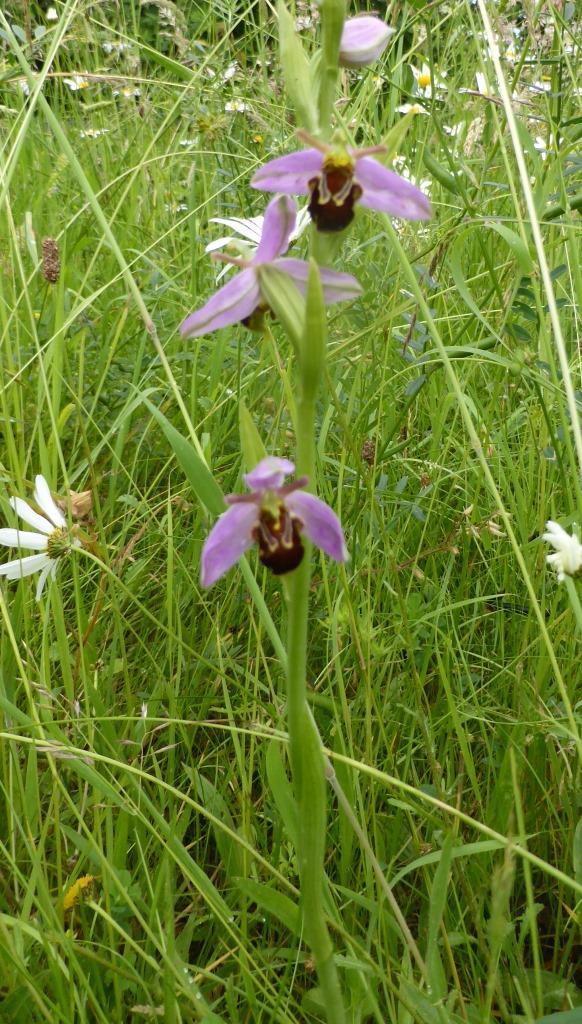
After that I have been watching for them to recover and didn’t see any until last week, when I was delighted to see some flowers as I drove past. I returned later with my camera and note pad for a better look, and was stunned to find about a dozen spotted orchids, more than 250 pyramidal orchids and even a rare bee orchid, the first I’ve ever seen!
It made me laugh that the wildlife trusts produce a leaflet on the best places to see orchids in our three neighbouring counties and people may be travelling for miles to look for them in the recommended places, quite probably driving right past this very place soon after leaving home!
Apparently some verges can be designated as ‘road verge nature reserves’ – I wonder whether this one can be?
I tried to upload a powerpoint file with pictures of the three orchid species but it wouldn't let me - anyone know why? Meanwhile here's the bee orchid instead.
All rights reserved. © Text and image copyright Fleur 2016.
11 people like this
11 responses


@changjiangzhibin89 (17239)
• China
22 Jun 16
It is a blessing in disguise for the wild plants and wild flowers.They not only survive the developement of a new road ,but thrive on the roadside verges.I have never seen the bee orchid ,is it fragrant ?
1 person likes this


@JamesHxstatic (29410)
• Eugene, Oregon
23 Jun 16
I had no idea that orchids grow by the roadside. Are they different than the tropical variety?
1 person likes this


@JohnRoberts (109841)
• Los Angeles, California
21 Jun 16
If you drive along roads in Kansas, there really are banks of sunflowers alongside. In California, you can see poppies.
1 person likes this


@responsiveme (22923)
• India
21 Jun 16
What a beautiful picture. Development does damage nature. In my case it was the building of a four lane national highway ,which is very necessary. But a lot of majestic and really old trees had to be cut down. That was seven years ago and it was losing old friends.
Now other trees have been replanted by the roadside by the social forestry department though the beautiful shady avenue of green is still a long way off.
1 person likes this

@rachz_kisses (3838)
• Philippines
22 Jun 16
That's a rare one. I don't see bee orchid that often. Lucky for you.
1 person likes this
