

Art Study - Bernard Gribble - Scapa Flow

@arthurchappell (44941)
Preston, England

January 21, 2017 10:41am CST
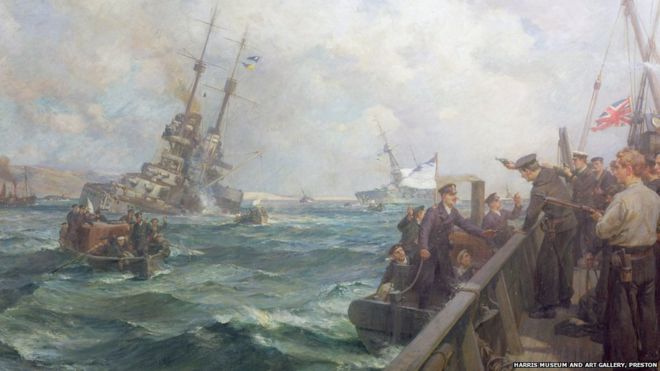
A formidable action packed painting based on the artist’s personal eye-witnessed account of the senseless scuppering of the German naval fleet at Scapa Flow, off the Scottish Orkney Islands in 1919, a year after the First World War ended.
After the Armistice of November 11th 1918, there was the huge question of what was to become of the captured German military vessels and hardware, especially the German navy.
The U-Boats were taken right away for dismantling but the surface fleet proved more problematic. The Allies wanted to send the ships to a neutral European port but no country could be found who were willing to co-operate so the 74 battleships, cruisers, frigates and other gun ships were sent temporarily to Scapa Flow until their fate could be decided.
Command was given to small care-taking German crews, with British warships guarding over them. The Germans were totally demoralized first by the humiliation of losing the war, and then by the deprivations of the containment of their fleet. They had meagre food rations, mostly sent from Germany by a very poor postal service. The sailors were desperately catching fish and seagulls to ease their diets. The men were also confined to their own ships, and denied communication with the crews of surrounding vessels.
Though the Allies planned to have the ships decommissioned and scrapped the fear was that the ships would be commandeered and distributed for refits to build up the Allied navies while Germany was to be left with virtually nothing. Admiral Ludwig Von Reuter, who was in charge of the fleet for the Germans ordered the ships to be scuttled, using flag and lighting signals between the ships. On the 21st June 1919, plugs were pulled, and hulls were smashed and drilled out from within the ships. The crews abandoned the ships by lifeboat.
The British were shocked to see the ships suddenly starting to go down, and rushed to try to force the Germans to return to the stricken vessels. Many lifeboats were refused permission to reach the British ships, and nine German navy men were shot, the last fatalities of a war seven months finished. A few ships were boarded and the British were able to beach them, but most of the fleet was lost. Reuter and many other men involved in the scuttling were made prisoners of war until late 1920. Wrecks from the sinking that were beyond salvage have led to Scapa Flow becoming a very popular region for diving. They have made the area a true maritime ship’s graveyard.
Bernard Gribble was present as a civilian observer and his painting was started soon after the events, capturing the slowly sinking vessels and the drama of the British threatening approaching lifeboats with shooting in spectacular detail on a huge canvas. It is now on display in Preston’s Harris Centre art gallery and museum.
The painting – Scapa Flow by Bernard Gribble 1920
Arthur Chappell
http://ichef.bbci.co.uk/news/660/media/images/68001000/jpg/_68001474_scapaflow.jpg
5 people like this
3 responses

@celticeagle (189820)
• Boise, Idaho
22 Jan 17
That is a great painting. I like paintings that have a lot going on. This is a great illustration of the story.
1 person likes this


@RasmaSandra (97957)
• Daytona Beach, Florida
21 Jan 17
That is a fascinating story. Thanks for sharing. Awesome artwork.
1 person likes this
