

Is It Wrong To Admire An Infectious Disease?

By freak369
@freak369 (5112)
United States

June 6, 2017 12:21pm CST
That title might need some explanation. The disease I'm referring to is Spongiform Encephalitis but most people will probably know it as Mad Cow Disease (BSE / Bovine Spongiform Encephalitis). As of this moment there's no cure for the human version; Creutzfeldt Jakob Disease is an offshoot of human TSE and is something a person is born with. It can manifest at an early age or sit dormant for years. The only way to diagnose it is by looking at the prions to see if there are any defects or oddly shapes protein cells. It's a crap shoot because the cells can be predisposed to CJD and not manifest or be detected for years.
The symptoms of TSE and CJD are the same however the human form can be passed on from mother to child (pre-birth). Symptoms include fatigue, manic outbursts, hallucinations, vomiting blood, sleeplessness, irritability and muscle spasms. That's the short list but those are the usual suspects across the board for prion based brain diseases. Any time prion disease is discussed you can bet that Kuru will be mentioned. The one thing that they all have in common is the end result – death.
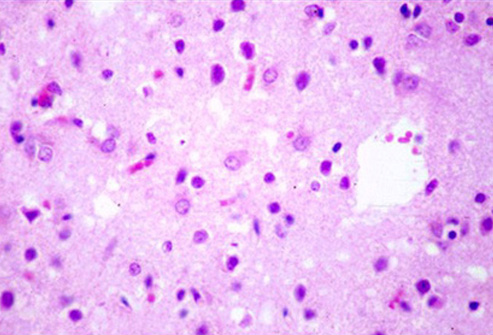
Kuru is almost always connected to ceremonial cannibalism; while a taboo subject in most parts of the world it is something that has been happening for centuries in New Guinea. The frequency of ceremonial cannibalism has decreased slightly since it was brought to light. Younger members of families that left the fold in search of a modern life returned with researchers that wanted to observe the tribes and help educate them about the dangers of eating human flesh – especially the brain.
Why is it an admirable disease? It is unstoppable. There are drug protocols for humans that can slow down the signs of infection but there is no cure. Why? The deformed prions might not be present one day and the next they magically appear. Chasing the symptoms to make a diagnoses isn't always effective to prevent any of the prion based diseases from entering a food chain or being passed to humans via beef, sheep, swine or fowl.
Photo: Kuru slide via MedScape Medical Research
3 people like this
2 responses

@TiarasOceanView (70020)
• United States
6 Jun 17
These fascinating diseases will live long after humans will be gone. I can see why you are saying it is admirable.
1 person likes this
@TiarasOceanView (70020)
• United States
7 Jun 17
@freak369 Yes the bacteria is nearly indestructible.