

The seven kingdoms of old England

By John Welford
@indexer (4852)
Leicester, England

October 13, 2018 10:40am CST
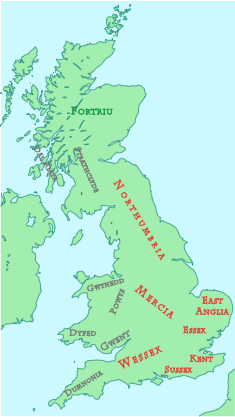
If you have ever wondered about the names of the English counties Essex and Sussex, not to mention the region of Wessex as beloved by the novelist Thomas Hardy, you might be interested to know that they are not as “sexy” as might be imagined. They were all ruled by their own kings many centuries ago, and the names are relics of those times.
The seven kingdoms were established by the Germanic tribes that moved into what is now England as the Roman Empire faded away and left a power vacuum. In 410 AD the last Roman troops departed and left the “Romano-British” to fend for themselves.
One account states that in about 450 a chieftain named Vortigern invited two brothers named Hengist and Horsa to bring an army to Britain to defend the British against the Picts who were invading from the far north. However, once this threat had been seen off the invited mercenaries decided not to go home but to settle in what became the Kingdom of Kent in the south-east corner of Britain.
Not long after, settlers from Saxony (modern Germany) arrived on the south coast and spread across a wide area, eventually creating the kingdoms of the East Saxons (Essex) South Saxons (Sussex) and West Saxons (Wessex).
Other settlers, who are generally referred to as Angles, arrived in what is now Norfolk and Suffolk, leading to the founding of the Kingdom of East Anglia. Despite their relative unimportance in the overall history of the country, it was the Angles who would eventually give their name to the whole country south of Scotland and east of Wales, namely England.
The last kingdoms to be established were those of Mercia (the Midlands) and Northumbria (north of the River Humber).
The seven kingdoms that emerged in the 5th to 7th centuries are generally known as the Heptarchy. They would remain in place for about 200 years until Danish invaders put an end to the eastern kingdoms and were only kept from taking over the whole of England by the obduracy of Wessex.
During the period of the Heptarchy the kings spent much of their time warring against each other. Their aim was not so much to absorb each others’ territory as to establish themselves as ‘senior king’. The king who achieved temporary domination was known as the Bretwalda which translated as ‘ruler of Britain’ but it did not signify anything other than that the holder was more powerful than the other kings and could make demands on them. The title was not hereditary, and any other king might become Bretwalda when the holder died or was defeated in battle.
During the period of the Heptarchy only Essax failed to produce a Bretwalda at some time or another. The only Bretwalda of the 8th century who came close to being ruler of all England in any meaningful sense was Offa of Mercia (757-96), who used the title ‘King of the English’ but was never completely dominant.
The last Bretwalda was Egbert of Wessex (802-39), who can be titled the first true ‘King of the English’, in that he united Wessex and Kent (Sussex, Essex and East Anglia had already been absorbed by their neighbours) and then conquered Mercia and received the formal submission of Northumbria. However, he could not hold on to his gains for long and Mercia again became independent.
The end of the Heptarchy came with the Danish invasions of the 9th century that left Wessex, led by Egbert’s grandson Alfred, as the sole bastion of the English in resisting the onslaught.
4 people like this
3 responses

@Courage7 (19626)
• United States
13 Oct 18
Fascinating thanks John. A bunch of marauding invaders.
Where did the Picts come from exactly? I had heard about them, but just wondering where they originated from and what were they about? The North you say they came from?
I know I can look it up but...
1 person likes this


@JudyEv (382412)
• Rockingham, Australia
14 Oct 18
This is really interesting. There isn't a 'Wessex' county now though, is there?

@FourWalls (86829)
• United States
13 Oct 18
How fascinating! Thank you for the information about the history of the names and the monarchy.
