

The man who should really have got the credit for innoculation

By John Welford
@indexer (4852)
Leicester, England

August 19, 2019 6:33am CST
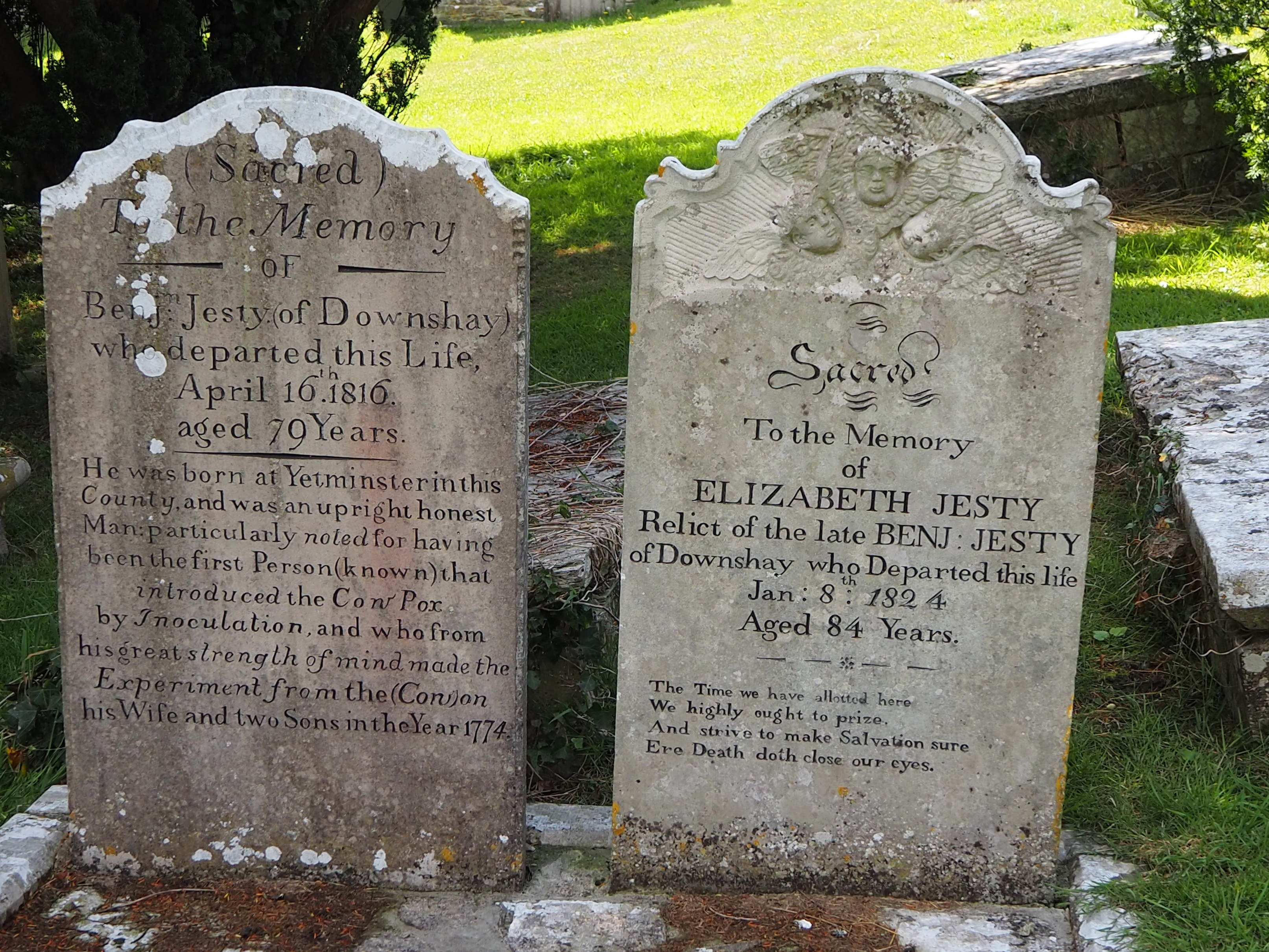
These are the gravestones of Benjamin Jesty and his wife Elizabeth, in the churchyard at Worth Matravers, Dorset.
The credit for innoculation (or vaccination), which is the use of a small quantity of disease cells to encourage the body to produce antibodies that will then be able to resist a much larger infection later on, has usually been given to Edward Jenner (1749-1823), a doctor from Gloucestershire.
However, 22 years before Jenner announced his discovery, Benjamin Jesty had carried out the experiment that is detailed on his gravestone. Jesty's lack of recognition in the scientific world was the result partly of his lack of knowledge of how to claim such recognition and partly from the fact that he was a humble farmer and not a trained medical practitioner.
Jesty had noticed that his milkmaids (and those of fellow farmers) always had smooth, unblemished skin because they never fell victim to smallpox. He deduced that this might be because they were constantly exposed to cowpox, which was the animal form of the disease.
His experiment consisted of scratching the skin of his wife and sons and smearing a small quantity of pus from an infected cow's udder into the scratch.
Although his wife suffered a serious infection - probably from blood poisoning, which was hardly surprising - the two boys showed no ill-effects and did not catch smallpox when an outbreak of the disease later swept the area.
Benjamin Jesty later applied the technique to more than 200 local people, with great success.
It has always amused me that this gravestone waxes lyrical about Jesty's "great strength of mind" but says nothing about that of his family members!
1 person likes this
1 response

@JudyEv (382337)
• Rockingham, Australia
19 Aug 19
The term 'relict of the late such and such' always amuses me. It's not a phrase that used any more - at least I've never seen it.
