

Dumb Ol Yellow Hair

By Four Walls
@FourWalls (86940)
United States

October 5, 2021 11:42pm CST
The Lakota called him “Yellow Hair.”
We call him George Armstrong Custer.
My major visit in Montana (other than looking for Frank Zappa’s crop of dental floss  ) was to Little Bighorn Battlefield, also known as “Custer’s Last Stand.”
The park is on the site of the battle, where fewer than 300 soldiers thought they could overtake a couple of thousand of Lakota and Cheyenne warriors.
If you know U.S. history, you know that didn’t end very well for “Yellow Hair.”
Interestingly enough, the informational displays include a segment showing Custer smoking a peace pipe with Stone Forehead, the keeper of the sacred arrow for the Cheyenne, in 1869. Custer swore he’d never so much as raise his gun to point it at another Cheyenne as long as he lived. Stone Forehead gave an ominous warning: “If you are acting treacherously toward us, sometime you and your whole command will be killed.”
Sadly, the Lakota won the battle but lost the war. Custer’s “mission” was to move the defiant Indians onto a reservation because gold had been discovered in the Dakota territory Black Hills region. The U.S. government offered the tribe six million for the land, but the spiritual leader of the Lakota, Sitting Bull, had already had enough of the government breaking treaties. (Or, as it’s put in the film Billy Jack, “The government’s entered into 3,500 treaties with the Indians to date, and they’ve broken 3,499 of them.”)
The newspaper accounts of the debacle screamed about the “savages” who slaughtered and mutilated the entire 7th Cavalry division that Custer led to the slaughter….I mean, “the brave troops.”
After the battle the Lakota did a victory dance, thanking the Great Spirit for their victory over “Yellow Hair.”
But there were more troops than Lakota, and soon enough the government showed up in force to do to the Lakota what they’d done to the Cherokee in North Carolina and the Seminole in Florida: take the land, no matter how many they had to kill to get it.
Little Bighorn (if you’re wondering, the name comes from the river Custer crossed over on his way to death and infamy was the Little Bighorn, a tributary of the Bighorn River), in the long run, was a disaster for both sides.
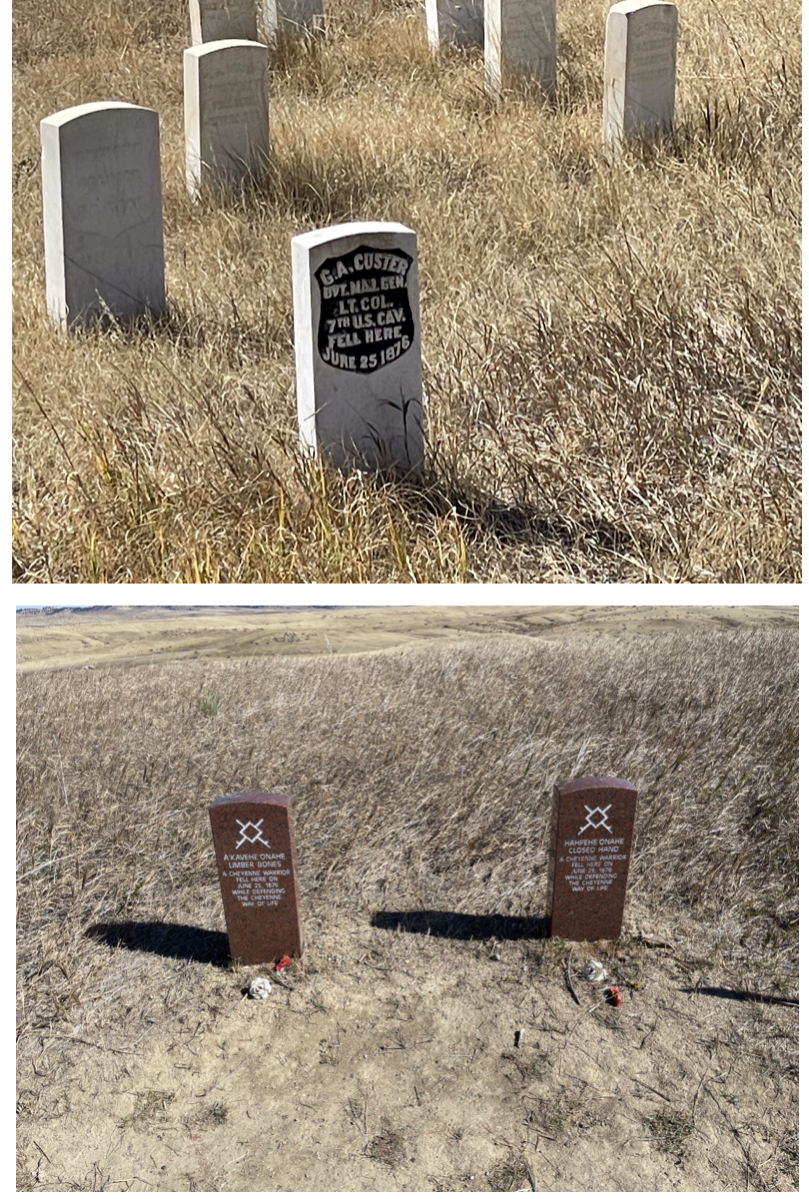
Throughout the landscape you’ll see white markers that look like headstones. They show were Custer’s men fell in the battle. The largest concentration is on what’s called “Last Stand Hill,” where Custer and his brother and about 40 others died. Since 1999 the National Park Service has been working with Lakota historians to place markers (red markers, to distinguish from the white markers of Custer’s men) where the Indian warriors were killed. That has proved to be difficult, given that the Lakota removed their dead immediately after the battle ended; however, no one in the U.S. Army knew about the battle until the scene was discovered two days later.
Still, it is nice to see that they are acknowledging that the Lakota tribe was fighting to preserve their land and way of life from an invading force, too.
PHOTOS:
(Top) The marker showing where Custer fell in the Battle of Little Bighorn.
(Bottom) Markers for Closed Hand and Limber Bones, two Cheyenne warriors killed in the battle.
) was to Little Bighorn Battlefield, also known as “Custer’s Last Stand.”
The park is on the site of the battle, where fewer than 300 soldiers thought they could overtake a couple of thousand of Lakota and Cheyenne warriors.
If you know U.S. history, you know that didn’t end very well for “Yellow Hair.”
Interestingly enough, the informational displays include a segment showing Custer smoking a peace pipe with Stone Forehead, the keeper of the sacred arrow for the Cheyenne, in 1869. Custer swore he’d never so much as raise his gun to point it at another Cheyenne as long as he lived. Stone Forehead gave an ominous warning: “If you are acting treacherously toward us, sometime you and your whole command will be killed.”
Sadly, the Lakota won the battle but lost the war. Custer’s “mission” was to move the defiant Indians onto a reservation because gold had been discovered in the Dakota territory Black Hills region. The U.S. government offered the tribe six million for the land, but the spiritual leader of the Lakota, Sitting Bull, had already had enough of the government breaking treaties. (Or, as it’s put in the film Billy Jack, “The government’s entered into 3,500 treaties with the Indians to date, and they’ve broken 3,499 of them.”)
The newspaper accounts of the debacle screamed about the “savages” who slaughtered and mutilated the entire 7th Cavalry division that Custer led to the slaughter….I mean, “the brave troops.”
After the battle the Lakota did a victory dance, thanking the Great Spirit for their victory over “Yellow Hair.”
But there were more troops than Lakota, and soon enough the government showed up in force to do to the Lakota what they’d done to the Cherokee in North Carolina and the Seminole in Florida: take the land, no matter how many they had to kill to get it.
Little Bighorn (if you’re wondering, the name comes from the river Custer crossed over on his way to death and infamy was the Little Bighorn, a tributary of the Bighorn River), in the long run, was a disaster for both sides.
Throughout the landscape you’ll see white markers that look like headstones. They show were Custer’s men fell in the battle. The largest concentration is on what’s called “Last Stand Hill,” where Custer and his brother and about 40 others died. Since 1999 the National Park Service has been working with Lakota historians to place markers (red markers, to distinguish from the white markers of Custer’s men) where the Indian warriors were killed. That has proved to be difficult, given that the Lakota removed their dead immediately after the battle ended; however, no one in the U.S. Army knew about the battle until the scene was discovered two days later.
Still, it is nice to see that they are acknowledging that the Lakota tribe was fighting to preserve their land and way of life from an invading force, too.
PHOTOS:
(Top) The marker showing where Custer fell in the Battle of Little Bighorn.
(Bottom) Markers for Closed Hand and Limber Bones, two Cheyenne warriors killed in the battle.
) was to Little Bighorn Battlefield, also known as “Custer’s Last Stand.”
The park is on the site of the battle, where fewer than 300 soldiers thought they could overtake a couple of thousand of Lakota and Cheyenne warriors.
If you know U.S. history, you know that didn’t end very well for “Yellow Hair.”
Interestingly enough, the informational displays include a segment showing Custer smoking a peace pipe with Stone Forehead, the keeper of the sacred arrow for the Cheyenne, in 1869. Custer swore he’d never so much as raise his gun to point it at another Cheyenne as long as he lived. Stone Forehead gave an ominous warning: “If you are acting treacherously toward us, sometime you and your whole command will be killed.”
Sadly, the Lakota won the battle but lost the war. Custer’s “mission” was to move the defiant Indians onto a reservation because gold had been discovered in the Dakota territory Black Hills region. The U.S. government offered the tribe six million for the land, but the spiritual leader of the Lakota, Sitting Bull, had already had enough of the government breaking treaties. (Or, as it’s put in the film Billy Jack, “The government’s entered into 3,500 treaties with the Indians to date, and they’ve broken 3,499 of them.”)
The newspaper accounts of the debacle screamed about the “savages” who slaughtered and mutilated the entire 7th Cavalry division that Custer led to the slaughter….I mean, “the brave troops.”
After the battle the Lakota did a victory dance, thanking the Great Spirit for their victory over “Yellow Hair.”
But there were more troops than Lakota, and soon enough the government showed up in force to do to the Lakota what they’d done to the Cherokee in North Carolina and the Seminole in Florida: take the land, no matter how many they had to kill to get it.
Little Bighorn (if you’re wondering, the name comes from the river Custer crossed over on his way to death and infamy was the Little Bighorn, a tributary of the Bighorn River), in the long run, was a disaster for both sides.
Throughout the landscape you’ll see white markers that look like headstones. They show were Custer’s men fell in the battle. The largest concentration is on what’s called “Last Stand Hill,” where Custer and his brother and about 40 others died. Since 1999 the National Park Service has been working with Lakota historians to place markers (red markers, to distinguish from the white markers of Custer’s men) where the Indian warriors were killed. That has proved to be difficult, given that the Lakota removed their dead immediately after the battle ended; however, no one in the U.S. Army knew about the battle until the scene was discovered two days later.
Still, it is nice to see that they are acknowledging that the Lakota tribe was fighting to preserve their land and way of life from an invading force, too.
PHOTOS:
(Top) The marker showing where Custer fell in the Battle of Little Bighorn.
(Bottom) Markers for Closed Hand and Limber Bones, two Cheyenne warriors killed in the battle.9 people like this
6 responses

@sallypup (69254)
• Centralia, Washington
6 Oct 21
I visited that battleground. Honestly, I don't care to return. Something smacked me there. Something deep in the soil grabbed hold and left me weepy. Maybe the time I visited was too close to when I found that I'd lost a dear friend in a climbing accident. All those sad spirits left me a weeping ninny.
1 person likes this
@FourWalls (86940)
• United States
6 Oct 21
It’s a very sad and somber place, for all parties concerned. I thought while I was listening to the recordings (there’s a website where you can get a narration/explanation of things as you drive through) that anyone who wonders why the “anti-vaxxers” don’t trust the government just needs to look at Little Bighorn and see what the U.S. government has done over the centuries. 
1 person likes this
@sallypup (69254)
• Centralia, Washington
6 Oct 21
@FourWalls I attended a powwow near there while I was over there. Quite something.
1 person likes this

@BarBaraPrz (51839)
• St. Catharines, Ontario
6 Oct 21
Raisin' it up
Waxin' it down
In a little white box...
1 person likes this

@wolfgirl569 (136063)
• Marion, Ohio
6 Oct 21
Glad they are finally recognizing the indians also. They just wanted a home
1 person likes this

@RasmaSandra (98157)
• Daytona Beach, Florida
7 Oct 21
History is always interesting and amazing how they have put up those markers,
1 person likes this

@LindaOHio (222896)
• United States
6 Oct 21
The taking of Native American land remains a smudge on our historical record. Thank you for the interesting back story.
1 person likes this

@DocAndersen (54399)
• United States
6 Oct 21
the cost alone to kill Custer and his troops lost the war. A loss rate of 10, 11 to 1. horrific slaughter. Had they more ammo, they (custers men) would have survived.
1 person likes this
