

Another One of “Those” Visits

By Four Walls
@FourWalls (86829)
United States

August 2, 2025 11:39pm CST
Every now and then I will walk the historical path that is painful. I did that today, when I visited the Greenwood section of Tulsa. It was the site of one of the most financially prosperous Black communities in America, as well as the site of one of the worst atrocities against Blacks in America.
It was known as “Black Wall Street,” because it was financially independent. Yes, in 1920 segregated America, there were African-Americans who had enough money to start their own businesses, and — thanks to the money that other Blacks had — succeed in those businesses. “Black Wall Street” encompassed about 40 square blocks of north Tulsa. And it all fell in one terrible night.
It began on May 31, 1921, when the Tulsa newspaper printed the arrest of a shoeshine boy, Dick Rowland. He accidentally tripped into a white woman in an elevator, and the white elevator operator reported it to the police as a rape.  Yes, he was promptly arrested. The paper’s evening edition advocated a lynch mob form at the jail. For his safety, Rowland was moved out of the jail and into the courthouse, where he was held on the top floor.
Some Blacks from Greenwood showed up to try to help Rowland, but they were no match against nearly a thousand angry whites. And, since they couldn’t get to Rowland, they figured any Black would do.
The next morning, “Black Wall Street” was in ruins and over thirty Blacks (most likely more, because records indicate that murdered people were hastily buried to keep the deaths a secret) were dead. Every building, save for one house, was burned to the ground — AFTER meticulous looting. The Tulsa fire department was kept away from the burning buildings.
To rub salt in the wound, the next day’s newspaper headlines screamed that “Two Whites Dead in Race Riot.” No mention of the number of Black deaths.
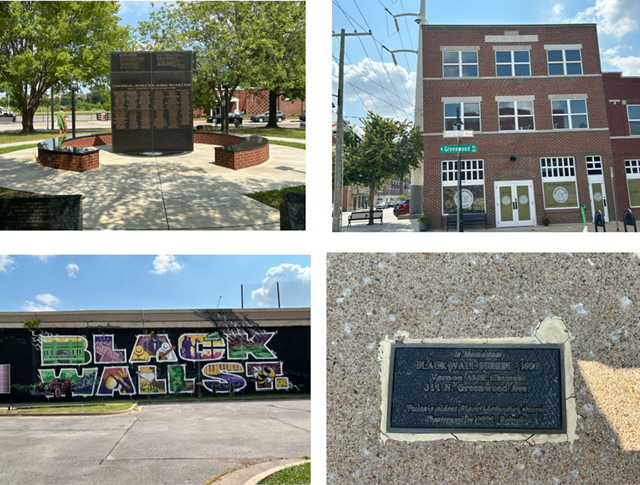
Walking along the route where this particular injustice was played out, there were markers in the sidewalk (bottom right), showing the address of the business destroyed and whether or not it was rebuilt. It was a gut punch, to say the least: every building in the area dates to no earlier than 1922, such as the Williams Building (top right), because everything was torched over a lie.
The top left is the memorial, which shows the long list of businesses that were destroyed in that awful May night of terror. And the bottom left is the mural that welcomes everyone to the area known as Black Wall Street.
Yes, he was promptly arrested. The paper’s evening edition advocated a lynch mob form at the jail. For his safety, Rowland was moved out of the jail and into the courthouse, where he was held on the top floor.
Some Blacks from Greenwood showed up to try to help Rowland, but they were no match against nearly a thousand angry whites. And, since they couldn’t get to Rowland, they figured any Black would do.
The next morning, “Black Wall Street” was in ruins and over thirty Blacks (most likely more, because records indicate that murdered people were hastily buried to keep the deaths a secret) were dead. Every building, save for one house, was burned to the ground — AFTER meticulous looting. The Tulsa fire department was kept away from the burning buildings.
To rub salt in the wound, the next day’s newspaper headlines screamed that “Two Whites Dead in Race Riot.” No mention of the number of Black deaths.
Walking along the route where this particular injustice was played out, there were markers in the sidewalk (bottom right), showing the address of the business destroyed and whether or not it was rebuilt. It was a gut punch, to say the least: every building in the area dates to no earlier than 1922, such as the Williams Building (top right), because everything was torched over a lie.
The top left is the memorial, which shows the long list of businesses that were destroyed in that awful May night of terror. And the bottom left is the mural that welcomes everyone to the area known as Black Wall Street.
Yes, he was promptly arrested. The paper’s evening edition advocated a lynch mob form at the jail. For his safety, Rowland was moved out of the jail and into the courthouse, where he was held on the top floor.
Some Blacks from Greenwood showed up to try to help Rowland, but they were no match against nearly a thousand angry whites. And, since they couldn’t get to Rowland, they figured any Black would do.
The next morning, “Black Wall Street” was in ruins and over thirty Blacks (most likely more, because records indicate that murdered people were hastily buried to keep the deaths a secret) were dead. Every building, save for one house, was burned to the ground — AFTER meticulous looting. The Tulsa fire department was kept away from the burning buildings.
To rub salt in the wound, the next day’s newspaper headlines screamed that “Two Whites Dead in Race Riot.” No mention of the number of Black deaths.
Walking along the route where this particular injustice was played out, there were markers in the sidewalk (bottom right), showing the address of the business destroyed and whether or not it was rebuilt. It was a gut punch, to say the least: every building in the area dates to no earlier than 1922, such as the Williams Building (top right), because everything was torched over a lie.
The top left is the memorial, which shows the long list of businesses that were destroyed in that awful May night of terror. And the bottom left is the mural that welcomes everyone to the area known as Black Wall Street.6 people like this
5 responses

@Kandae11 (57230)
•
3 Aug
What a terrible, sad story! I would have hated living in the United States back in those days and l greatly admire the black Americans who pressed on , survived and claimed their place in society. I also admire the few whites who went against the rules and tried to help the oppressed.
2 people like this
@FourWalls (86829)
• United States
3 Aug
Oklahoma was filled with people “nobody” wanted. This is where the Cherokee were sent on the Trail of Tears march in the 19th century as well. 
2 people like this


@LindaOHio (222726)
• United States
3 Aug
These are things that make me ashamed to be a white person. How people can do this to another person is beyond me.
2 people like this

@celticeagle (189957)
• Boise, Idaho
4 Aug
It is very sad the many stories of the black experience in history. Have you read or heard the story of Rosewood? It was x a horrible thing that happened back about this same time. All over a misunderstood series of events. Horrible and very sad.
1 person likes this
@celticeagle (189957)
• Boise, Idaho
4 Aug
@FourWalls ......Yes. It is probably the worse story I had heard to date. An entire town was murdered in Rosewood.
1 person likes this
@FourWalls (86829)
• United States
4 Aug
That’s in Florida, isn’t it? Harry and Harriette Moore were killed by the Klan there in 1951.
1 person likes this

@wolfgirl569 (135966)
• Marion, Ohio
3 Aug
I have heard a little about that. Very sad times to live in.
2 people like this
@FourWalls (86829)
• United States
3 Aug
To their credit, the residents rebuilt. They didn’t stop living because of the riot and the killing and the failed promises (one of the memorials has a list of how much money was not paid in damages: over $2.7 million, in 1921 money…the Inflation Calculator says that’s nearly $50,000,000 today) and the continued threats after the riot. It’s a very well-maintained part of town.
2 people like this

