

And ANOTHER One of Those West Virginia Tragedies

By Four Walls
@FourWalls (88437)
United States

October 8, 2026 10:59pm CST
West Virginia’s bread and butter has always been coal mining. As a result, there have been an exorbitant amount of fatal incidents in the state. Here’s a stat for you: although Kentucky has had the most “fatal mine incidents,” with 454 (compared to West Virginia’s 428), West Virginia’s official fatality tally from those tragedies is an unbelievable 103,207 (according to Mining Incidents). Again, using Kentucky for comparison, the fatality count in our state is nearly 20,000 fewer, despite having more incidents.
West Virginia was the home of the worst mining disaster in American history, and I’ll deal with that in another discussion. This one is about the second-worst disaster in West Virginia mines: Eccles.
Eccles is the name of the town where the mine, owned by New River Collieries, was located. It isn’t too far from the city of Beckley. It was sadly added to the map of worst disasters in coal mining history on the afternoon of April 28, 1914.
At about 2:30 in the afternoon a miner’s lamp (which was either a candle or acetylene) caused coal dust to explode, touching off a chain reaction. The results, to this day, are disputed, but terrible by anyone’s standards: between 180 and 186 dead. Everyone in mine number 5 perished, along with six people in the adjacent mine (number 6).
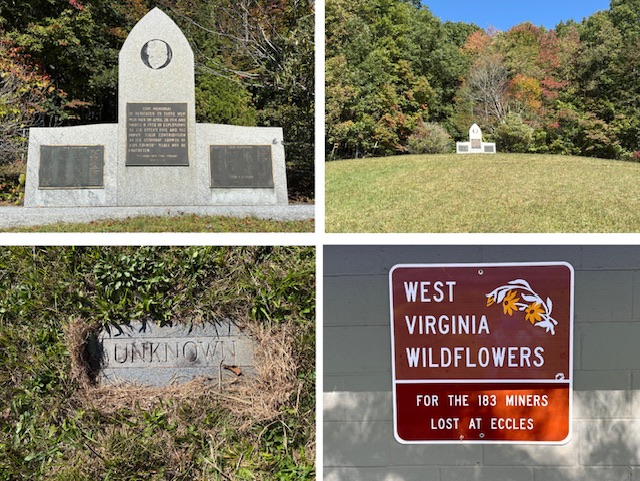
Three of the photos you see in the montage were taken at the Eccles Mine Disasters Memorial Cemetery. If you look closely you’ll see “1914” AND “1926” on the marker. That’s because the same mine had another disaster on March 8, 1926, that time killing 19. This cemetery is on the site of the Eccles No. 5 mine, where the disasters happened.
The lower right photo was taken at a wildflower display at the Beckley Exhibition Mine Museum in Beckley, showing the tribute paid there to the lives lost at Eccles in 1914. On the lower left, you see another one of the tragedies: one of many graves in the cemetery marked “unknown,” meaning the body was never identified because it was not recognizable. (They didn’t have DNA identification in those days.)
Thinking about that number — 103,000 deaths — is rough. The third largest city in Kentucky doesn’t have a population of 100,000 (Bowling Green has about 80,000), so that shows you just how many men have died in the coal mines of West Virginia.
COLLAGE:
(Upper left) Closer view of the monument that has the names of the 180 dead in 1914 and the 19 killed in 1926
(Upper right) The monument and the hill it sits on
(Lower left) One of many “unknown” grave markers in the cemetery
(Lower right) The wildflowers sign paying tribute to the victims of the 1914 explosion.
7 people like this
5 responses

@FourWalls (88437)
• United States
7h
I know, I was thinking how beautiful it was there, after such an ugly history on the site.
3 people like this


@Fleura (36045)
• United Kingdom
2h
That's an awful lot of deaths. Going to work shouldn't end that way.
I did laugh though that you felt it necessary to mention that DNA identification wasn't available in 1914. DNA was only confirmed as the genetic material in cells in the 1950s, sequencing was developed in the 1970s, and it was only recently that the methods became fast enough and accurate enough to be used as commonly as they are now!


