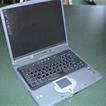
A laptop computer, or simply laptop (also notebook computer or notebook), is a small mobile computer, which usually weighs 2.2-18 pounds (1-6 kilograms), depending on size, materials, and other factors.
While the terms laptop and notebook are often used interchangeably, "laptop" is the older term, introduced in 1983 with the Gavilan SC. "Notebook computer" is a later coinage, which was used to differentiate smaller devices such as those of the NEC UltraLite and Compaq LTE series in 1989, which were, in contrast to previous laptops, the approximate size of an A4 or letter size paper sheet.[1] The terms are imprecise: due to heat and other issues, many laptops are inappropriate for use on one's lap, and most notebooks are not the size of typical letter or A4 paper notebook. Although some older portable computers, such as the Macintosh Portable and certain Zenith TurbosPort models, were sometimes described as "laptops", their size and weight were too great for this category.
As of 2007, most manufacturers use the term "notebook" (or some variant thereof) for what most end-users call a "laptop".
Laptops usually run on a single battery or from an external AC/DC adapter which can charge the battery while also supplying power to the computer itself.
As personal computers, laptops are capable of the same tasks as a desktop PC, although they are typically less powerful for the same price. They contain components that are similar to their desktop counterparts and perform the same functions, but are miniaturized and optimized for mobile use and efficient power consumption. Laptops usually have liquid crystal displays and most of them use different memory modules for their random access memory (RAM), for instance, SO-DIMM in lieu of the larger DIMMs. In addition to a built-in keyboard, they may utilize a touchpad (also known as a trackpad) or a pointing stick for input, though an external keyboard or mouse can usually be attached.
Many schools have taken in laptop based programs in which every student receives a laptop for school use only. The operating system is configured (or a third party program is installed) to limit the student's access to perform administrative tasks such as hardware or software installation, or operating system modifications. Students are generally permitted to use these systems to take notes, write papers, and perform other school-related activities.
Contents
[hide]* 1 Categories
o 1.1 Related devices* 2 History* 3 Parts* 4 Disadvantages
o 4.1 Standardization issues
o 4.2 Compatibility issues
+ 4.2.1 Compatibility with free software* 5 Naming conventions* 6 Upgradeability* 7 Performance* 8 Health issues* 9 Security* 10 Major manufacturers* 11 See also* 12 Notes and references* 13 External Link
Categories
Terms sometimes used for subtypes of laptop computers include:Ultraportables
Laptops with screens typically less than 12 inches diagonally and a weight of less than 1.7kg. Their keyboards are usually not full-size. Their primary audience is usually business travelers, who need small, light laptops. Ultraportables are often very expensive, have extended battery and/or battery life, house power-saving CPUs and almost always have integrated graphics.
A Sony VAIO FJ76 Notebook
Thin-and-lights
Laptops usually weighing in between 1.8kg and 2.8kg with a screen size of between 12 and 14 inches diagonally. Examples of this variety: the Sony VAIO FJ, Apple MacBook and Dell XPS M1210.
Medium-sized laptops
These usually have screens of 14 - 15.4 inches diagonally and a weight of around 3-3.5kg. They usually sacrifice a little computing power for smaller dimensions and longer battery life, although the length and width are usually determined by the screen size.
Desktop replacement computers
Powerful laptops meant to be mainly used in a fixed location and infrequently carried out due to their weight and size; the latter provides more space for powerful components and a big screen, usually measuring 17-20 inches. Desktop replacements tend to have limited battery life, rarely exceeding three hours, because the hardware is not optimized for efficient power usage.
Related devices
Laptops can be understood as a particular point on the continuum of more or less portable computing devices: the point at which the device is large enough to use substantially the same software as a desktop machine, but small enough to be support Mobile computing. Other points on the continuum include:Transportables
Computers which can easily be moved from place to place, but cannot be used while in transit, usually because they require AC power. The most famous example is the Osborne 1. A transportable, like a laptop, can run desktop software; but it does not support mobile computing.
Tablets
Computers shaped like slates or (paper) notebooks, with touchscreen interfaces. As of 2007, the most common subcategory is the Tablet PC, which is essentially a laptop with a touchscreen. Some tablets have no keyboard; others, called "convertibles", have a keyboard which can be folded behind the screen. A tablet supports mobile computing, and, commonly, can run some desktop software (possibly with modification), but not all.
Ultra Mobile PCs (UMPCs)
Very small Tablet PCs.
Internet tablets
Internet appliances in tablet form. An internet tablet supports mobile computing, but usually does not run any desktop software.
Personal digital assistants (PDAs)
Small computers, usually pocket-sized, usually with limited functionality. A PDA supports mobile computing, but almost never runs any desktop software.
Handheld computers
A high-end PDA or small tablet.
Smartphone
A handheld or PDA with an integrated cellphone.
As will be clear, these categories are blurry at times. For example, the OQO UPC is a PDA-sized Tablet PC; the Apple eMate had the clamshell form factor of a laptop, but ran PDA software. The HP Omnibook line of laptops included some devices small enough to be called handheld computers. The hardware of the Nokia 770 Internet tablet is essentially the same as that of a PDA such as the Zaurus 6000; the only reason it's not called a PDA is that it doesn't have PIM software. On the other hand, both the 770 and the Zaurus can run some desktop Linux software, usually with modifications.
History
Before laptop/notebook computers were technically feasible, similar ideas had been proposed, most notably Alan Kay's Dynabook concept, developed at Xerox PARC in the early 1970s.
The first commercially available portable computer was the Osborne 1 in 1981, which used the CP/M operating system. Although it was large and heavy compared to today's laptops, with a tiny CRT monitor, it had a near-revolutionary impact on business, as professionals were able to take their computer and data with them for the first time. This and other "luggables" were inspired by what was probably the first portable computer, the Xerox NoteTaker, again developed at Xerox PARC, in 1976; however, only ten prototypes were built. The Osborne was about the size of a portable sewing machine, and importantly could be carried on a commercial aircraft. However, it was not possible to run the Osborne on batteries; it had to be plugged in.
A more enduring success was the Compaq Portable, the first product from Compaq, introduced in 1983, by which time the IBM Personal Computer had become the standard platform. Although scarcely more portable than the Osborne machines, and also requiring AC power to run, it ran MS-DOS and was the first true IBM clone (IBM's own later Portable Computer, which arrived in 1984, was notably less IBM PC-compatible than the Compaq[citation needed]).
Another significant machine announced in 1981, although first sold widely in 1983, was the Epson HX-20. A simple handheld computer, it featured a full-transit 68-key keyboard, rechargeable nickel-cadmium batteries, a small (120 x 32-pixel) dot-matrix LCD display with 4 lines of text, 20 characters per line text mode, a 24 column dot matrix printer, a Microsoft BASIC interpreter, and 16 KiB of RAM (expandable to 32 KiB).
However, arguably the first true laptop was the GRiD Compass 1101, designed by Bill Moggridge in 1979-1980, and released in 1982. Enclosed in a magnesium case, it introduced the now familiar clamshell design, in which the flat display folded shut against the keyboard. The computer could be run from batteries, and was equipped with a 320×200-pixel plasma display and 384 kibibyte bubble memory. It was not IBM-compatible, and its high price (US$ 8-10,000) limited it to specialized applications. However, it was used heavily by the U.S. military, and by NASA on the Space Shuttle during the 1980s. The GRiD's manufacturer subsequently earned significant returns on its patent rights as its innovations became commonplace. GRiD Systems Corp. was later bought by Tandy (RadioShack).
Two other noteworthy early laptops were the Sharp PC-5000 and the Gavilan SC, announced in 1983 but first sold in 1984. The Gavilan was notably the first computer to be marketed as a "laptop". It was also equipped with a pioneering touchpad-like pointing device, installed on a panel above the keyboard. Like the GRiD Compass, the Gavilan and the Sharp were housed in clamshell cases, but they were partly IBM-compatible, although primarily running their own system software. Both had LCD displays, and could connect to optional external printers.
The year 1983 also saw the launch of what was probably the biggest-selling early laptop, the Kyocera Kyotronic 85, which owed much to the design of the previous Epson HX-20. Although it was at first a slow seller in Japan, it was quickly licensed by Tandy Corporation, Olivetti, and NEC, which saw its poten |