milan | MilanPower and control are yours with the Mercury Milan. Learn more.
Hotels in Milan, ItalySave up to 75% on Milan hotels. Pay at check-in. No booking fees.
Milan Hotel DiscountsTravelocity Race to Savings Sale: Up to 50% off Hotels in Milan.
|
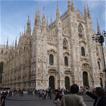
| | photo results | milano - santa maria delle grazie | Milan Cathedral (Italian: Duomo di Milano; Milanese: Domm de Milan) is the cathedral church of Milan in Lombardy, northern Italy. It is the seat of the Archbishop of Milan, currently Cardinal Dionigi Tettamanzi. The cathedral is significant in the promulgation of the Christian faith, for its role in the establishment of Catholic traditions of worship, its outstanding musical heritage and the splendour of its Gothic architecture. Built from the late 14th well into the 19th century (and in a sense, never completed as work continues), the Duomo di Milano is one of the world's largest churches, being second in size within Italy only to Saint Peter's Basilica in Rome, and being the second largest Gothic cathedral in the world, after the Cathedral of Seville in Spain. The interior height of its central nave is surpassed only by the choir of the incomplete Beauvais Cathedral in France. The plan of Milan, with streets either radiating from the Duomo or circling it, reveals the Duomo occupies the most center site in Roman Mediolanum, that of the public basilica facing the forum. Saint Ambrose's 'New Basilica' was built on this site at the beginning of the 5th century, with an adjoining basilica added in 836. When fire damaged both buildings in 1075, they were rebuilt as the Duomo The cathedral of Milano is often described as one of the greatest churches in the world. The ground plan is of a nave with 5 aisles, crossed by a transept and then followed by choir and apsis. The height of the nave is about 45 meters, the highest Gothic vaults of a complete church (less than the 48 meters of Beauvais Cathedral that was never completed). The roof is open to tourists (for a fee), which allows many a close-up view of some spectacular sculpture that would otherwise be unappreciated. The roof of the cathedral is renowned for the forest of openwork pinnacles and spires, sitting upon delicate flying buttresses. The cathedral's five wide naves, divided by forty pillars, are reflected in the hierarchic openings of the facade. Even the transepts have aisles. The nave columns are 24.5 metres (80 ft) high, and the apsidal windows are 20.7 x 8.5 metres (68 x 28 feet). The huge building is of brick construction, faced with marble from the quarries which Gian Galeazzo Visconti donated in perpetuity to the cathedral chapter. Its maintenance and repairs are very complicated. [edit] Main monuments and sights The interior of the cathedral includes a huge quantity of monuments and artworks. These include:The Archbishop Alberto da Intimiano's sarcophagus, which is overlooked by a Crucifix in copper laminae (a replica). The sarcophagi of the archbishops Ottone Visconti and Giovanni Visconti, created by a Campionese master in the 14th century. The sarcophagus of Marco Carelli, who donated 35,000 ducati to accelerate the construction of the cathedral. The three magnificent altars by Pellegrino Pellegrini, which include the notable Federico Zuccari's Visit of St. Peter to St. Agatha jailed. In the right transept, the monument to Gian Giacomo Medici di Marignano, called "Medeghino", by Leone Leoni, and the adjacent Renaissance marble altar, decorated with gilt bronze statues. In front of the former mausoleum is the most renowned work of art of the cathedral, the St. Bartholomew statue by Marco D'Agrate. The presbytery is a late Renaissance masterpiece composing a choir, a Temple by Pellegrini, two pulpits with giant telamones covered in copper and bronze, and two large organs. Around the choir the two sacristies' portals, some frescoes and a fifteenth-century statue of Martin V by Jacopino da Tradate) can be seen. The transepts house the Trivulzio Candelabrum, which is in two pieces. The base (attributed to Nicolas of Verdun, 12th century), characterized by a fantastic ensemble of vines, vegetables and imaginary animals; and the stem, of the mid-16th century. In the left aisle, the Arcimboldi monument by Alessi and Romanesque figures depicting the Apostles in red marble and the neo-Classic baptistry by Pellegrini. A small red light bulb in the dome above the apse marks the spot where one of the nails from the Crucifixion of Christ has been placed. In November-December, in the days surrounding the birthdate of the San Carlo Borromeo, a series of large canvases, the Quadroni are exhibited along the nave. [edit] The Duomo in literature The American writer and journalist Mark Twain visited Milan in the summer of 1867. He dedicated chapter 18 of Innocents Abroad to the Milan Cathedral, including many physical and historical details, and a now uncommon visit to the roof. He describes the Duomo as follows:“ What a wonder it is! So grand, so solemn, so vast! And yet so delicate, so airy, so graceful! A very world of solid weight, and yet it seems ...a delusion of frostwork that might vanish with a breath!... The central one of its five great doors is bordered with a bas-relief of birds and fruits and beasts and insects, which have been so ingeniously carved out of the marble that they seem like living creatures-- and the figures are so numerous and the design so complex, that one might study it a week without exhausting its interest...everywhere that a niche or a perch can be found about the enormous building, from summit to base, there is a marble statue, and every statue is a study in itself...Away above, on the lofty roof, rank on rank of carved and fretted spires spring high in the air, and through their rich tracery one sees the sky beyond. ... (Up on) the roof...springing from its broad marble flagstones, were the long files of spires, looking very tall close at hand, but diminishing in the distance...We could see, now, that the statue on the top of each was the size of a large man, though they all looked like dolls from the street... They say that the Cathedral of Milan is second only to St. Peter's at Rome. I cannot understand how it can be second to anything made by human hands. The 1934 song "O mia bela Madonina" by Giovanni d'Anzi about the golden Madonna statue on the spire can be considered today an unofficial "city anthem" of Milan. Luchino Visconti's 1960 film Rocco e i suoi fratelli, set in Milan, has a scene where the Duomo rooftop serves as a backdrop. Mainly Milanese dialect speaking people, due to the centuries needed to complete the Duomo, use the "Fabbrica del Duomo" ("Fabrica del Dom" in the dialect) as an adjective (sometimes in a humoristic way sometimes not) to describe an extremely long, too complex task, maybe even impossible to complete. The Italian phrase "mangiare a ufo", stemming from the milanese phrase "mangià a uf" meaning "being paid for a job not done", comes from the fact that the goods used to build the Duomo wore the inscription "A.U.F.", shorthand for Latin "Ad Usum Fabricae" (to be used for the construction). | |
|  JoMarch (1850) |
|
 | duomo milano | Milan Cathedral (Italian: Duomo di Milano; Milanese: Domm de Milan) is the cathedral church of Milan in Lombardy, northern Italy. It is the seat of the Archbishop of Milan, currently Cardinal Dionigi Tettamanzi.
The cathedral is significant in the promulgation of the Christian faith, for its role in the establishment of Catholic traditions of worship, its outstanding musical heritage and the splendour of its Gothic architecture.
Built from the late 14th well into the 19th century (and in a sense, never completed as work continues), the Duomo di Milano is one of the world's largest churches, being second in size within Italy only to Saint Peter's Basilica in Rome, and being the second largest Gothic cathedral in the world, after the Cathedral of Seville in Spain.
The interior height of its central nave is surpassed only by the choir of the incomplete Beauvais Cathedral in France.
The plan of Milan, with streets either radiating from the Duomo or circling it, reveals the Duomo occupies the most center site in Roman Mediolanum, that of the public basilica facing the forum. Saint Ambrose's 'New Basilica' was built on this site at the beginning of the 5th century, with an adjoining basilica added in 836. When fire damaged both buildings in 1075, they were rebuilt as the Duomo The cathedral of Milano is often described as one of the greatest churches in the world. The ground plan is of a nave with 5 aisles, crossed by a transept and then followed by choir and apsis. The height of the nave is about 45 meters, the highest Gothic vaults of a complete church (less than the 48 meters of Beauvais Cathedral that was never completed).
The roof is open to tourists (for a fee), which allows many a close-up view of some spectacular sculpture that would otherwise be unappreciated. The roof of the cathedral is renowned for the forest of openwork pinnacles and spires, sitting upon delicate flying buttresses.
The cathedral's five wide naves, divided by forty pillars, are reflected in the hierarchic openings of the facade. Even the transepts have aisles. The nave columns are 24.5 metres (80 ft) high, and the apsidal windows are 20.7 x 8.5 metres (68 x 28 feet). The huge building is of brick construction, faced with marble from the quarries which Gian Galeazzo Visconti donated in perpetuity to the cathedral chapter. Its maintenance and repairs are very complicated.
[edit] Main monuments and sights
The interior of the cathedral includes a huge quantity of monuments and artworks. These include:The Archbishop Alberto da Intimiano's sarcophagus, which is overlooked by a Crucifix in copper laminae (a replica).
The sarcophagi of the archbishops Ottone Visconti and Giovanni Visconti, created by a Campionese master in the 14th century.
The sarcophagus of Marco Carelli, who donated 35,000 ducati to accelerate the construction of the cathedral.
The three magnificent altars by Pellegrino Pellegrini, which include the notable Federico Zuccari's Visit of St. Peter to St. Agatha jailed.
In the right transept, the monument to Gian Giacomo Medici di Marignano, called "Medeghino", by Leone Leoni, and the adjacent Renaissance marble altar, decorated with gilt bronze statues.
In front of the former mausoleum is the most renowned work of art of the cathedral, the St. Bartholomew statue by Marco D'Agrate.
The presbytery is a late Renaissance masterpiece composing a choir, a Temple by Pellegrini, two pulpits with giant telamones covered in copper and bronze, and two large organs. Around the choir the two sacristies' portals, some frescoes and a fifteenth-century statue of Martin V by Jacopino da Tradate) can be seen.
The transepts house the Trivulzio Candelabrum, which is in two pieces. The base (attributed to Nicolas of Verdun, 12th century), characterized by a fantastic ensemble of vines, vegetables and imaginary animals; and the stem, of the mid-16th century.
In the left aisle, the Arcimboldi monument by Alessi and Romanesque figures depicting the Apostles in red marble and the neo-Classic baptistry by Pellegrini.
A small red light bulb in the dome above the apse marks the spot where one of the nails from the Crucifixion of Christ has been placed.
In November-December, in the days surrounding the birthdate of the San Carlo Borromeo, a series of large canvases, the Quadroni are exhibited along the nave. [edit] The Duomo in literature
The American writer and journalist Mark Twain visited Milan in the summer of 1867. He dedicated chapter 18 of Innocents Abroad to the Milan Cathedral, including many physical and historical details, and a now uncommon visit to the roof. He describes the Duomo as follows:“ What a wonder it is! So grand, so solemn, so vast! And yet so delicate, so airy, so graceful! A very world of solid weight, and yet it seems ...a delusion of frostwork that might vanish with a breath!... The central one of its five great doors is bordered with a bas-relief of birds and fruits and beasts and insects, which have been so ingeniously carved out of the marble that they seem like living creatures-- and the figures are so numerous and the design so complex, that one might study it a week without exhausting its interest...everywhere that a niche or a perch can be found about the enormous building, from summit to base, there is a marble statue, and every statue is a study in itself...Away above, on the lofty roof, rank on rank of carved and fretted spires spring high in the air, and through their rich tracery one sees the sky beyond. ... (Up on) the roof...springing from its broad marble flagstones, were the long files of spires, looking very tall close at hand, but diminishing in the distance...We could see, now, that the statue on the top of each was the size of a large man, though they all looked like dolls from the street... They say that the Cathedral of Milan is second only to St. Peter's at Rome. I cannot understand how it can be second to anything made by human hands.
The 1934 song "O mia bela Madonina" by Giovanni d'Anzi about the golden Madonna statue on the spire can be considered today an unofficial "city anthem" of Milan.
Luchino Visconti's 1960 film Rocco e i suoi fratelli, set in Milan, has a scene where the Duomo rooftop serves as a backdrop.
Mainly Milanese dialect speaking people, due to the centuries needed to complete the Duomo, use the "Fabbrica del Duomo" ("Fabrica del Dom" in the dialect) as an adjective (sometimes in a humoristic way sometimes not) to describe an extremely long, too complex task, maybe even impossible to complete.
The Italian phrase "mangiare a ufo", stemming from the milanese phrase "mangià a uf" meaning "being paid for a job not done", comes from the fact that the goods used to build the Duomo wore the inscription "A.U.F.", shorthand for Latin "Ad Usum Fabricae" (to be used for the construction). | |
|  JoMarch (1850) |
|
 | castle in lombardy | Lombardy (Latin: Langobardia, Italian: Lombardia, Western Lombard: Lumbardìa, Eastern Lombard: Lombardia) is one of the 20 regions of Italy. The capital is Milan. One-sixth of Italy's population lives in Lombardy and about one fifth of Italy's GDP is produced in this region. The languages are Italian, Western Lombard and Eastern Lombard. The primary religion is Catholic, of Ambrosian rite or Roman rite.the provinces are 12: Bergamo
• Brescia
• Como
• Cremona
• Lecco
• Lodi
• Mantua
• Milan
• Monza and Brianza
• Pavia
• Sondrio
• Varese | |
|  JoMarch (1850) |
|
 | milano duomo | Milan Cathedral (Italian: Duomo di Milano; Milanese: Domm de Milan) is the cathedral church of Milan in Lombardy, northern Italy. It is the seat of the Archbishop of Milan, currently Cardinal Dionigi Tettamanzi.
The cathedral is significant in the promulgation of the Christian faith, for its role in the establishment of Catholic traditions of worship, its outstanding musical heritage and the splendour of its Gothic architecture.
Built from the late 14th well into the 19th century (and in a sense, never completed as work continues), the Duomo di Milano is one of the world's largest churches, being second in size within Italy only to Saint Peter's Basilica in Rome, and being the second largest Gothic cathedral in the world, after the Cathedral of Seville in Spain.
The interior height of its central nave is surpassed only by the choir of the incomplete Beauvais Cathedral in France.
The plan of Milan, with streets either radiating from the Duomo or circling it, reveals the Duomo occupies the most center site in Roman Mediolanum, that of the public basilica facing the forum. Saint Ambrose's 'New Basilica' was built on this site at the beginning of the 5th century, with an adjoining basilica added in 836. When fire damaged both buildings in 1075, they were rebuilt as the Duomo The cathedral of Milano is often described as one of the greatest churches in the world. The ground plan is of a nave with 5 aisles, crossed by a transept and then followed by choir and apsis. The height of the nave is about 45 meters, the highest Gothic vaults of a complete church (less than the 48 meters of Beauvais Cathedral that was never completed).
The roof is open to tourists (for a fee), which allows many a close-up view of some spectacular sculpture that would otherwise be unappreciated. The roof of the cathedral is renowned for the forest of openwork pinnacles and spires, sitting upon delicate flying buttresses.
The cathedral's five wide naves, divided by forty pillars, are reflected in the hierarchic openings of the facade. Even the transepts have aisles. The nave columns are 24.5 metres (80 ft) high, and the apsidal windows are 20.7 x 8.5 metres (68 x 28 feet). The huge building is of brick construction, faced with marble from the quarries which Gian Galeazzo Visconti donated in perpetuity to the cathedral chapter. Its maintenance and repairs are very complicated.
[edit] Main monuments and sights
The interior of the cathedral includes a huge quantity of monuments and artworks. These include:The Archbishop Alberto da Intimiano's sarcophagus, which is overlooked by a Crucifix in copper laminae (a replica).
The sarcophagi of the archbishops Ottone Visconti and Giovanni Visconti, created by a Campionese master in the 14th century.
The sarcophagus of Marco Carelli, who donated 35,000 ducati to accelerate the construction of the cathedral.
The three magnificent altars by Pellegrino Pellegrini, which include the notable Federico Zuccari's Visit of St. Peter to St. Agatha jailed.
In the right transept, the monument to Gian Giacomo Medici di Marignano, called "Medeghino", by Leone Leoni, and the adjacent Renaissance marble altar, decorated with gilt bronze statues.
In front of the former mausoleum is the most renowned work of art of the cathedral, the St. Bartholomew statue by Marco D'Agrate.
The presbytery is a late Renaissance masterpiece composing a choir, a Temple by Pellegrini, two pulpits with giant telamones covered in copper and bronze, and two large organs. Around the choir the two sacristies' portals, some frescoes and a fifteenth-century statue of Martin V by Jacopino da Tradate) can be seen.
The transepts house the Trivulzio Candelabrum, which is in two pieces. The base (attributed to Nicolas of Verdun, 12th century), characterized by a fantastic ensemble of vines, vegetables and imaginary animals; and the stem, of the mid-16th century.
In the left aisle, the Arcimboldi monument by Alessi and Romanesque figures depicting the Apostles in red marble and the neo-Classic baptistry by Pellegrini.
A small red light bulb in the dome above the apse marks the spot where one of the nails from the Crucifixion of Christ has been placed.
In November-December, in the days surrounding the birthdate of the San Carlo Borromeo, a series of large canvases, the Quadroni are exhibited along the nave. [edit] The Duomo in literature
The American writer and journalist Mark Twain visited Milan in the summer of 1867. He dedicated chapter 18 of Innocents Abroad to the Milan Cathedral, including many physical and historical details, and a now uncommon visit to the roof. He describes the Duomo as follows:“ What a wonder it is! So grand, so solemn, so vast! And yet so delicate, so airy, so graceful! A very world of solid weight, and yet it seems ...a delusion of frostwork that might vanish with a breath!... The central one of its five great doors is bordered with a bas-relief of birds and fruits and beasts and insects, which have been so ingeniously carved out of the marble that they seem like living creatures-- and the figures are so numerous and the design so complex, that one might study it a week without exhausting its interest...everywhere that a niche or a perch can be found about the enormous building, from summit to base, there is a marble statue, and every statue is a study in itself...Away above, on the lofty roof, rank on rank of carved and fretted spires spring high in the air, and through their rich tracery one sees the sky beyond. ... (Up on) the roof...springing from its broad marble flagstones, were the long files of spires, looking very tall close at hand, but diminishing in the distance...We could see, now, that the statue on the top of each was the size of a large man, though they all looked like dolls from the street... They say that the Cathedral of Milan is second only to St. Peter's at Rome. I cannot understand how it can be second to anything made by human hands.
The 1934 song "O mia bela Madonina" by Giovanni d'Anzi about the golden Madonna statue on the spire can be considered today an unofficial "city anthem" of Milan.
Luchino Visconti's 1960 film Rocco e i suoi fratelli, set in Milan, has a scene where the Duomo rooftop serves as a backdrop.
Mainly Milanese dialect speaking people, due to the centuries needed to complete the Duomo, use the "Fabbrica del Duomo" ("Fabrica del Dom" in the dialect) as an adjective (sometimes in a humoristic way sometimes not) to describe an extremely long, too complex task, maybe even impossible to complete.
The Italian phrase "mangiare a ufo", stemming from the milanese phrase "mangià a uf" meaning "being paid for a job not done", comes from the fact that the goods used to build the Duomo wore the inscription "A.U.F.", shorthand for Latin "Ad Usum Fabricae" (to be used for the construction). | |
|  JoMarch (1850) |
|
 | milano duomo | Milan Cathedral (Italian: Duomo di Milano; Milanese: Domm de Milan) is the cathedral church of Milan in Lombardy, northern Italy. It is the seat of the Archbishop of Milan, currently Cardinal Dionigi Tettamanzi.
The cathedral is significant in the promulgation of the Christian faith, for its role in the establishment of Catholic traditions of worship, its outstanding musical heritage and the splendour of its Gothic architecture.
Built from the late 14th well into the 19th century (and in a sense, never completed as work continues), the Duomo di Milano is one of the world's largest churches, being second in size within Italy only to Saint Peter's Basilica in Rome, and being the second largest Gothic cathedral in the world, after the Cathedral of Seville in Spain.
The interior height of its central nave is surpassed only by the choir of the incomplete Beauvais Cathedral in France.
The plan of Milan, with streets either radiating from the Duomo or circling it, reveals the Duomo occupies the most center site in Roman Mediolanum, that of the public basilica facing the forum. Saint Ambrose's 'New Basilica' was built on this site at the beginning of the 5th century, with an adjoining basilica added in 836. When fire damaged both buildings in 1075, they were rebuilt as the Duomo The cathedral of Milano is often described as one of the greatest churches in the world. The ground plan is of a nave with 5 aisles, crossed by a transept and then followed by choir and apsis. The height of the nave is about 45 meters, the highest Gothic vaults of a complete church (less than the 48 meters of Beauvais Cathedral that was never completed).
The roof is open to tourists (for a fee), which allows many a close-up view of some spectacular sculpture that would otherwise be unappreciated. The roof of the cathedral is renowned for the forest of openwork pinnacles and spires, sitting upon delicate flying buttresses.
The cathedral's five wide naves, divided by forty pillars, are reflected in the hierarchic openings of the facade. Even the transepts have aisles. The nave columns are 24.5 metres (80 ft) high, and the apsidal windows are 20.7 x 8.5 metres (68 x 28 feet). The huge building is of brick construction, faced with marble from the quarries which Gian Galeazzo Visconti donated in perpetuity to the cathedral chapter. Its maintenance and repairs are very complicated.
[edit] Main monuments and sights
The interior of the cathedral includes a huge quantity of monuments and artworks. These include:The Archbishop Alberto da Intimiano's sarcophagus, which is overlooked by a Crucifix in copper laminae (a replica).
The sarcophagi of the archbishops Ottone Visconti and Giovanni Visconti, created by a Campionese master in the 14th century.
The sarcophagus of Marco Carelli, who donated 35,000 ducati to accelerate the construction of the cathedral.
The three magnificent altars by Pellegrino Pellegrini, which include the notable Federico Zuccari's Visit of St. Peter to St. Agatha jailed.
In the right transept, the monument to Gian Giacomo Medici di Marignano, called "Medeghino", by Leone Leoni, and the adjacent Renaissance marble altar, decorated with gilt bronze statues.
In front of the former mausoleum is the most renowned work of art of the cathedral, the St. Bartholomew statue by Marco D'Agrate.
The presbytery is a late Renaissance masterpiece composing a choir, a Temple by Pellegrini, two pulpits with giant telamones covered in copper and bronze, and two large organs. Around the choir the two sacristies' portals, some frescoes and a fifteenth-century statue of Martin V by Jacopino da Tradate) can be seen.
The transepts house the Trivulzio Candelabrum, which is in two pieces. The base (attributed to Nicolas of Verdun, 12th century), characterized by a fantastic ensemble of vines, vegetables and imaginary animals; and the stem, of the mid-16th century.
In the left aisle, the Arcimboldi monument by Alessi and Romanesque figures depicting the Apostles in red marble and the neo-Classic baptistry by Pellegrini.
A small red light bulb in the dome above the apse marks the spot where one of the nails from the Crucifixion of Christ has been placed.
In November-December, in the days surrounding the birthdate of the San Carlo Borromeo, a series of large canvases, the Quadroni are exhibited along the nave. [edit] The Duomo in literature
The American writer and journalist Mark Twain visited Milan in the summer of 1867. He dedicated chapter 18 of Innocents Abroad to the Milan Cathedral, including many physical and historical details, and a now uncommon visit to the roof. He describes the Duomo as follows:“ What a wonder it is! So grand, so solemn, so vast! And yet so delicate, so airy, so graceful! A very world of solid weight, and yet it seems ...a delusion of frostwork that might vanish with a breath!... The central one of its five great doors is bordered with a bas-relief of birds and fruits and beasts and insects, which have been so ingeniously carved out of the marble that they seem like living creatures-- and the figures are so numerous and the design so complex, that one might study it a week without exhausting its interest...everywhere that a niche or a perch can be found about the enormous building, from summit to base, there is a marble statue, and every statue is a study in itself...Away above, on the lofty roof, rank on rank of carved and fretted spires spring high in the air, and through their rich tracery one sees the sky beyond. ... (Up on) the roof...springing from its broad marble flagstones, were the long files of spires, looking very tall close at hand, but diminishing in the distance...We could see, now, that the statue on the top of each was the size of a large man, though they all looked like dolls from the street... They say that the Cathedral of Milan is second only to St. Peter's at Rome. I cannot understand how it can be second to anything made by human hands.
The 1934 song "O mia bela Madonina" by Giovanni d'Anzi about the golden Madonna statue on the spire can be considered today an unofficial "city anthem" of Milan.
Luchino Visconti's 1960 film Rocco e i suoi fratelli, set in Milan, has a scene where the Duomo rooftop serves as a backdrop.
Mainly Milanese dialect speaking people, due to the centuries needed to complete the Duomo, use the "Fabbrica del Duomo" ("Fabrica del Dom" in the dialect) as an adjective (sometimes in a humoristic way sometimes not) to describe an extremely long, too complex task, maybe even impossible to complete.
The Italian phrase "mangiare a ufo", stemming from the milanese phrase "mangià a uf" meaning "being paid for a job not done", comes from the fact that the goods used to build the Duomo wore the inscription "A.U.F.", shorthand for Latin "Ad Usum Fabricae" (to be used for the construction). | |
|  JoMarch (1850) |
|
 | duomo milano | Milan Cathedral (Italian: Duomo di Milano; Milanese: Domm de Milan) is the cathedral church of Milan in Lombardy, northern Italy. It is the seat of the Archbishop of Milan, currently Cardinal Dionigi Tettamanzi.
The cathedral is significant in the promulgation of the Christian faith, for its role in the establishment of Catholic traditions of worship, its outstanding musical heritage and the splendour of its Gothic architecture.
Built from the late 14th well into the 19th century (and in a sense, never completed as work continues), the Duomo di Milano is one of the world's largest churches, being second in size within Italy only to Saint Peter's Basilica in Rome, and being the second largest Gothic cathedral in the world, after the Cathedral of Seville in Spain.
The interior height of its central nave is surpassed only by the choir of the incomplete Beauvais Cathedral in France.
The plan of Milan, with streets either radiating from the Duomo or circling it, reveals the Duomo occupies the most center site in Roman Mediolanum, that of the public basilica facing the forum. Saint Ambrose's 'New Basilica' was built on this site at the beginning of the 5th century, with an adjoining basilica added in 836. When fire damaged both buildings in 1075, they were rebuilt as the Duomo The cathedral of Milano is often described as one of the greatest churches in the world. The ground plan is of a nave with 5 aisles, crossed by a transept and then followed by choir and apsis. The height of the nave is about 45 meters, the highest Gothic vaults of a complete church (less than the 48 meters of Beauvais Cathedral that was never completed).
The roof is open to tourists (for a fee), which allows many a close-up view of some spectacular sculpture that would otherwise be unappreciated. The roof of the cathedral is renowned for the forest of openwork pinnacles and spires, sitting upon delicate flying buttresses.
The cathedral's five wide naves, divided by forty pillars, are reflected in the hierarchic openings of the facade. Even the transepts have aisles. The nave columns are 24.5 metres (80 ft) high, and the apsidal windows are 20.7 x 8.5 metres (68 x 28 feet). The huge building is of brick construction, faced with marble from the quarries which Gian Galeazzo Visconti donated in perpetuity to the cathedral chapter. Its maintenance and repairs are very complicated.
[edit] Main monuments and sights
The interior of the cathedral includes a huge quantity of monuments and artworks. These include:The Archbishop Alberto da Intimiano's sarcophagus, which is overlooked by a Crucifix in copper laminae (a replica).
The sarcophagi of the archbishops Ottone Visconti and Giovanni Visconti, created by a Campionese master in the 14th century.
The sarcophagus of Marco Carelli, who donated 35,000 ducati to accelerate the construction of the cathedral.
The three magnificent altars by Pellegrino Pellegrini, which include the notable Federico Zuccari's Visit of St. Peter to St. Agatha jailed.
In the right transept, the monument to Gian Giacomo Medici di Marignano, called "Medeghino", by Leone Leoni, and the adjacent Renaissance marble altar, decorated with gilt bronze statues.
In front of the former mausoleum is the most renowned work of art of the cathedral, the St. Bartholomew statue by Marco D'Agrate.
The presbytery is a late Renaissance masterpiece composing a choir, a Temple by Pellegrini, two pulpits with giant telamones covered in copper and bronze, and two large organs. Around the choir the two sacristies' portals, some frescoes and a fifteenth-century statue of Martin V by Jacopino da Tradate) can be seen.
The transepts house the Trivulzio Candelabrum, which is in two pieces. The base (attributed to Nicolas of Verdun, 12th century), characterized by a fantastic ensemble of vines, vegetables and imaginary animals; and the stem, of the mid-16th century.
In the left aisle, the Arcimboldi monument by Alessi and Romanesque figures depicting the Apostles in red marble and the neo-Classic baptistry by Pellegrini.
A small red light bulb in the dome above the apse marks the spot where one of the nails from the Crucifixion of Christ has been placed.
In November-December, in the days surrounding the birthdate of the San Carlo Borromeo, a series of large canvases, the Quadroni are exhibited along the nave. [edit] The Duomo in literature
The American writer and journalist Mark Twain visited Milan in the summer of 1867. He dedicated chapter 18 of Innocents Abroad to the Milan Cathedral, including many physical and historical details, and a now uncommon visit to the roof. He describes the Duomo as follows:“ What a wonder it is! So grand, so solemn, so vast! And yet so delicate, so airy, so graceful! A very world of solid weight, and yet it seems ...a delusion of frostwork that might vanish with a breath!... The central one of its five great doors is bordered with a bas-relief of birds and fruits and beasts and insects, which have been so ingeniously carved out of the marble that they seem like living creatures-- and the figures are so numerous and the design so complex, that one might study it a week without exhausting its interest...everywhere that a niche or a perch can be found about the enormous building, from summit to base, there is a marble statue, and every statue is a study in itself...Away above, on the lofty roof, rank on rank of carved and fretted spires spring high in the air, and through their rich tracery one sees the sky beyond. ... (Up on) the roof...springing from its broad marble flagstones, were the long files of spires, looking very tall close at hand, but diminishing in the distance...We could see, now, that the statue on the top of each was the size of a large man, though they all looked like dolls from the street... They say that the Cathedral of Milan is second only to St. Peter's at Rome. I cannot understand how it can be second to anything made by human hands.
The 1934 song "O mia bela Madonina" by Giovanni d'Anzi about the golden Madonna statue on the spire can be considered today an unofficial "city anthem" of Milan.
Luchino Visconti's 1960 film Rocco e i suoi fratelli, set in Milan, has a scene where the Duomo rooftop serves as a backdrop.
Mainly Milanese dialect speaking people, due to the centuries needed to complete the Duomo, use the "Fabbrica del Duomo" ("Fabrica del Dom" in the dialect) as an adjective (sometimes in a humoristic way sometimes not) to describe an extremely long, too complex task, maybe even impossible to complete.
The Italian phrase "mangiare a ufo", stemming from the milanese phrase "mangià a uf" meaning "being paid for a job not done", comes from the fact that the goods used to build the Duomo wore the inscription "A.U.F.", shorthand for Latin "Ad Usum Fabricae" (to be used for the construction). | |
|  JoMarch (1850) |
|
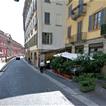
 | milan italy 72 | Visitors will find that walking is the best option to explore the center of Milan. You can wander from shop to shop and attraction to attraction, stopping at museums and taking necessary breaks at restaurants and cafes, and this will give you the best experience of central Milan
Getting around the city by public transportation is easy and absolutely recommended -- look up the relevant section on TripAdvisor Inside at http://www.tripadvisor.com/Travel-g18...
Driving in Milan can be quite an adventure, especially in the center of the city, and is best avoided. If you have never driven in Europe (or at least in Tijuana!), you would find the frenetic pace to be quite a challenge to say the least! Besides, as from Jan. 2008 the city has been enforcing a pollution charge to drive in and through a large chunk of the center. Those travelers who do not wish to make use of public transportation should consider taking taxis anywhere that they are not able or willing to walk to, although this can be a somewhat pricey choice. | |
|  robert19ph (1483) |
|
 | FNAC in Milan | FNAC shop in Milan...place that sells books, cds, dvds, and some electronic stuff | |
|  JoMarch (1850) |
|
 | lombardy- map | Lombardy (Latin: Langobardia, Italian: Lombardia, Western Lombard: Lumbardìa, Eastern Lombard: Lombardia) is one of the 20 regions of Italy. The capital is Milan. One-sixth of Italy's population lives in Lombardy and about one fifth of Italy's GDP is produced in this region. The languages are Italian, Western Lombard and Eastern Lombard. The primary religion is Catholic, of Ambrosian rite or Roman rite.the provinces are 12: Bergamo
• Brescia
• Como
• Cremona
• Lecco
• Lodi
• Mantua
• Milan
• Monza and Brianza
• Pavia
• Sondrio
• Varese | |
|  JoMarch (1850) |
|
|
| | |
| | | | |
|