

Do you buy papads or do you make them?

@owlwings (43897)
Cambridge, England

August 22, 2008 5:45am CST
Usually I buy papads (pappadums) ready made and either fry or toast them under the grill.
I was interested, though, in making them from scratch. I know they are made from gram flour (flour made from a bean, pea or lentil) which I think I would have to find in an Indian market - I have never found it in Tesco (a normal grocery market).
Do you know if it would be possible to make my own gram flour and which kind of pea, bean or lentil should I use? I can get most kinds of dried pulse quite easily. Should I cook the pulses first and then mash and dry them or are they simply ground from the dried seed?
Once I have the flour, what is the method for making papads?
1 person likes this
6 responses

@SViswan (12051)
• India
22 Aug 08
I'm an Indian from a state called Kerala....where every home will have pappadums for lunch and dinner! I have no clue how it is made from scratch...because I (as well as everyone else I know) buy the ready made packets from the local grocery stores. We lived in Kuwait before I was married and we always got the store brought pappadums.
My husband's family usually makes everything from scratch and don't buy the store-brought stuff. Even they buy pappadums and don't make it from scratch.
But I'm guessing her based on what I see on television. I think the pulses are dried in the sun first (roasting them will have the same effect) and then cooked and then mashed. They are then rolled out into pappadum shapes and then left to dry in the sun again. I THINK that's how it is done.
3 people like this
@SViswan (12051)
• India
22 Aug 08
I just checked up with my grandmother and it isn't very easy to make pappadums at home. Apparently, there is something that was used earlier to pound the dough and it took two people at the same time to do it for quite some time.
this was years ago...I'm sure there is some machine to do the same process now.
3 people like this
@owlwings (43897)
• Cambridge, England
22 Aug 08
Thank you for your information. It is very helpful! I know that most pulses need to be cooked before they are eaten - and that includes chickpeas (channa) and black lentils (urad), which is what Wikipedia says that most papads are made from. Your answer has suggested that the dhal is first cooked and mashed before turning into flour, which is what I suspected.
There are some things which it is just easier to buy from the store, I agree, but I am curious about making things from scratch. I would even experiment with growing the beans/peas and learning about the whole process! I once grew wheat in my garden, hoping to make bread. It turns out that there is so much wastage and labor involved if one does these things on a small scale that it really isn't worth it. If you add up the time involved and cost it out, even the exorbitant price you pay at the store is cheap!
2 people like this
@owlwings (43897)
• Cambridge, England
23 Aug 08
I think I know what you mean by a 'thing to pound the dough' - I have seen pictures! It's a huge wooden mortar (or deep bowl) with usually two wooden sticks. I have seen movies of women working these with a wonderful rhythm (helped by songs, very often). All the movies I have seen suggest that it's an enjoyable task ... bright sarees and wonderful white grins on their faces, LOL.
Just find me two lovely Indian wives, please! 


@checapricorn (16060)
• United States
22 Aug 08
Hi owl,
[i]hmmm...I am sorry but I can't help you about this, we always buy it and we never tried or we even don't have plan to make it!
I wish you can find at you tube since I found everything I will search there, like last time I wanted to learn how to make sushi and they have all the videos![/i]
2 people like this

@pumpkinjam (8876)
• United Kingdom
23 Aug 08
Well, I can't help you here with the making and stuff but if you can get to a "Tesco Extra", they have speciality aisles with different world foods. My local one has Indian, African and Polish. I'm sure I have seen gram flour in the Indian aisle.
1 person likes this
@owlwings (43897)
• Cambridge, England
23 Aug 08
I have a Tesco Express just across the road that stocks Pappadums and I have a big Tesco just a few minutes away (they may even now be an 'Extra' but it is mighty confusing!) They do have aisles devoted to ethnic foods and may, by now, have gram flour (though I didn't see it last time I was there a couple of days ago).
I think that all of these markets (supermarkets in UK parlance) stock what is in demand in their area: if I went to Bradford, for example, I might find what I want in every small corner shop (or Tesco Express or whatever they have there).
Really what I am interested in, though, is how I could make 'gram' flour from scratch in the first place! I am up for buying the right kind of dried beans, rather than actually growing them, but should I cook the beans before I make flour from them or not? It seems (from what little I can find and from what others have said) that they are cooked first. It certainly makes sense, because they are then easier to mash. I have experimented a little with Puy Lentils (a green lentil) ground in a coffee grinder and then made into a dough. I have had some success with this (and no ill effects from eating samples of the cooked product).
I have yet to try drained canned chickpeas - or any kind of bean which has been canned and therefore cooked - as a base and 'mashed potato' pappadums are something I am seriously considering ... except they might be called crisps here!
Mushy peas are something that are very popular in your area ... a 'mooshy pea bap' was something I first encountered in Coventry! I wonder if something couldn't be done with that virulent green substance to make it into a thin crispy biscuit which one could toast or fry like a pappadum (or even a taco).


@kalav56 (11464)
• India
23 Aug 08
I do not think it is worth your while to make papads at home. This I know is a very very laborious process. I am from a traditional family and I have heard that this was made only in the days of our great grandmothers.Once when i was young I saw my own grandmother making it[with a cook at home]The raw flour dough was out of this world. This has some nuances to be followed and why bother? Get papads from Chennai Mylapore if you are very particular about different varieties and special varieties. Othewise the taste would only be marginally different. The best brands may be AMBIKA, and POPULAR.But this is appalam. Pappadam is different. This is normally fried. Appalam can be grilled too.
1 person likes this
@owlwings (43897)
• Cambridge, England
23 Aug 08
Thank you so much! I know that it is a laborious business (and I am glad that there are now factories where some women can find employment and earn a fair wage for their work). Of course, now that we have machinery to make the flour and the dough in quantity, the work is so much easier.
Thank you, also, for naming some good varieties. I shall look out for them and ask for them by name in the local Indian stores that we have here.
I think that mostly what we can buy here you would call 'appalam' because I know it can be grilled or fried (or even microwaved). Sometimes we can buy it already grilled, which is convenient, of course.
When I eat at an Indian restaurant here, the pappadums are always fried (and I am not always very happy about how oily they are). I love to know the correct names - though they must vary depending on the region and the language - so that I can ask for exactly what I want.
@kalav56 (11464)
• India
23 Aug 08
The names that I have written would have the word’ appalam’ printed on the label.; there is another variety which is known as ‘pappadan’’ but this is best only when fried. The appalam can be microwaved and this is very good and oil free. Pappadams should be had immediately after you fry them and they would puff up like pooris. That is the difference. I also have a feeling that while papad is a bit wet Appalam is dry. All these, I am told, are not dried in the sun. They would only be let to dry in shade. Anyhow, as I told you earlier never think of making them at home.
On the other hand you have Vadagams that are easier to prepare at home itself provided there is good hot sun.
All doctors make it their first advice to tell the patient to avoid consuming papad if they are hypertensive. Apparently the salt content is pretty high in this.
1 person likes this

@ANTIQUELADY (36440)
• United States
29 Aug 08
i never heard of them so therfore can't help u out. explain to me what they are. are they like some kind of bread? thanks.
@owlwings (43897)
• Cambridge, England
29 Aug 08
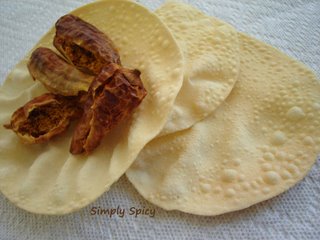
One description I found says that 'Pappad is a natural, healthy and lip-smacking delicacy, which is a crunchy wafer delicious to eat. It is a dehydrated product made of pure vegetable oil, Rice flour, Urad dal [chickpea flour], spices, salt etc. Pappad is rich in vitamins and nutrients and is almost free from fat as its oil take in is neglible.'
I'm sure that if you go looking for them in your local store, perhaps in the Indian or Ethnic section, you will almost certainly find them. Sometimes you can find them cooked, when they are something like a large, round, puffed potato chip/crisp or a large taco; occasionally you will find them uncooked as very thin greenish yellow disks. They can be fried for a few seconds, toasted over a gas flame (using tongs and great care!) or even cooked in the microwave.
They are usually eaten as a starter or a snack with various accompaniments such as chutney or something very like a Mexican salsa.
Here is a picture:
@owlwings (43897)
• Cambridge, England
29 Aug 08
Actually, urad dhal is NOT chickpea (gram) flour but flour made from white lentils (urad - black lentils which have had the black skin taken off). These are a different variety to our more common green (puy) or yellow lentils, though I have no doubt that a similar flour could be made from these too.
@ANTIQUELADY (36440)
• United States
29 Aug 08
thank you for the info & taking up your time to explain. i learned something today. we never get too old tolearn something new. greetings from tennessee.
