

Talk Review – How Morecambe Bay Got Its Name

@arthurchappell (44941)
Preston, England

February 1, 2017 3:58pm CST
A short informal talk I attended on Tuesday March 31st at Ingol, Preston’s Intact Centre. The talk was presented by historian Bill Shannon.
Morecambe Bay in Lancashire, is the biggest area of mudflats and sand in Britain, covering over 120 square miles. It is an area rich in wildlife and outstanding natural beauty. It is also one of the most dangerous places on Earth. Crossing the Bay without trained sand-guides can lead unwary walkers to be cut off by very fast incoming tides that can outpace a galloping horse, and also quicksands which move round with little predictability on the Bay sands.
Bill’s talk concentrated on how the Bay got its unusual but surprisingly not unique name. There is a much smaller seaside village of the same name near Carlisle.
Bill is an avid map scholar (he brought in several of his own maps and charts to display). He told us how the earliest known map of the county of Lancashire, which contains both Preston and Morecambe, dates from 1025 but makes no mention of Morecambe at all. The map looks strange as it disregards later understandings of direction or scale, so there is no regard for North, South, East or West.
A later map by cartographer Richard Gough, c.1410, shows the west coast of Lancashire as straight line when in most maps the vast arcing crescent curve of Morecambe Bay (still un-named) is very visible but as Bill showed, at low tide, the water recedes and the sand flats do make the whole edge of the land look much more of straight line. Maps allowing for differences created by incoming and outgoing tides were a later creation.
Maps drawn and sold for public use in 1577 make no use of the name Morecambe Bay known to many then as Lancashire Sands.
The new name was actually created by John Whittaker in 1771, except it was not new at all. A Greek historian called Ptolemy had before his death around 170 AD, made vague references to a region in North West England called ‘Morikambe’ given to savage tidal surges. Whittaker arbitrarily decided the main Morecambe Bay we know and love was Ptolemy’s place and the name stuck, appearing in virtually every map created ever after. The name Morecambe translates as ‘The curve in the sea’.
After the arrival of the railways Morecambe became a very popular Victorian and Edwardian holiday and bathing resort. It is also an area with lots of wind turbines and sea based gas drilling platforms. Cockles and oysters are regularly farmed on the bay and a group of 23 Chinese Cockle Pickers (mostly enslaved illegal immigrants) drowned in the tidal surges of the Bay in 2004. Comedian John Eric Bartholomew, born in the town, adopted the stage name Eric Morecambe and his statue now adorns the sea front of Morecambe Town itself.
A fascinating look at one of the North West’s most spectacular areas.
Youtube – Christy Moore – On Morecambe Bay, a haunting folk song tribute to those who died in the Chinese Cockle Pickers tragedy of 2004
Arthur Chappell

Christy Moore performs Morcombe Bay on The Late Late Show, October 28th, 2011
7 people like this
5 responses

@Jessicalynnt (50523)
• Centralia, Missouri
1 Feb 17
I had no idea a place that dangerous was a beach in England!
1 person likes this
@arthurchappell (44941)
• Preston, England
2 Feb 17
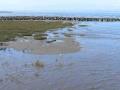
it is very dangerous at times - this is a film of the tide coming in really fast - not speeded up -
1 person likes this
@Jessicalynnt (50523)
• Centralia, Missouri
3 Feb 17
@arthurchappell I dont think I have ever seen tide rise that fast
1 person likes this
@arthurchappell (44941)
• Preston, England
9 Feb 17
@Jessicalynnt I have seen it on the coast of Jersey - stayed specially to watch it and ride back on the amphibeous bus which was great fun
1 person likes this


@teamfreak16 (43579)
• Denver, Colorado
4 Feb 17
Quicksand that moves around? Interesting. I had no idea that it does that.
1 person likes this
@arthurchappell (44941)
• Preston, England
4 Feb 17
@teamfreak16 quicksand is basically just waterlogged loose sand so as sand shifts between tides it can end up in different places - a safe path one day can be deadly the next
1 person likes this

@celticeagle (189820)
• Boise, Idaho
2 Feb 17
Quicksand is scary stuff. This place sounds like one you just want to see from a distance and call it good. Curve in the sea, huh? Another interesting write up.
1 person likes this

@Poppylicious (11134)
• United Kingdom
1 Feb 17
I've never been here. It's fascinating to know where the name comes from.
1 person likes this

@arthurchappell (44941)
• Preston, England
2 Feb 17
I have been to Morecambe but not since childhood @JudyEv
1 person likes this
