

Environmental sampling

By Fleur
@Fleura (34960)
United Kingdom

July 28, 2019 4:25am CST
As many of you know I’m interested in wildlife and have been involved in various conservation activities, from the toad patrol to insect surveys.
Through toad patrol contacts, we were put in touch with the Freshwater Habitats Trust (FHT), who are trying to carry out a survey of freshwater sites all around the locality to see what animals live there. The huge advances in technology over the last few years means that rather than creeping about at dawn or dusk looking for signs of animal activity, it is now possible to sample the water and look for traces of DNA from animals that have passed through. This is quite astonishing really when you think that only 20 or so years ago it was necessary to have quite a reasonable chunk of sample in order to extract enough DNA from it – now you don’t need any of the actual tissue at all!
Various people volunteered to take on two or three of the sites, since getting to them can be tricky and time-consuming. Along with another toad patrol member, I agreed to help with a couple of sites. The FHT provided a detailed map of each location, grid reference, and a test kit, and off we went.
Our first site proved a bit of a challenge! It took us a while to get to the exact spot and when we got there, there was actually no water in the little stream, just mud covered with a skin of algae. However when we scrambled a bit further along through the nettles we found a stretch with water still flowing.
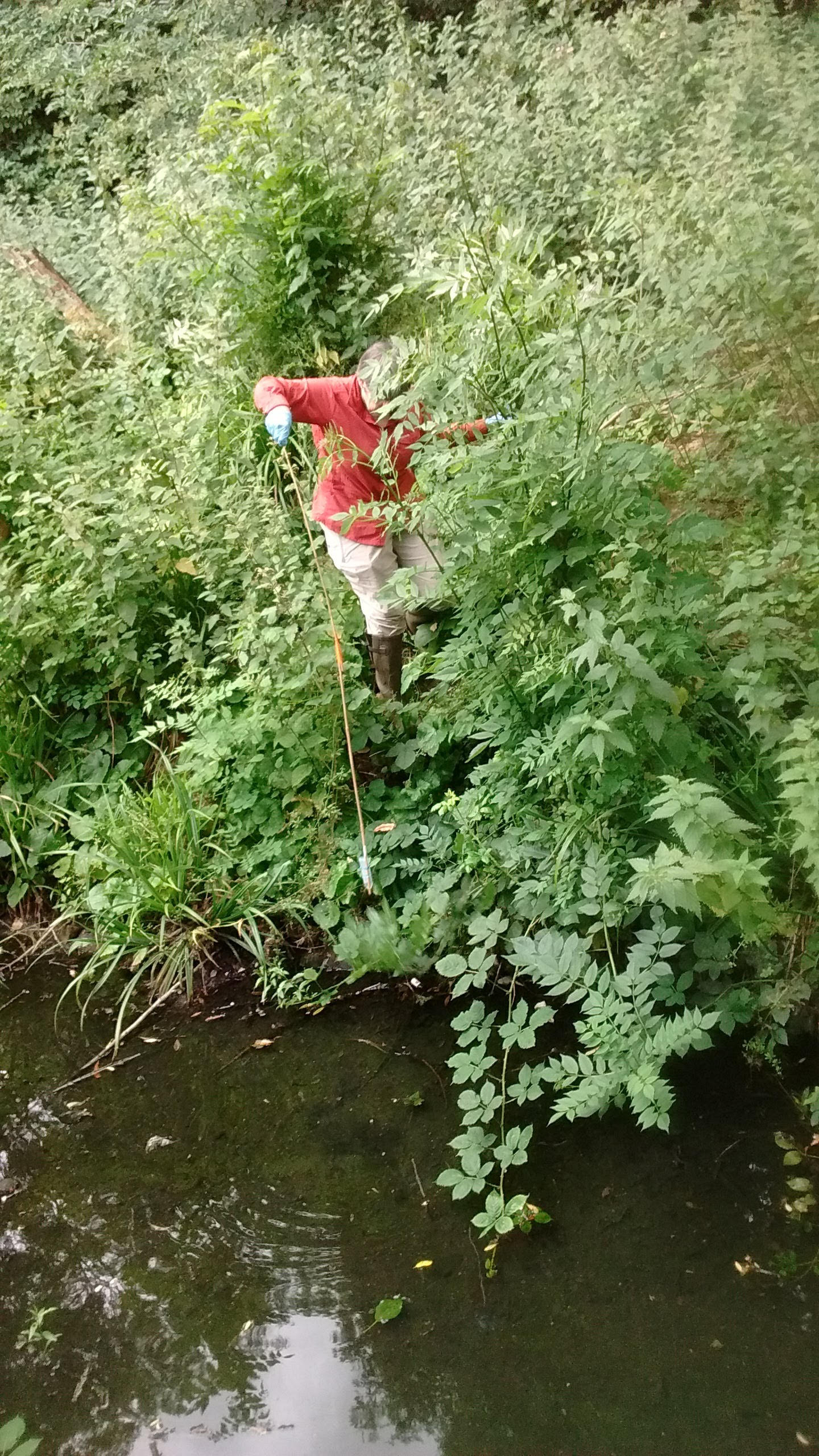
Then there was the difficulty of reaching the water. With a sterile tube attached to the end of a clean bamboo stick, we needed to scoop samples from the surface layer of the water, without disturbing any of the sediment which would contain DNA from years ago rather than from animals which had recently passed that way.
As you can see in the picture, this was a bit tricky! Nevertheless we managed to scoop out enough samples, which we then had to squeeze through a special filter using a syringe.
The final step was to dry the filter by syringing air through it, then add a tiny bit of preservative, seal it in an envelope and post it away to be analysed.
It will be interesting to find out in due course what the results reveal. I’m sure there is plenty of activity out there that we don’t even suspect!
All rights reserved. © Text and image copyright Fleur 2019.
10 people like this
12 responses


@owlwings (43897)
• Cambridge, England
28 Jul 19
What an enjoyable and productive way to spend some free time! I had no idea that such small samples could contain enough DNA to identify the species of animals which had passed through the water. I would be fascinated to see the results (and I shall visit their website to see if I can find more information, though, sadly, it's not something I could do these days).
1 person likes this
@owlwings (43897)
• Cambridge, England
28 Jul 19
@Fleura I was wondering about contamination. Presumably it would invalidate the sample if you so much as dipped your hand in the water. I was also thinking about the forensic applications this might be useful for (not to mention the "Whose dog left this?" kind of thing!)
1 person likes this
@Fleura (34960)
• United Kingdom
28 Jul 19
@owlwings It's all very difficult. You have to attach the sample tube to a stick so as to reach the water, so you wear gloves to handle everything but of course you have to get hold of the gloves to put them on, and the things they suggest to use to attach the tube (elastic band or cable tie) are obviously not DNA-free even if they are new, someone has undoubtedly handled them somewhere alog the line. The more you think about it the more impossible it is to keep absolutely everything contamination free, unless you are working with brand new items in hermetically-sealed packaging.
But yes you certainly can use it for the dog ID kind of thing, it's just the expense that restricts the use.
1 person likes this


@crazyhorseladycx (39503)
• United States
28 Jul 19
utterly fascinatin' they can get all that from jest water samples taken, eh? kudo's to y'all fer helpin' with the 'fforts. a health ecosystem 'tis a good thingy. i hope yer gonna share such results with 's when ya word.
2 people like this


@luisadannointed (11842)
• Philippines
28 Jul 19
Cool, i think that technology makes your life a bit easier. I am not really into habitat but I love cats.
1 person likes this


