

Quince cheese/ dulce de membrillo

By Fleur
@Fleura (34927)
United Kingdom

October 22, 2022 10:09am CST
My partner’s mum brought us a bag of quinces when they visited a couple of weeks ago. They have been hanging around since then so I finally bit the bullet last night. I had been putting it off because quinces are notoriously hard to process.
Some years ago we tried quince cheese at a specialist food market and it was so delicious, but expensive, we thought we could make our own. My partner spent hours painstakingly pressing the pureed fruit through a sieve. The result was delicious, but we began to understand why it was so expensive to buy!
This time I looked for a different approach and after a bit of research, came up with a plan.
First I peeled all the quinces (some of which were quite small), then I cut them into quarters and cut out the core, as I would with an apple.
Then I dropped the quarters into a bowl of water to wash off left-over bits of pips etc. The core is surrounded by a layer of tough fibrous white tissue, so then I cut each quarter into small pieces and carefully cut away any traces of the white parts.
When I was sure I had nothing but diced flesh, I rinsed them a few times, then with just a bit of water in the bottom of the bowl, I put a plate on top and cooked them in the microwave on medium power until the pieces were completely soft.
After cooling for a few minutes I pureed the lot with a hand blender, to produce a thick puree.
Next I weighed the puree and added an equal weight of sugar. After stirring well to mix, it was back to the microwave again where I cooked it on medium power in ten-minute bursts (leaving it to cool a little in between so that it wouldn’t bubble all over the inside of the microwave!) until it was thickened and a rich darker colour.
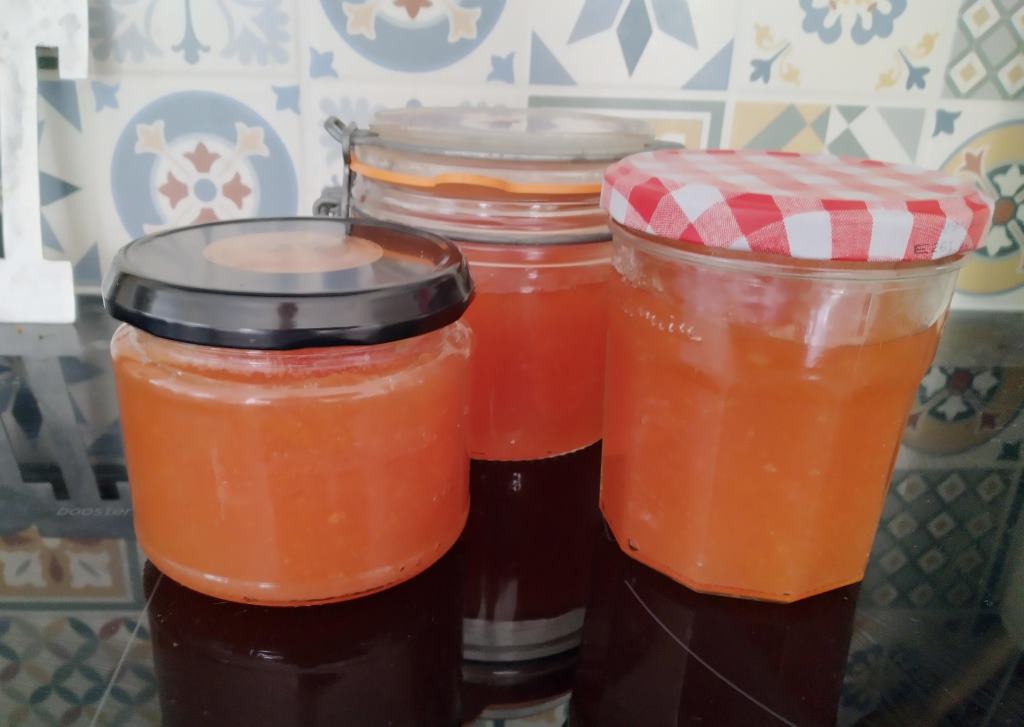
At this point the articles I had read said the puree could be spread in a thick layer in a dish and allowed to set to produce dulce de membrillo. Or my trusty ‘jams and preserves’ cookbook said the same puree could be poured into jars or moulds to produce quince cheese.
In the end I opted for the latter because I wouldn’t have to look for a suitable container to store it!
The result seems rather good. Also a lot easier than our previous effort. Trimming away all the fibrous parts eliminated the need for sieving, and cooking in the microwave eliminated the need for constant stirring for an hour or so.
The only thing I would do differently is that next time, I will invite some friends to come and help with the fruit preparation, which was really quite tedious. It would be so much nicer with some friendly chat! Then we could share the proceeds  All rights reserved. © Text and image copyright Fleur 2022.
All rights reserved. © Text and image copyright Fleur 2022.8 people like this
7 responses


@Fleura (34927)
• United Kingdom
23 Oct 22
They have a very distinctive flavour for sure. And yes I do try to use the microwave since it's supposed to be more energy efficient. I would like to check that but can't work out how to. We have one of those plug-in energy monitors so I could measure how much energy the microwave uses, but the main electric oven and hob is wired in so the only way to measure that would be to turn off absolutely every electric thing in the house and then read the main meter before and after.
1 person likes this
@Fleura (34927)
• United Kingdom
23 Oct 22
@JudyEv No doubt the manual would tell you the power wattage, but it can't tell you exactly how much is actually used to cook something because that would depend on variables such as how many things were in the oven at the same time and how many times you opened the door etc.
1 person likes this

@allknowing (153544)
• India
23 Oct 22
That is a pretty long process but the process becomes short if one has enthusiasm and interest which you both seemed to have.
1 person likes this


@DaddyEvil (174208)
• United States
22 Oct 22
I remember mom talking about quince but don't remember if she got some of made anything with them.
1 person likes this