

“There Will Be a Day…When This Guide Will Not Have to Be Published”

By Four Walls
@FourWalls (86778)
United States

August 21, 2024 10:19pm CST
My goal for the day was to visit the National Underground Railroad Museum in Cincinnati. While it has prominent displays (which I’ll detail later), the thing I was most interested in was the current special exhibit on something that you most likely — thankfully — have never heard of.
That is The Negro Motorist Green Book.
In the lifetime of many people who are still alive, there was a thing colloquially known as “Jim Crow.” It was a set of laws that found a loophole in the 1896 Supreme Court ruling that African-Americans were “separate but equal.” As a result, the “white” restrooms might be modern while the “colored” restrooms were outhouses.
In addition, the existence of “sundown towns” — “be out of town by sundown” — was a reality for blacks, not just a cheesy Western B-movie line. (It should be noted that these “sundown laws” weren’t limited to blacks, but also included American Indians and Asians. I watched a documentary on the 1906 San Francisco earthquake the other night, and it discussed how “Chinatown” was a slum area where the Asian population was kept by the use of “sundown laws.”)
Victor Hugo Green, a World War I veteran and postal worker living in Harlem, saw a need. And he filled it. Oh, did he ever. Beginning in 1936, he published what he called The Negro Motorist Green Book. Yes, the cover was green, but it was also a reference to his name.
If you have ever seen travel books like the old American Automobile Association “TourBook” or the Fodors guide books, you may have a clue as to what this was about.
In the mid-1910s there was a “Jewish Vacation Guide” book published, which indicated areas where Jews were (or were NOT) welcome and could find things like lodging and kosher food without fear of discrimination. These books may have inspired Victor Green to publish his Negro Motorist Green Book.
At first he focused around New York, where there was plenty of places that welcomed blacks. Quickly, however, his work spread out to other parts of the country.
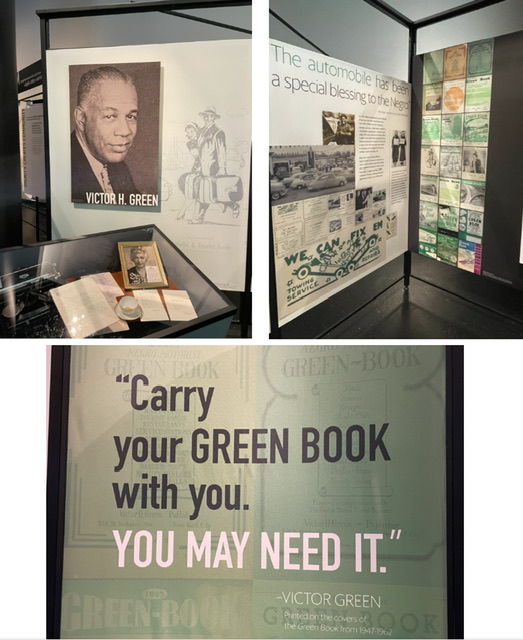
We’ll never know the lives it saved. As the guide’s motto said, “Carry your Green Book with you — you may need it.” With blacks owning cars and free to travel, the one thing they did NOT want was to find themselves in a Klan hotbed, a “sundown town,” or a place where no food, gas, or lodging was available to them because of the color of their skin.
So Green listed places that were black-owned or had no racial discrimination in their serving. One of the most significant advances in this was Standard Oil, then known as Esso, who advertised in the Green Book AND made it a nationwide policy to serve ALL motorists, regardless of race.
In the preface to the 1948 book, Victor Green wrote, “There will be a day sometime in the near future when this guide will not have to be published. That is when we as a race will have equal opportunities and privileges in the United States. It will be a great day for us to suspend publication, for then we can go where we please, and without embarrassment.” While Green did not live to see that dream come true (he died in 1960), his words rang true. The final version of The Negro Motorist Green Book was simply called Travelers’ Green Book, and was touted as a guide “for vacation without aggravation.” It was published in 1966.
The exhibit is sad, but it is also refreshing to see. There’s a quote from Aretha Franklin, which says that, when she couldn’t find a place that would serve her, she’d go to a grocery store and get souse and crackers. “Listen, darling,” the quote says, “I loved souse.” 
 The black community filled its own needs thanks to the foresight of a remarkable man named Victor Hugo Green.
I’m so glad I got to visit this exhibit.
PHOTO COLLAGE:
(Top left) Photo of Victor Green
(Top right) The covers of the various Green Book editions throughout the years, and enlarged photos and ads from the book
(Bottom) The advice for black travelers for always having a Green Book.
The black community filled its own needs thanks to the foresight of a remarkable man named Victor Hugo Green.
I’m so glad I got to visit this exhibit.
PHOTO COLLAGE:
(Top left) Photo of Victor Green
(Top right) The covers of the various Green Book editions throughout the years, and enlarged photos and ads from the book
(Bottom) The advice for black travelers for always having a Green Book.
The black community filled its own needs thanks to the foresight of a remarkable man named Victor Hugo Green.
I’m so glad I got to visit this exhibit.
PHOTO COLLAGE:
(Top left) Photo of Victor Green
(Top right) The covers of the various Green Book editions throughout the years, and enlarged photos and ads from the book
(Bottom) The advice for black travelers for always having a Green Book.9 people like this
6 responses

@FourWalls (86778)
• United States
22 Aug 24
I’m sure there are people who’d like to go back to those dark times…in your country and in mine.
2 people like this
@JudyEv (382328)
• Rockingham, Australia
23 Aug 24
@FourWalls Yes, I guess so. Even now there are occurences of people being brought in from the islands; their passports are taken from them, they'd paid a pittance and find it difficult to get home.
1 person likes this

@RasmaSandra (98026)
• Daytona Beach, Florida
22 Aug 24
Sounds fascinating, Such a tragic history for the people truly amazing that so many survived all of this,
2 people like this
@FourWalls (86778)
• United States
22 Aug 24
Thankfully most of us learned from the past. I worry about the ones who haven’t. 
2 people like this

@FourWalls (86778)
• United States
22 Aug 24
The entire museum was amazing and, in many respects, overwhelming. Reading about Jim Crow laws is one thing, but being up close and personal with the relics from the era is quite another.
1 person likes this

@wolfgirl569 (135881)
• Marion, Ohio
22 Aug 24
That is sad. Glad we are past that and hope not to go back
2 people like this

@LindaOHio (222624)
• United States
22 Aug 24
I know about the Green Book; but hadn't heard of the Jewish Vacation Guide. Sad reminders of days gone by.
2 people like this
@FourWalls (86778)
• United States
22 Aug 24
Pretty fascinating history…in a sad way.
2 people like this

@MarieCoyle (59259)
•
22 Aug 24
I would like to see that exhibit. Like you said, sad. But I know that I would still enjoy learning all I can.
I still remember the public restrooms in the south…one for men, one for women, and one oh so shamefully for “N” if there was one for them at all. If not there might be an outhouse for them, or the woods. 
2 people like this
@FourWalls (86778)
• United States
22 Aug 24
The saddest thing in the museum is a “slave hut,” a place where auctions/sales were held in the 19th century. It was found in a barn on a farm in nearby northern Kentucky and reassembled in the museum. Talk about sobering!
1 person likes this
