Clinical depression (also called major depressive disorder, or sometimes unipolar when compared with bipolar disorder) is a state of intense sadness, melancholia or despair that has advanced to the point of being disruptive to an individual's social functioning and/or activities of daily living. Although a low mood or state of dejection that does not affect functioning is often colloquially referred to as depression, clinical depression is a clinical diagnosis and may be different from the everyday meaning of "being depressed." Many people identify the feeling of being depressed as "feeling sad for no reason", or "having no motivation to do anything." One suffering from depression may feel tired, sad, irritable, lazy, unmotivated, and apathetic. Clinical depression is generally acknowledged to be more serious than normal depressed feelings. It often leads to constant negative thinking and sometimes substance abuse.
Without careful assessment, delirium can easily be confused with depression and a number of other psychiatric disorders because many of the signs and symptoms are conditions present in depression, as well as other mental illnesses including dementia and psychosis.[1]
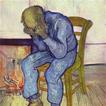
Vincent van Gogh, who himself suffered from depression and committed suicide, painted this picture in 1890 of a man that can symbolize the desperation and hopelessness felt in depression.Contents [hide]
1 History
2 Prevalence
2.1 Symptoms
2.2 Mnemonics
3 Types of depression
3.1 Major clinical depression
3.2 Other categories of depression
4 The role of anxiety in depression
4.1 Anxiety
4.2 Hypomania
5 Causes of depression
6 Treatment
6.1 Medication
6.2 Dietary supplements
6.3 Augmentor drugs
6.4 Psychotherapy
6.5 Transcranial magnetic stimulation
6.6 Vagus nerve stimulation
6.7 Electroconvulsive therapy
6.8 Other methods of treatment
6.8.1 Light therapy
6.8.2 Exercise
6.8.3 Meditation
6.9 Deep brain stimulation
6.10 Archaic methods
6.11 Self medication
7 Adverse reactions
8 Relapse
9 Social attitudes towards depression
9.1 Employment
9.2 Mental health stigma
10 See also
10.1 Books by psychologists and psychiatrists
10.2 Books by people suffering or having suffered from depression
10.3 Historical account
11 Sources
12 External links
[edit] History
The modern idea of depression appears similar to the much older concept of melancholia. The name melancholia derives from "black bile," one of the "four humours" postulated by Galen.
Clinical depression was originally considered to be a chemical imbalance in transmitters in the brain, a theory based on observations made in the 1950s of the effects of reserpine and isoniazid in altering monoamine neurotransmitter levels and affecting depressive symptoms.[2] Since these suggestions, many other causes for clinical depression have been proposed.[3]
[edit] Prevalence
Clinical depression affects about 16%[4] of the population on at least one occasion in their lives. In some countries, such as Australia, one in four women and one in eight men will suffer from depression[citation needed]. The mean age of onset, from a number of studies, is in the late 20s[citation needed]. About twice as many females as males report or receive treatment for clinical depression, though this imbalance is shrinking over the course of recent history; this difference seems to completely disappear after the age of 50–55. Clinical depression is currently the leading cause of disability in North America as well as other countries, and is expected to become the second leading cause of disability worldwide (after heart disease) by the year 2020, according to the World Health Organization.[5]
[edit] Symptoms
According to the DSM-IV-TR criteria for diagnosing a major depressive disorder (cautionary statement) one of the following two elements must be present for a period of at least two weeks:Depressed mood, or
Anhedonia
It is sufficient to have either of these symptoms in conjunction with five of a list of other symptoms over a two-week period. These include:Feelings of overwhelming sadness and/or fear, or the seeming inability to feel emotion (emptiness).
A decrease in the amount of interest or pleasure in all, or almost all, daily activities.
Changing appetite and marked weight gain or loss.
Disturbed sleep patterns, such as insomnia, loss of REM sleep, or excessive sleep (Hypersomnia).
Psychomotor agitation or retardation nearly every day.
Fatigue, mental or physical, also loss of energy.
Intense feelings of guilt, nervousness, helplessness, hopelessness, worthlessness, isolation/loneliness and/or anxiety.
Trouble concentrating, keeping focus or making decisions or a generalized slowing and obtunding of cognition, including memory.
Recurrent thoughts of death (not just fear of dying), desire to just "lie down and die" or "stop breathing", recurrent suicidal ideation without a specific plan, or a suicide attempt or a specific plan for committing suicide.
Feeling and/or fear of being abandoned by those close to one.
Other symptoms often reported but not usually taken into account in diagnosis include:Self-loathing.
A decrease in self-esteem.
Inattention to personal hygiene.
Sensitivity to noise.
Physical aches and pains, and the belief these may be signs of serious illness.
Fear of 'going mad'.
Change in perception of time.
Periods of sobbing.
Possible behavioral changes, such as aggression and/or irritability.
Depression in children is not as obvious as it is in adults. Here are some symptoms that children might display:Loss of appetite.
Irritability.
Sleep problems, such as recurrent nightmares.
Learning or memory problems where none existed before.
Significant behavioral changes; such as withdrawal, social isolation, and aggression.
An additional indicator could be the excessive use of drugs or alcohol. Depressed adolescents are at particular risk of further destructive behaviours, such as eating disorders and self-harm.
One of the most widely used instruments for measuring depression severity is the Beck Depression Inventory, a 21-question multiple choice survey.
It is hard for people who have not experienced clinical depression, either personally or by regular exposure to people suffering it, to understand its emotional impact and severity, interpreting it instead as being similar to "having the blues" or "feeling down." As the list of symptoms above indicates, clinical depression is a serious, potentially lethal systemic disorder characterized by the psychiatric profession as interlocking physical, affective, and cognitive symptoms that have consequences for function and survival well beyond sad or painful feelings.
[edit] Mnemonics
Mnemonics commonly used to remember the DSM-IV criteria are SIGECAPS[6] (sleep, interest (anhedonia), guilt, energy, concentration, appetite, psychomotor, suicidality) and DEAD SWAMP[7] (depressed mood, energy, anhedonia, death (thoughts of), sleep, worthlessness/guilt, appetite, mentation, psychomotor).
[edit] Types of depression
The diagnostic category major depressive disorder appears in the Diagnostic and Statistical Manual of Mental Disorders of the American Psychiatric Association. The term is generally not used in countries which instead use the ICD-10 system, but the diagnosis of depressive episode is very similar to an episode of major depression. Clinical depression also usually refers to acute or chronic depression severe enough to need treatment. Minor depression is a less-used term for a subclinical depression that does not meet criteria for major depression but where there are at least two symptoms present for two weeks.
[edit] Major clinical depression
Major Depression, or, more properly, Major Depressive Disorder (MDD), is characterized by a severely depressed mood that persists for at least two weeks. Major Depressive Disorder is specified as either "a single episode" or "recurrent"; periods of depression may occur as discrete events or as recurrent over the lifespan. Episodes of major or clinical depression may be further divided into mild, major or severe. Where the patient has already had an episode of mania or markedly elevated mood, a diagnosis of bipolar disorder (also called bipolar affective disorder) is usually made instead of MDD; depression without periods of elation or mania is therefore sometimes referred to as unipolar depression because their mood remains on one pole. The diagnosis also usually excludes cases where the symptoms are a normal result of bereavement.
Diagnosticians recognize several possible subtypes of Major Depressive Disorder. ICD-10 does not specify a melancholic subtype, but does distinguish on presence or absence of psychosis.
Depression with Melancholic Features - Melancholia is characterized by a loss of pleasure (anhedonia) in most or all activities, a failure of reactivity to pleasurable stimuli, a quality of depressed mood more pronounced than that of grief or loss, a worsening of symptoms in the morning hours, early morning waking, psychomotor retardation, anorexia (excessive weight loss, not to be confused with Anorexia Nervosa), or excessive guilt.
Depression with Atypical Features - Atypical Depression is characterized by mood reactivity (paradoxical anhedonia) and positivity, significant weight gain or increased appetite, excessive sleep or somnolence (hypersomnia), leaden paralysis, or significant social impairment as a consequence of hypersensitivity to perceived interpersonal rejection. Contrary to its name, atypical depression is the most common form of depression.[8] Depression with Psychotic Features - Some people with Major Depressive or Manic episode may experience psychotic features. They may be presented with hallucinations or delusions that are either mood-congruent (content coincident with depressive themes) or non-mo |