

I Still Haven't Found What I'm Looking For, or In Search of the Dixie Highway

By Four Walls
@FourWalls (85820)
United States

May 10, 2026 10:04pm CST
When I saw Bruce Springsteen here in 1985 on the Born in the USA tour, he sang "Darlington County" (side one, song three, between "Cover Me" and "Working on the Highway," for those of you who read @TheHorse 's discussion on playing albums and the "next song"). There's a line in the song: "Then we'll leave this Darlington city for a ride down that Dixie Highway." When he got to that line the place roared.
We have a Dixie Highway here, and naturally, growing up here, I figured that it was just a "southern name" for a road in a "southern town" in a "southern state." Oh, no.
Y'all know how I have loved traveling on Route 66. It's one of the most famous roads in American history, thanks to the TV show and the song and all of the legacy. This year is the centennial of Route 66, and there are many celebrations along the Mother Road.
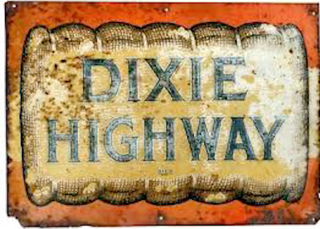
But did you know that Route 66 wasn't the first? Oh, no. The Dixie Highway and the Lincoln Highway existed before Route 66. The Lincoln Highway began in 1913, and the Dixie Highway began in 1914. While the Lincoln Highway was one road (east-west), with markers still in existence today, the history of the Dixie Highway has faded into obscurity. Only a few markers remain, and they are hard to find.
That's what I went to Indiana to try to find: part of the Dixie Highway. The problem is that Dixie Highway, unlike the Lincoln Highway and Route 66, wasn't one road. It was a lot of roads. The purpose was simply to get people from the north, in their newfangled automobiles, down to Florida for a summer vacation.
Great premise, huh? The problem was that Dixie Highway didn't originate in one place. It didn't go through one place. It didn't even end up in one place.
The good thing is that there are pieces of it. Interstate 24 in Tennessee runs through Monteagle, where the Dixie Highway used to run. Lots of "new and improved" roads where it used to be...just no markers.
Why has it fallen off the map, literally and figuratively? It's sad that part of American road history has vanished because of so many reasons (too expansive, too far back in time, too eclipsed by the better Route 66 and subsequent federal and interstate systems). And I couldn't find it. No signs, no museums, no memories.
But we did get a mention in a Springsteen song!!
Here's part of a documentary on Dixie Highway:
Your browser isn’t supported anymore. Update it to get the best YouTube experience and our latest features. Learn moreRemind me later
6 people like this
5 responses


@MarieCoyle (58030)
•
6h
A close friend is just winding up a big trip she took doing Route 66...they did the whole thing. They drove their motor home and took their dogs, and took their time, too. She said she would call me this week to tell me some of the highlights, and that she took lots of pictures. She went places she had never seen, and I think from what she said, they had a blast.
I am familiar with what the old timers of my earlier years referred to as ''Dixie Bee Line'' and have driven it many times with family. With your road knowledge, you are no doubt familiar with it, but for the others here I will add this:
''The Dixie Bee Line (often called Dixie Bee Highway) was a prominent early 20th-century auto trail in Indiana that connected Chicago to Nashville, serving as a "beeline" to the South via Terre Haute and Evansville. It was essentially a competitor to the main Dixie Highway, with the "B" signifying an alternative, more westerly, and often faster route.
Key Facts About the Dixie Bee Line in Indiana:
Route: The trail ran from Chicago, entered Indiana near Danville, Illinois, and ran through Clinton, Terre Haute, and down to Evansville, where it utilized a ferry to cross into Kentucky.
Forerunner to U.S. 41: The Dixie Bee Line was developed around 1915 and served as the primary, albeit often muddy, route through western Indiana before the establishment of U.S. 41 in the mid-1920s.
Markings: It was marked by its local boosters with a "DBL" sign, often painted as three white letters on a black background or, more commonly, blue letters on white on telegraph poles.''
Evansville Courier and Press
1 person likes this


@JudyEv (379597)
• Rockingham, Australia
3h
That's a great shame that are few reminders of the Dixie highway.
