

The Reality of Slavery

By Four Walls
@FourWalls (86757)
United States

February 20, 2026 8:14pm CST
Yesterday was mostly filled with a visit to the Legacy Museum, which details the evils of slavery. It’s in Montgomery, Alabama, and part of it is located on the site of slave factories. Not too far from the museum (on the bus ride as you go to the boat that’ll take you to the sculpture park) you’ll pass the street where the slave warehouses and auctions happened.
Yeah, folks, we used to buy and sell human beings in this country like they were dogs. Except the dogs had legal protection.
It’s not a pleasant part of American history. It’s also not unique to American history: the British Isles were acquiring slaves before they settled here. World Population Review indicates that, by modern definitions of “slavery” (people who are not free to get their own job, leave a job if they want to, are forced into a marriage, or trafficked for sexual or labor purposes), about 25 million people are subjected to forced labor, marriage, or restriction of life activities (like learning or living independently).
Those issues are for another time (although if you want to be nauseated by how prevalent it is in the name of religion, watch a documentary on the arranged marriages in ultra-orthodox Hasidic sects). The museums in Montgomery deal mainly with what Europeans brought to the new world with them: blacks from Africa who’d been bought from tribes who sold the people they conquered in battle, or just kidnapped by people looking to make a buck.
There were certainly many examples of “slaves” who were treated more as house servant employees would be (save for, as many of the places I’ve visited have had, separate entrances from the whites). Unfortunately, for every one of those “good” stories there are a hundred or a thousand tales of beatings, whippings, and murders…all of which were “legal” because the slave wasn’t considered human, but property.
If that’s hard to read, imagine walking through a museum filled with the stories of it. One scene showed heads (instead of skulls) buried in sand with tidal water washing over it, to represent the people who died aboard transport ships and were tossed overboard like an unwanted bluegill fish. Or a sculpture of a gigantic steel ball with the chain leading to a leg shackle (this one was unlocked, because the sculpture was titled Free At Last). Or reading how New York City had the largest population of slaves in the country at one point. Or seeing laws from various southern states that said slaves who escaped once would be whipped and branded, whipped and branded and in some cases have their ear lobbed off if they tried a second time, and killed if they tried a third time.
Yes, that was a difficult day of museum visiting.
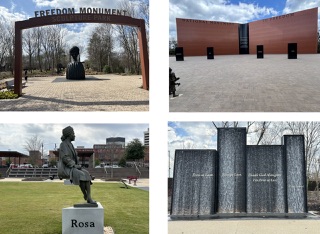
The museum and the sculpture garden did not allow photography except in a very few places, which is why I have so few photos to show you. The collage here:
(Upper left) Entrance to the Freedom Monument Sculpture Park.
(Upper right) The “National Monument to Freedom” wall. What you cannot see is the inscribed names on that wall, representing the untold millions who died in slavery.
(Lower left) A statue of Rosa Parks in the meditation/contemplation park across the street from the Legacy Museum.
(Lower right) A waterfall sculpture at the end of the sculpture park, emblazoned with the words of an old spiritual: “Free at last, free at last, thank God Almighty I’m free at last.”
15 people like this
14 responses


@FourWalls (86757)
• United States
21 Feb
Well, some present tense murders, too…but yes, what we did to the American Indians is atrocious.
1 person likes this

@MarieCoyle (59250)
•
21 Feb
As a very young girl, I remember living in the south for awhile, traveling to the grandparents in Illinois in the car. I was too young to know about slavery yet, but not too young to know that black people were treated differently. One thing always stuck in my mind, was the gas station bathrooms--you may or may not recall they were accessed from the outside, not by walking in to the gas station itself. Usually, three bathrooms. Why three, some will say? One said ''Ladies'' one said ''Gentlemen'' and the third said ''Colored.'' In some of the more crude areas of the south, the third one said one word that started with N, and I refuse to use that word or spell it here or anywhere. Oh, in some cases there WAS no third bathroom. They had to use the woods if they could find one, or hide behind something somewhere.
One time really stood out. We were driving late, the two lane highway going north was winding and it was very dark. Dad drove around a curve, and the field was filled with white sheeted people and burning crosses. He yelled at us (he never did!) said to get down right now, and don't even move! We did what he said. He never drove us the north south route after that if it was getting dark, ever.
If studying slavery was required/mandatory, maybe racism would not be so rampant? I sure don't know.
2 people like this
@FourWalls (86757)
• United States
21 Feb
If you remember, I went to the Underground Railroad Museum in Cincinnati when they had an exhibit on the Negro Motorist Green Book, which was started by a postal employee named Victor Green to let black travelers know where they could safely find gas, food, and lodging. It was modeled after Jewish travel books before them. In the 60s there were the “Bob Damron’s Address Books” for gay people. Of course, you can “hide” being Jewish or gay…can’t hide being black. 
2 people like this
@MarieCoyle (59250)
•
21 Feb
@FourWalls
I do remember your writing of the Underground Railroad Museum. And you and I both know you shouldn't have to hide for being who you are. It's just wrong in every way.
1 person likes this

@FourWalls (86757)
• United States
21 Feb
In so many ways. And there are people who claim it didn’t happen, like the people who deny the Holocaust.
2 people like this

@FourWalls (86757)
• United States
21 Feb
Nope, we don’t learn. “Love God, love your neighbor” sounds simple but the way we act, it’s an impossible task.
1 person likes this
@LadyDuck (502569)
• Italy
22 Feb
@FourWalls - It seems a more and more difficult task.
1 person likes this

@Deepizzaguy (122195)
• Lake Charles, Louisiana
21 Feb
Slavery is one terrible thing that should happen to anyone.
1 person likes this
@FourWalls (86757)
• United States
22 Feb
I know, and I wish we could get all forms of it done away with once and for all.
1 person likes this


@FourWalls (86757)
• United States
22 Feb
@jaylar — I wasn’t born then (or I was and was in diapers), but I’ve read a lot of complaints about the “horrors” America would face if they elected a Catholic president in 1960. Of course, they DID: JFK. Biden was our second Catholic president, and his religion was never mentioned.
@FourWalls (86757)
• United States
22 Feb
Another joke about the Constitution: the thing about freedom of religion? One of the signers of the Declaration of Independence was John Carroll, who wasn’t allowed to hold office by law…because he was a Catholic.
@jaylar (3727)
• Kingston, Jamaica
22 Feb
@FourWalls I didn't know that. Such hypocricy
1 person likes this

@GardenGerty (169479)
• United States
22 Feb
It sounds overwhelming and oppressive. A lot of history is, though, if we look at the truth.
1 person likes this
@FourWalls (86757)
• United States
22 Feb
History is written by the winners, they say, so they like to hide or minimize their atrocities.

@crossbones27 (52905)
• Mojave, California
21 Feb
I heard they are trying to erase all of it, not the museum in Alabama but Trump admin is trying to erase it all. why he keeps butting in and put my name on it. He can try but some things people can never forget. Even if he wins, it will resurface. People want to know what and who their ancestors were and what they were about, why they are the way they are. Lies and hiding will never tell that truth. The true always find out.
1 person likes this
@FourWalls (86757)
• United States
21 Feb
They say history is written by the winners, but like you said, that won’t suppress the truth.
1 person likes this
@crossbones27 (52905)
• Mojave, California
21 Feb
@FourWalls This country is built like no other country in the world. People ask why they keep coming here. That is the main part. You get a fair shake, even if its not a true fair shake. No other country seems to promise that.
1 person likes this

@Letranknight2015 (52665)
• Philippines
21 Feb
It should be served as a reminder of the past so it won't happen again.
1 person likes this
@FourWalls (86757)
• United States
21 Feb
As long as people exist the problems will. The saddest thing is that so much of the slavery was done in God’s name. 

@wolfgirl569 (135819)
• Marion, Ohio
21 Feb
It was a sad time and even sader that it still goes on
1 person likes this
@FourWalls (86757)
• United States
21 Feb
I’m sure the people who keep things like the caste system and the forced marriages in various religions wouldn’t call it “slavery.” You can call a pig a diamond but that doesn’t change what it is.
2 people like this

@RasmaSandra (98033)
• Daytona Beach, Florida
21 Feb
At least their stories can be told. I know and believe that many of these places have spirits roaming around to see that the stories told about them are true.
1 person likes this
@FourWalls (86757)
• United States
22 Feb
People are trying to shut their stories up, and I don’t know why.
1 person likes this


@LindaOHio (222534)
• United States
21 Feb
A very thought-provoking visit. Thank you.
1 person likes this
@FourWalls (86757)
• United States
22 Feb
I go to these places that are painful to visit a lot. I’m glad they are painful for me to visit.
1 person likes this

@misunderstood_zombie (8765)
• United States
21 Feb
As Amber says, it's mind boggling that this ever happened. I think everyone should visit this museum, I know I would want to go.
1 person likes this
@FourWalls (86757)
• United States
21 Feb
It’s not unique to us. Remember, the Jews were enslaved in Egypt for 400 years.
2 people like this
