

Let’s Talk About That Church Again

By Four Walls
@FourWalls (88208)
United States

October 1, 2026 10:24pm CST
While I was at another church today (in Peoria, the burial spot of Archbishop Fulton J. Sheen), I want to talk some more about that church I went to in Fulton yesterday.
As I mentioned, St. Mary the Virgin, Aldermanbury, was one of the churches destroyed during the Blitz. To be precise, on the night of December 29, 1940, the Luftwaffe unleashed nearly 100,000 incendiary bombs on London, starting fires all over the city in what was called “the second Great Fire.” The first Great Fire was in 1666, and it destroyed a considerable amount of London. St. Mary the Virgin church was one of the victims of both fires.
Sir Christopher Wren, one of the most legendary architects in British history, helped reconstruct a number of the destroyed churches after the Great Fire. (He also built St. Paul’s Cathedral, considered his greatest work.) One of the churches he helped reconstruct was St. Mary the Virgin.
After the War, rebuilding homes seemed to take precedence over rebuilding the churches. Despite the architectural history, the churches weren’t touched. Finally, in the early 60s, it was decided to raze the ruins.
Not so fast. There had already been discussions about creating a Winston Churchill “memorial” ( he was still alive when these plans started) at the site of his legendary “Iron Curtain” speech in 1946. (Quick explanation: Westminster College is hardly a large university with national or international recognition. It has less than a thousand students enrolled. Although President Truman was from Missouri, he didn’t go to college there [side note: Truman never attended college, period]. However, his close aide and friend, Harry Vaughan, did attend Westminster, so that may be why it was chosen for the location of Churchill’s speech.) Groups began making plans to save the ruins of the church from the wrecking ball for both the architectural and world history.
There were naysayers. Imagine hauling tons of charred concrete across the ocean, and from the ports to the middle of the country, for the project. However, people stepped up to the plate to help. Shippers allowed the church on the ships for free, considering it ballast weight (what is in the bottom of a ship to lower the center of gravity). And, of course, archeologists and architects lined up to help. Who wouldn’t want to study centuries-old work AND something that the great Sir Christopher Wren was involved with?
They called it “the world’s largest jigsaw puzzle,” but eventually (four years after Churchill’s death, so he didn’t see the finished product) the church rose from the ashes for a third time…this time, as a centerpiece of America’s National Churchill Museum. (By the way, the footprint of the church is now a park in London, with memorial plaques explaining the history of the church that once stood there.)
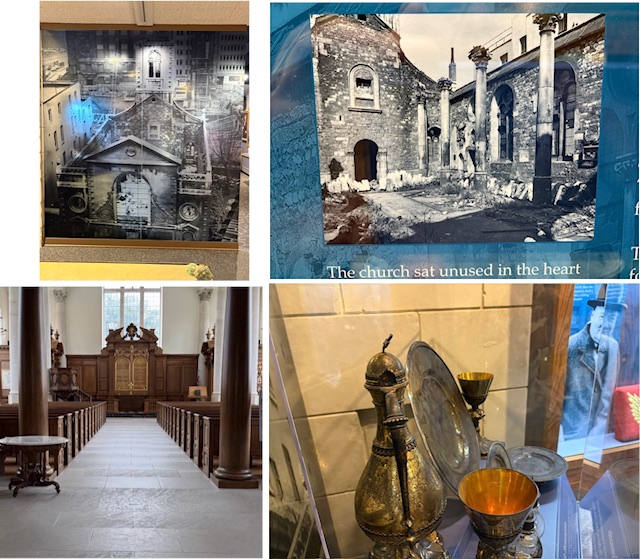
The top two photos in the collage are photos showing what was left of St. Mary the Virgin after the Blitz. The bottom left is the interior of the rebuilt church in Missouri. Finally, on the bottom right, you see a communion service set. It was found in the safe of the church after the 1940 bombing and fire…damaged but not destroyed. Just like the attitude of the British during the Blitz.
he was still alive when these plans started) at the site of his legendary “Iron Curtain” speech in 1946. (Quick explanation: Westminster College is hardly a large university with national or international recognition. It has less than a thousand students enrolled. Although President Truman was from Missouri, he didn’t go to college there [side note: Truman never attended college, period]. However, his close aide and friend, Harry Vaughan, did attend Westminster, so that may be why it was chosen for the location of Churchill’s speech.) Groups began making plans to save the ruins of the church from the wrecking ball for both the architectural and world history.
There were naysayers. Imagine hauling tons of charred concrete across the ocean, and from the ports to the middle of the country, for the project. However, people stepped up to the plate to help. Shippers allowed the church on the ships for free, considering it ballast weight (what is in the bottom of a ship to lower the center of gravity). And, of course, archeologists and architects lined up to help. Who wouldn’t want to study centuries-old work AND something that the great Sir Christopher Wren was involved with?
They called it “the world’s largest jigsaw puzzle,” but eventually (four years after Churchill’s death, so he didn’t see the finished product) the church rose from the ashes for a third time…this time, as a centerpiece of America’s National Churchill Museum. (By the way, the footprint of the church is now a park in London, with memorial plaques explaining the history of the church that once stood there.)
The top two photos in the collage are photos showing what was left of St. Mary the Virgin after the Blitz. The bottom left is the interior of the rebuilt church in Missouri. Finally, on the bottom right, you see a communion service set. It was found in the safe of the church after the 1940 bombing and fire…damaged but not destroyed. Just like the attitude of the British during the Blitz.
he was still alive when these plans started) at the site of his legendary “Iron Curtain” speech in 1946. (Quick explanation: Westminster College is hardly a large university with national or international recognition. It has less than a thousand students enrolled. Although President Truman was from Missouri, he didn’t go to college there [side note: Truman never attended college, period]. However, his close aide and friend, Harry Vaughan, did attend Westminster, so that may be why it was chosen for the location of Churchill’s speech.) Groups began making plans to save the ruins of the church from the wrecking ball for both the architectural and world history.
There were naysayers. Imagine hauling tons of charred concrete across the ocean, and from the ports to the middle of the country, for the project. However, people stepped up to the plate to help. Shippers allowed the church on the ships for free, considering it ballast weight (what is in the bottom of a ship to lower the center of gravity). And, of course, archeologists and architects lined up to help. Who wouldn’t want to study centuries-old work AND something that the great Sir Christopher Wren was involved with?
They called it “the world’s largest jigsaw puzzle,” but eventually (four years after Churchill’s death, so he didn’t see the finished product) the church rose from the ashes for a third time…this time, as a centerpiece of America’s National Churchill Museum. (By the way, the footprint of the church is now a park in London, with memorial plaques explaining the history of the church that once stood there.)
The top two photos in the collage are photos showing what was left of St. Mary the Virgin after the Blitz. The bottom left is the interior of the rebuilt church in Missouri. Finally, on the bottom right, you see a communion service set. It was found in the safe of the church after the 1940 bombing and fire…damaged but not destroyed. Just like the attitude of the British during the Blitz.11 people like this
9 responses

@FourWalls (88208)
• United States
7h
It’ll take your breath away walking into it, especially given that photos before you go upstairs to see it show what happened after the bombing.
1 person likes this


@rebelann (118893)
• El Paso, Texas
3h
You're right @FourWalls but since this one in particular was relocated to the US I just wondered if any notable historical figures were buried under that church.
1 person likes this
@FourWalls (88208)
• United States
3h
@rebelann — there were, but I would think that was dealt with after the war and before the removal of the church.
1 person likes this
@FourWalls (88208)
• United States
4h
I’m sure things like that were investigated following the War. That certainly wasn’t the only church or graveyard that was damaged/destroyed by the Blitz.
1 person likes this

@GardenGerty (170745)
• United States
6h
Wonderful to have people restoring historic things, rather than knocking them down. Do not tell Trump about this, he will want his name on it.
1 person likes this
@FourWalls (88208)
• United States
5h
I’d suggest putting his name on garbage dumps, but I’m certain that even trash has more dignity than that.

@Orson_Kart (8859)
• United Kingdom
10h
I know about the London Bridge that was dismantled and taken to America, but I’ve never heard about this church. Another amazing feat of engineering. Great to see it restored. 
1 person likes this
@FourWalls (88208)
• United States
7h
I’m glad it was preserved as well. I’m also happy that they didn’t put a shopping mall over the footprint of where the church was in London.
1 person likes this

@everwonderwhy (7364)
•
11h
Wow! Every brick, every nook and cranny is monumental throughout history, space and time.
I see Winston Churchill's image there:-) Is it Churchill?
1 person likes this
@FourWalls (88208)
• United States
7h
Yes, it’s part of a Winston Churchill museum. I’ll get to him later. 
1 person likes this

@FourWalls (88208)
• United States
7h
That’s where I live, with my nose in history.
1 person likes this
@FourWalls (88208)
• United States
6h
@LooeyVille — on my way, even as we speak. 
1 person likes this
@LooeyVille (86)
• United States
6h
@FourWalls . . . and your mouth at Chuy's! hahahaha.
1 person likes this


@MarieCoyle (63671)
•
16h
This is just a fascinating story. I knew he had a museum but never realized just how strange this must have been, to haul the ''jigsaw puzzle'' pieces so far away. Thank you for this story, and for sharing it with us.
1 person likes this
@FourWalls (88208)
• United States
7h
I’m sure he was skeptical despite his enthusiasm. I’m sorry he didn’t love to see it.

